Best Property Investment Areas in Dubai for ROI 2026
A data backed guide to rental yields, capital appreciation, and total returns across Dubai's most investable locations.
What Makes Dubai One of the Best Property Investment Markets in the World?
Dubai processed AED 761 billion in real estate transactions in 2024. That single figure tells you more than any marketing pitch ever could. The market didn't just recover from the post-2014 correction, it matured into something structurally different. Transaction volumes in 2025 continued that trajectory, with over 180,000 units sold, and early 2026 data suggests the pace is holding.
But raw transaction volume is only half the story. What makes Dubai genuinely compelling for property investors is the combination of factors that no other major city replicates. Zero income tax on rental earnings. Zero capital gains tax on exits. A transparent, enforceable legal framework under RERA. Freehold ownership for foreign nationals in designated zones. And a population that grew by over 100,000 residents in 2025 alone, putting sustained upward pressure on rental demand.
Compare that to London, where a higher rate taxpayer surrenders 40% of rental income to HMRC before considering council tax, maintenance, and letting fees. Or Singapore, where Additional Buyer Stamp Duty for foreign purchasers hit 60% in 2023 and shows no sign of easing. In New York, the combined federal, state, and city tax burden on rental income can exceed 45%. Dubai's regulatory advantage is not marginal, it is structural. The gap between gross yield and net yield in Dubai is among the smallest of any global gateway city.
Then there is the demand side. The UAE's Golden Visa programme has brought a measurable shift in buyer demographics. Long term residency tied to property ownership (AED 2 million threshold) has attracted capital from India, Pakistan, the UK, Russia, and increasingly from East Asia. These are not speculative flippers. Visa-linked buyers hold assets for longer periods, which stabilises rental markets and supports capital appreciation.
The supply picture has also changed. After years of oversupply in certain segments, developers are now releasing projects in phases with more disciplined pricing. Master developers like Emaar, DAMAC, and Dubai Properties are focusing on branded and lifestyle segments where margins and demand resilience are higher. The days of speculative bulk launches with 1% booking fees are largely behind us.

How We Measured ROI Across Dubai's Top Investment Areas
Before diving into individual areas, a note on methodology. ROI in real estate is not a single number. It is the sum of two components that behave differently: rental yield and capital appreciation. We track both, because an area with spectacular capital gains but poor rental yield can leave you cash-flow negative for years, and an area with high yield but stagnant prices can trap capital.
Rental yield in this analysis is calculated as net annual rent divided by purchase price (including DLD fees and registration costs). We use actual achieved rents from Q1 2026 data via Property Finder and Bayut, not developer projections. Capital appreciation is measured year on year based on average transacted price per square foot from DLD records, comparing Q1 2025 to Q1 2026.
Liquidity matters too. An area with fantastic yields means nothing if it takes six months to find a tenant or twelve months to exit. We rate liquidity based on average days to lease (from Property Monitor) and average days on market for resale (from DXB Interact data). Total ROI is the combined annual return: rental yield plus capital appreciation percentage.
One important caveat: past performance does not guarantee future results. Capital appreciation, in particular, is cyclical. The figures here represent a snapshot of current momentum, not a guaranteed annual return. Rental yields tend to be more stable and predictable.
Table 1: 8-Area ROI Comparison (Q1 2026 Data)
| Area | Avg Price/Sqft | Rental Yield | Capital Appreciation (YoY) | Total ROI | Liquidity | Entry Price (Studio) | Investor Profile |
|---|---|---|---|---|---|---|---|
| Arjan | 850 - 1,100 AED | 8.0 - 8.5% | 20 - 22% | ~30% | Medium | AED 420K | Growth |
| DLRC | 750 - 950 AED | 7.5 - 8.0% | 23 - 25% | ~33% | Medium | AED 380K | Growth |
| JVC | 900 - 1,200 AED | 7.0 - 7.5% | 13 - 15% | ~22% | High | AED 450K | Yield |
| Business Bay | 1,400 - 1,800 AED | 6.5 - 7.0% | 10 - 12% | ~19% | High | AED 650K | Balanced |
| Dubai Hills | 1,500 - 2,100 AED | 5.5 - 6.0% | 12 - 14% | ~20% | High | AED 750K | Premium |
| Downtown Dubai | 2,200 - 3,200 AED | 5.0 - 5.5% | 6 - 8% | ~13% | Very High | AED 1.1M | Blue Chip |
| Dubai Marina | 1,800 - 2,600 AED | 5.5 - 6.0% | 5 - 7% | ~12% | Very High | AED 900K | Blue Chip |
| Motor City | 800 - 1,000 AED | 7.0 - 7.5% | 8 - 10% | ~17% | Medium | AED 400K | Yield |
Arjan: The High Growth Contender
Arjan has moved from an overlooked Dubailand sub-community to one of the most actively transacted investment corridors in Dubai. The area sits along Al Barsha South, with direct access to Hessa Street and Sheikh Mohammed Bin Zayed Road. It is positioned between the established premium communities of Dubai Hills and Motor City, benefiting from infrastructure that was built for those developments.
Current average prices range from AED 850 to 1,100 per square foot, depending on the project and stage. That is roughly 40% below equivalent units in JVC and 60% below Business Bay. For investors, that price gap is the core thesis: Arjan offers yields that match or beat JVC today, with significantly more room for capital appreciation as the area matures.
Rental yields in Arjan are running at 8.0 to 8.5%, among the highest in Dubai for new build residential stock. Studios that sold off plan at AED 420,000 are achieving annual rents of AED 34,000 to AED 38,000. One bedroom units purchased at AED 650,000 are renting at AED 52,000 to AED 58,000. These are actual achieved rents, not wishful listing prices.
Capital appreciation has been equally strong. Year on year, average transacted prices in Arjan rose 20 to 22% between Q1 2025 and Q1 2026. Some premium projects with strong branding and amenity packages have appreciated faster. The growth is driven by a simple supply/demand equation: Arjan is delivering units at price points that attract both end users and investors, while infrastructure improvements (the extension of Al Barsha South services, new retail, and F&B clusters) are increasing the area's livability.
The risk here is concentration. Arjan's appreciation has been fast, and the area has significant upcoming supply. Investors should focus on projects with genuine differentiators, branded design, superior amenity programmes, and reputable developers rather than chasing the lowest per-sqft price.
Pearlshire Spotlight: Bond Enclave, Arjan
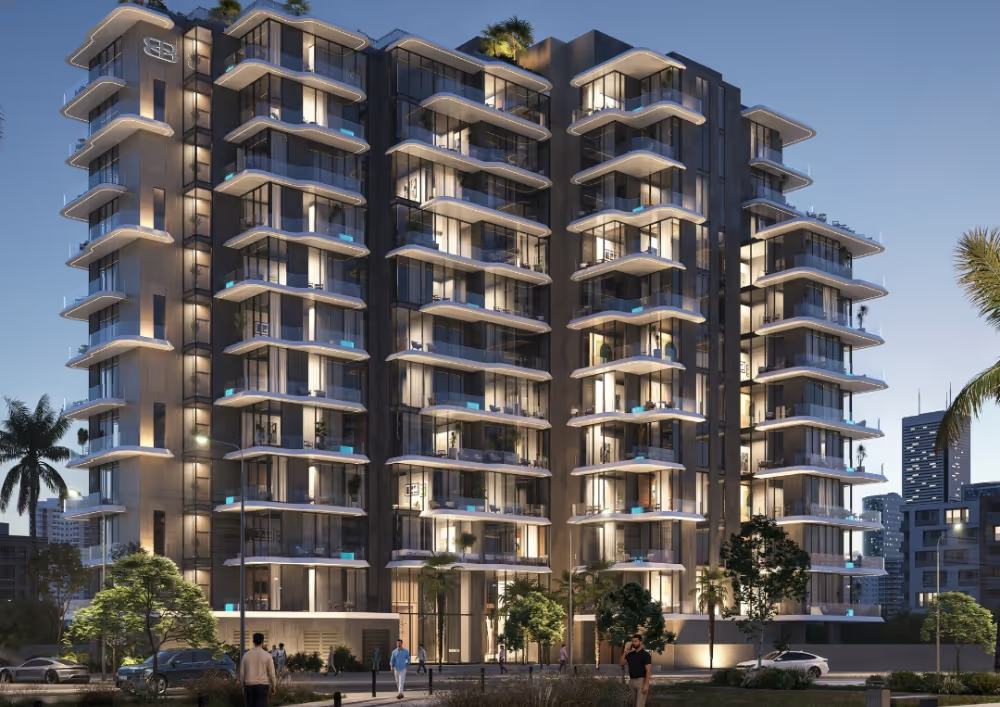
158 branded residences designed by ZN|ERA Architecture
Projected rental yield: 8.2% based on current Arjan rental comparables
30/70 payment plan with 4% DLD fee waiver (saving AED 16,800 to AED 40,000+)
Handover: 30th November 2027
Starting prices from AED 1,149,777
Learn more: pearlshire.com/bondenclave
DLRC (Dubailand Residence Complex): Undervalued and Accelerating
DLRC sits in Dubailand, one of the largest master planned areas in Dubai. For years, it was treated as a fringe location, a place where developers offered low entry prices to attract first time buyers. That narrative is outdated. DLRC in 2026 is a different proposition entirely.
The community has matured considerably. Schools, supermarkets, mosques, and community parks are now operational. The extension of major road networks, particularly the connection to Academic City and Silicon Oasis, has reduced commute times significantly. The Dubai Metro's Blue Line expansion, while still in planning stages for this corridor, is expected to be a major catalyst when announced.
Average prices in DLRC range from AED 750 to 950 per square foot. That makes it one of the most affordable entry points in Dubai with genuine infrastructure behind it. Rental yields sit at 7.5 to 8.0%, which is remarkable for an area at these price points. A studio purchased at AED 380,000 can generate AED 28,000 to AED 32,000 in annual rent. One bedrooms at AED 550,000 achieve AED 42,000 to AED 46,000.
Capital appreciation is where DLRC truly stands out. Year on year price growth of 23 to 25% reflects the market's repricing of an area that was fundamentally undervalued. Early investors who entered at AED 500 to 600 per square foot in 2023 have already seen 50 to 60% capital growth. The question for 2026 buyers is whether there is more runway. Our view: yes. DLRC is still 55 to 65% cheaper per square foot than JVC. As long as that gap exists and demand continues growing, appreciation has structural support.
The risk is timeline. DLRC's transformation is still in progress. Investors buying for rental income will see strong yields immediately, but the capital appreciation thesis plays out over three to five years as the area builds density and retail/leisure infrastructure catches up.
Pearlshire Spotlight: Bond Living, DLRC
94 residences in Dubailand Residence Complex
Projected rental yield: 7.8% based on current DLRC rental market
30/70 payment plan (30% during construction, 70% on handover)
Handover: 30th September 2028
Starting prices from AED 773,000 (studio)
Learn more: pearlshire.com/bondliving
JVC (Jumeirah Village Circle): The Yield Workhorse
JVC has been the default answer to "where should I invest in Dubai" for the better part of five years, and the data supports the reputation. It is the most transacted community in Dubai by unit volume, with over 15,000 sales recorded in 2025. That liquidity is its greatest strength.
Average prices have risen to AED 900 to 1,200 per square foot, reflecting both demand and the area's transition from a pure value play to a mid-market staple. Rental yields remain strong at 7.0 to 7.5%, though they have compressed slightly from the 8%+ levels seen in 2023. That compression is a natural result of prices rising faster than rents, a pattern common in maturing areas.
What JVC offers that many newer areas cannot is depth of amenity. Multiple supermarkets, dozens of restaurants, parks, gyms, nurseries, and a functional public transport network make it a genuine neighbourhood rather than a construction site that happens to have residents. This maturity is what sustains both occupancy rates (consistently above 90%) and relatively fast tenant placement (average 10 to 14 days to lease).
Capital appreciation has moderated to 13 to 15% year on year. That is still excellent by global standards, but it signals that JVC's explosive growth phase is behind it. For investors buying into JVC today, the thesis is yield rather than growth. You are buying a reliable cash flow machine in a proven location, not a speculative bet on future infrastructure.
The risk is oversupply in specific micro-locations. JVC is large, and some pockets have significant upcoming inventory. Investors should focus on established clusters near the main circle and community parks, where rental demand is deepest.
Business Bay: Corporate Corridor with Rental Demand
Business Bay is the commercial spine of new Dubai, and its residential stock benefits directly from that corporate density. Thousands of professionals working in DIFC, Downtown, and Business Bay itself need housing within walking or short commuting distance. That demand is structural, not cyclical.
Prices range from AED 1,400 to 1,800 per square foot for standard tower units, with premium waterfront or branded projects commanding AED 2,000 to 2,500. Rental yields sit at 6.5 to 7.0%, lower than emerging areas but delivered with significantly less vacancy risk. Studios and one bedrooms in Business Bay rarely sit empty for more than two weeks.
Capital appreciation has been steady at 10 to 12% year on year. The area is not going to deliver the explosive growth of Arjan or DLRC, but it is not supposed to. Business Bay is a core holding, the kind of asset that generates consistent rental income with predictable, moderate capital growth.
The investment thesis here is corporate demand resilience. Dubai's position as a regional headquarters for multinationals, tech companies, and financial services firms continues to strengthen. As long as office occupancy in Business Bay and DIFC remains above 85% (it was 92% in Q4 2025), residential rental demand stays firm.
Risks include tower-specific issues. Business Bay has over 200 towers, and quality varies enormously. Older buildings with poor maintenance or high service charges can underperform newer stock. Due diligence on specific buildings matters more here than in any other Dubai community.
Dubai Hills Estate: Premium Suburban Play
Dubai Hills Estate represents Emaar's vision of suburban Dubai done right. Built around the championship golf course and anchored by Dubai Hills Mall, the community has achieved something rare: genuine desirability among both families and investors.
Apartment prices range from AED 1,500 to 2,100 per square foot. Villa plots and townhouses command significantly more. Rental yields on apartments sit at 5.5 to 6.0%, which is lower than value-oriented areas but comes with two important benefits: extremely low vacancy risk and a tenant demographic (typically families on long term leases) that provides income stability.
Capital appreciation of 12 to 14% year on year reflects sustained demand from end users rather than speculative investors. Dubai Hills is one of the few communities where owner-occupier demand competes directly with investor demand, which supports prices during market softening.
The premium suburban thesis works because Dubai is following a global pattern where affluent families prioritise space, green areas, and school proximity over proximity to the CBD. Dubai Hills delivers all three, with the added advantage of being only 15 minutes from DIFC and Downtown.
The risk is entry cost. At AED 750,000 or more for a studio and AED 1.2 million for a one bedroom, Dubai Hills requires more capital than many investor budgets allow. The yield is also lower in absolute terms, making it less attractive for pure buy to let strategies. This is a capital appreciation play with defensive income, not a yield maximiser.
Downtown Dubai and Dubai Marina: Blue Chip Stability
Downtown and Marina are to Dubai property what blue chip stocks are to equities: lower returns, higher liquidity, and significantly less downside risk. They are the two most recognisable addresses in the city, and that recognition translates directly into demand from both tenants and buyers.
Downtown Dubai commands AED 2,200 to 3,200 per square foot. Iconic projects like the Burj Khalifa residences trade at the higher end, while secondary towers trade lower. Rental yields of 5.0 to 5.5% are the lowest on this list, but vacancies are near zero for well-maintained units, and tenant quality is typically high (long term professionals, often on company-sponsored leases).
Dubai Marina sits at AED 1,800 to 2,600 per square foot. Yields are marginally higher at 5.5 to 6.0%, partly because the area has deeper short term rental demand from tourists and business travellers. Units with Marina or sea views command premium rents that push yields higher than the community average.
Capital appreciation in both areas has moderated to 5 to 8% year on year. The explosive growth phase for these areas ended a decade ago. What remains is steady, inflation-beating appreciation supported by constrained new supply (very little land remains for new projects in either location) and permanent demand from the global affluent.
The investment thesis for Downtown and Marina is capital preservation with moderate income. An investor parking AED 3 million in a two bedroom Downtown apartment is not expecting 30% total ROI. They are expecting to earn 5% in rental income, see 6 to 7% appreciation, and know they can exit the asset within 30 to 60 days at a fair market price. That liquidity premium has real value, especially for investors who may need to rebalance or repatriate capital.

How to Build a Dubai Property Portfolio by Budget
Property investment returns in Dubai vary dramatically based on where you enter, what you buy, and how long you hold. The table below maps budget ranges to areas, strategies, and realistic expectations. If you are buying your first investment property in Dubai, start here.
Table 2: Budget Allocation Guide
| Budget Tier | Recommended Areas | Strategy | Expected Yield | Risk Level | Typical Unit |
|---|---|---|---|---|---|
| Under AED 500K | Arjan, DLRC, Motor City | Off plan growth | 7.5 - 8.5% | Medium-High | Studio / 1BR off plan |
| AED 500K - 1M | JVC, Arjan, Business Bay | Yield + appreciation | 6.5 - 8.0% | Medium | 1BR ready or 2BR off plan |
| AED 1M - 2M | Business Bay, Dubai Hills, JVC | Balanced portfolio | 6.0 - 7.0% | Medium-Low | 2BR ready or premium 1BR |
| AED 2M - 5M | Dubai Hills, Downtown, Marina | Premium capital play | 5.0 - 6.0% | Low-Medium | 2-3BR premium |
| AED 5M+ | Downtown, Marina, Palm | Trophy asset / legacy | 4.0 - 5.5% | Low | Penthouse / duplex |
For investors under AED 500,000, the play is straightforward: buy off plan in high growth corridors like Arjan or DLRC, ride the construction period appreciation, and either hold for rental income on handover or flip for capital gains. The 64/36 and 40/60 payment plans offered by quality developers in these areas mean your capital outlay during construction is limited, improving effective returns on deployed capital.
The AED 500,000 to 1 million bracket opens up the most interesting opportunities. You can access ready properties in JVC that start generating rental income immediately, or buy larger off plan units in growth areas. A one bedroom in JVC at AED 700,000 renting for AED 50,000 annually delivers an immediate 7.1% yield with minimal vacancy risk.
Above AED 1 million, the focus shifts from yield to total return and portfolio quality. Business Bay and Dubai Hills offer the balance between income and appreciation that institutional investors target. At AED 2 million and above, Downtown and Marina provide the liquidity and capital preservation that sophisticated investors value.
One strategy that works particularly well in Dubai's current market: split your capital. Rather than putting AED 1 million into a single unit, consider AED 400,000 in an off plan Arjan studio (high growth, limited initial outlay) and AED 600,000 in a ready JVC one bedroom (immediate income). You diversify your risk across two areas and two asset stages while capturing both yield and appreciation.

Tax Advantages and Regulatory Framework for Property Investors
Dubai's tax framework for property investors is not just favourable. It is the most investor-friendly regulatory environment of any major global property market. Understanding exactly what you save, compared to alternative destinations, is critical for any serious allocation decision.
There is no annual property tax in Dubai. None. A property generating AED 60,000 in annual rent keeps every dirham (after maintenance and service charges). In London, that same rental income would face income tax of 20 to 45% depending on your bracket, plus council tax, plus potential corporation tax if held through a company structure. In Singapore, rental income is taxed at up to 22% for non-residents. In New York, you face federal income tax, state income tax, city income tax, and annual property tax that can exceed 1.5% of assessed value.
Table 3: Global Tax Comparison for Property Investors
| Tax / Cost | Dubai | London | Singapore | New York |
|---|---|---|---|---|
| Property Tax (Annual) | None | Council Tax (varies) | 10 - 20% of AV | 0.8 - 1.9% of value |
| Capital Gains Tax | 0% | 18 - 28% | 0 - 22% | 15 - 20% (federal) |
| Rental Income Tax | 0% | 20 - 45% | 0 - 22% | 10 - 37% (federal) |
| Stamp Duty / Transfer Fee | 4% DLD fee | 0 - 12% SDLT | 1 - 6% BSD + ABSD | 1 - 2.5% transfer tax |
| VAT on New Property | 0% | 0% (residential) | 8% GST (new) | N/A |
| Net Yield After Tax (est.) | 6 - 8% | 3 - 4% | 3 - 5% | 2 - 4% |
Capital gains are entirely untaxed in Dubai. Sell an asset after three years for a 40% gain, and the full profit is yours. In the UK, Capital Gains Tax on residential property ranges from 18 to 28%. In the United States, short term gains are taxed as ordinary income (up to 37%), and long term gains face 15 to 20% federal tax plus state taxes.
The primary transaction cost in Dubai is the DLD (Dubai Land Department) transfer fee of 4% on purchase. This is a one time cost, not recurring. It replaces what would be stamp duty in other markets. Some off plan projects, including Bond Enclave in Arjan, offer DLD waivers that eliminate even this cost, effectively reducing the breakeven period for investors by 12 to 18 months.
RERA (Real Estate Regulatory Authority) provides the governance framework. All developers must register projects, maintain escrow accounts for buyer funds, and meet construction milestones before drawing from escrow. Rental disputes are resolved through the Rental Disputes Settlement Centre, which handles cases within weeks rather than months. The legal infrastructure is mature and predictable.
For foreign investors, ownership is straightforward. Freehold zones cover all the areas discussed in this guide. There are no restrictions on repatriation of rental income or sale proceeds. No currency controls. No requirement for local partnership. The combination of zero taxation, legal transparency, and full capital mobility is what positions Dubai as a passive income real estate destination without parallel among global cities.
Numbers only tell half the story, though. Before committing capital, it pays to vet the developer and community fundamentals behind the yield spreadsheet, our guide to what smart investors look for beyond the ROI numbers breaks down exactly what to check.
1. What is the average rental yield in Dubai in 2026?
City-wide average gross rental yield in Dubai sits at approximately 6.5 to 7.0% in 2026. However, this average masks significant variation by area. Emerging communities like Arjan and DLRC deliver 7.5 to 8.5%, while established premium locations like Downtown Dubai and Dubai Marina offer 5.0 to 6.0%. Net yields (after service charges) are typically 1 to 1.5% lower than gross figures.
2. Is it better to invest in off plan or ready property in Dubai?
Both have distinct advantages. Off plan property offers lower entry prices, developer payment plans that reduce upfront capital requirements, and the potential for significant capital appreciation during construction. Ready property generates immediate rental income and eliminates construction risk. For investors prioritising cash flow, ready is preferable. For investors seeking maximum total ROI with a 2 to 3 year horizon, off plan in growth areas typically outperforms.
3. Can foreigners buy property in Dubai?
Yes. Foreign nationals can purchase freehold property in designated freehold zones across Dubai. All eight areas analysed in this guide are freehold zones. There are no restrictions based on nationality, and no local partner or sponsor is required. Ownership grants full title with the right to rent, sell, or pass the property to heirs. Properties valued at AED 2 million or above qualify for a 10-year Golden Visa.
4. What are the hidden costs of owning investment property in Dubai?
The main costs beyond purchase price are: DLD transfer fee (4% of purchase price, one time), agent commission (typically 2% on resale), annual service charges (AED 12 to 25 per sqft depending on community and building quality), DEWA connection fee (AED 2,000 to AED 4,000), and chiller charges in district cooled buildings (varies). There is no annual property tax, income tax, or capital gains tax. Budget approximately AED 15,000 to AED 25,000 in annual running costs for a typical one bedroom apartment.
5. How much do I need to invest in Dubai real estate?
The minimum practical entry point is approximately AED 380,000 to AED 450,000 for a studio apartment in emerging areas like DLRC or Arjan. Off plan purchases require only the down payment (typically 10 to 20%) upfront, meaning you can secure a unit with AED 40,000 to AED 90,000 initially. For ready property with immediate rental income, budget AED 500,000 or more for a studio, or AED 700,000+ for a one bedroom in a high-yield area like JVC.
6. Is Dubai property a good investment compared to London or Singapore?
On a net yield basis, Dubai significantly outperforms both. A property yielding 7% gross in Dubai retains approximately 6% net after service charges. The same gross yield in London becomes 3.5 to 4.0% after income tax, council tax, and maintenance. In Singapore, non-resident buyers face 60% ABSD on purchase, making the effective entry cost prohibitive for pure investment. Dubai also offers superior capital mobility with no restrictions on repatriation of funds.
7. What is the best area in Dubai for rental income?
For pure rental yield in 2026, Arjan and DLRC lead with 7.5 to 8.5% gross yields. JVC follows at 7.0 to 7.5%. For investors who prioritise occupancy stability and tenant quality over headline yield, Business Bay (6.5 to 7.0%) offers the best balance. The optimal choice depends on whether you prioritise maximum yield, capital appreciation, or a blend of both.
8. How do I calculate ROI on Dubai property?
Total ROI combines rental yield and capital appreciation. Rental yield = (Annual Net Rent / Total Purchase Cost) x 100. Total purchase cost includes the property price plus DLD fee (4%), agent fee (if applicable), and any other closing costs. Capital appreciation = (Current Value minus Purchase Price) / Purchase Price x 100, annualised. For a complete picture, calculate your Cash on Cash Return: Annual Net Rent / Total Cash Invested (including down payment and DLD). This is especially useful for off plan properties where you have not yet paid the full purchase price.
9. Are there property taxes in Dubai?
No. Dubai does not levy annual property tax, income tax on rental earnings, or capital gains tax on property sales. The only government-imposed transaction costs are the DLD transfer fee (4% on purchase) and a nominal registration fee. This zero-tax framework is one of the primary reasons Dubai's net yields are significantly higher than equivalent gross yields in London, New York, or Singapore.
10. What is the safest area to invest in Dubai property?
For capital preservation and minimal downside risk, Downtown Dubai and Dubai Marina are the safest options. Both have constrained new supply, permanent global demand, near-zero vacancy rates, and the highest resale liquidity in the city. However, "safe" comes with a trade-off: these areas offer the lowest yields (5.0 to 6.0%) and most modest appreciation. For a balance of safety and returns, JVC and Business Bay offer strong risk-adjusted performance with proven demand and high liquidity.