
Property Management in Dubai 2026: Complete Guide for Overseas Investors

Many Dubai property investors do not live in the UAE. They buy apartments from Mumbai, houses from London, studios from Lahore, and then face a question that rarely appears in the glossy sales brochure: who looks after this thing once the keys are in your hand?
Property management is one of those topics that sounds straightforward until you start doing it. Collecting rent, finding tenants, registering Ejari contracts, setting up DEWA accounts, coordinating maintenance at 2 AM because a water heater burst in a unit 5,000 kilometres away. That is the reality of owning rental property in Dubai from overseas, and either you handle it yourself or you pay someone to do it.
This guide covers what property management companies do, how their fees work, how to choose one, and when you might be better off managing things on your own. Whether you own a single studio in Arjan or a portfolio of apartments across JVC and Business Bay, the principles are the same.

Key Takeaways
- Long-term management is usually charged as a percentage of collected rent, and short-term (Airbnb) management as a percentage of booking revenue, with extra fees often charged for tenant finding, renewals and maintenance. Ask for every fee in writing.
- Full-service management covers tenant sourcing, rent collection, Ejari registration, DEWA transfers, maintenance, inspections, and financial reporting.
- Airbnb property management in Dubai requires a holiday home permit, dynamic pricing expertise, and hands-on guest communication that long-term management does not.
- Ask any management company for its licence details and check them with the relevant authority before you sign.
- Self-managing from abroad is possible for a single long-term rental with a reliable maintenance contact, but impractical for multiple units or short-term rentals.
- Contract red flags include automatic renewal without notice, heavy exit fees, and vague clauses around maintenance cost markup.
- Look for a clear fee structure, knowledge of your area and consistent monthly reporting.
What Property Management Companies Actually Do
The phrase "property management services Dubai" covers a broad range of tasks, and not every company offers all of them. Before you start comparing quotes, understand what a full-service property management company should be handling for you.
Tenant Finding and Screening
This is usually the first thing a management company does. They list your property on Bayut, Property Finder, and Dubizzle, handle viewings, screen applicants (employment verification, ID checks, references from previous landlords), and negotiate the lease terms.
Ejari Registration
Every rental contract in Dubai must be registered through the Ejari system. This is a legal requirement, not optional. The management company handles the registration. Without Ejari registration, your tenant cannot connect DEWA, and you have limited legal recourse if a dispute arises.
DEWA and Utility Transfers
When a new tenant moves in, DEWA (Dubai Electricity and Water Authority) accounts need to be set up in their name, and closed or moved back when they leave. The management company coordinates these transfers, including settling any outstanding bills and handling the DEWA security deposit, which Bayut lists at AED 2,000 for apartments and AED 4,000 for villas (as of October 2026; confirm on dewa.gov.ae).
Rent Collection
Rent in Dubai is often paid by post-dated cheques, though online payment and direct bank transfers are also used. Your management company collects the cheques, deposits them on schedule, and follows up on bounced payments. For short-term rentals, they process credit card payments through booking platforms.
Maintenance Coordination
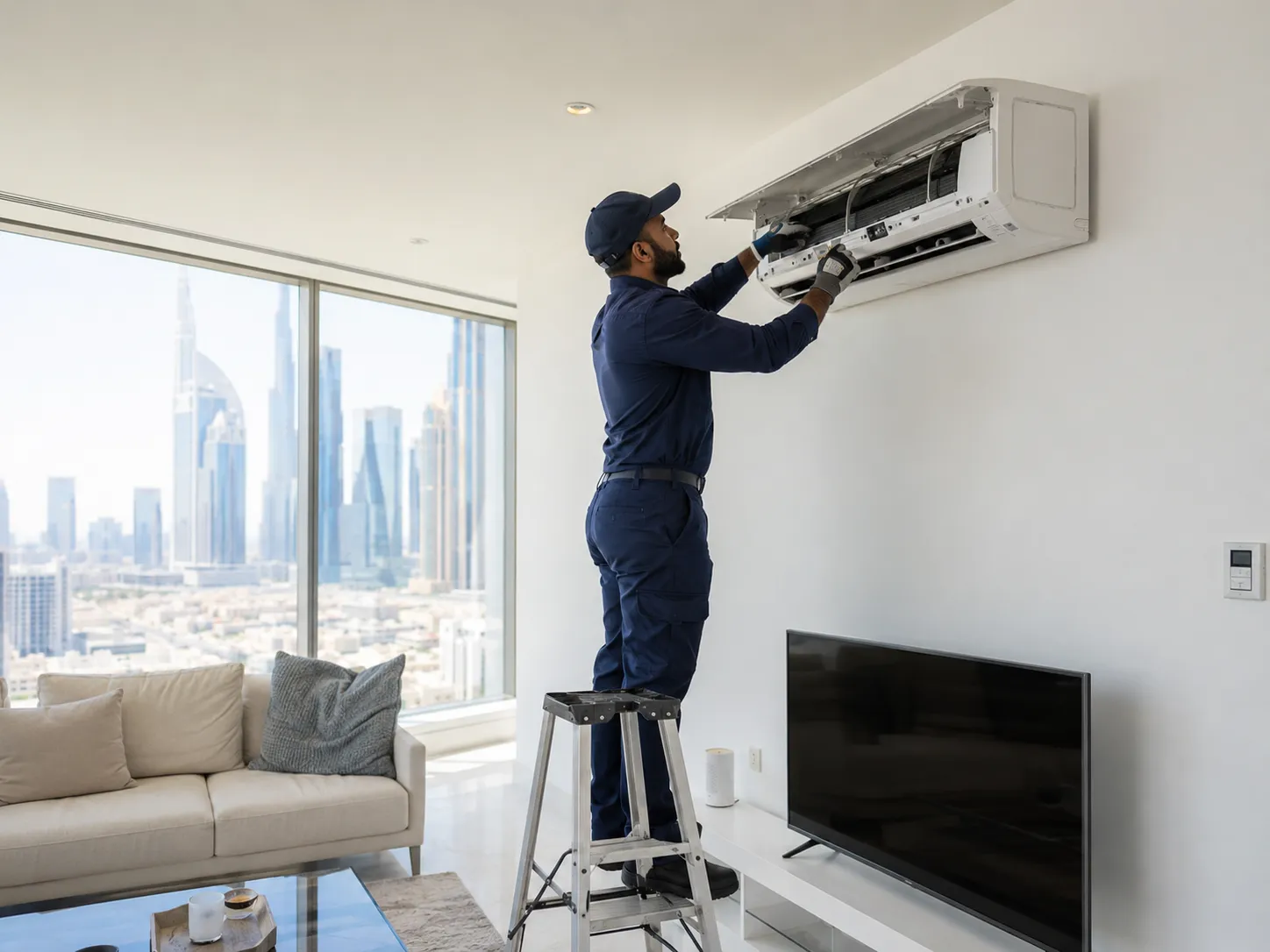
This is where management companies earn their fee, particularly for overseas investors. A tap leaks at midnight. The AC stops working in August. A window crack appears after a storm. The management company receives the maintenance request, dispatches the right contractor, oversees the work, and bills either the tenant (if it is their responsibility under the lease) or the landlord. Many companies maintain a network of contractors for plumbing, electrical, AC servicing, painting, and general repairs.
Move-In and Move-Out Inspections
Professional management includes documented inspections at both ends of a tenancy. Move-in inspection records the condition of the property with photos and a checklist. Move-out inspection compares the current state against the original record and identifies any damage beyond normal wear and tear. This is how deductions from the security deposit are justified, and it protects both landlord and tenant.
Financial Reporting
You should receive monthly statements showing rental income received, management fees deducted, maintenance expenses, and any other charges. Quarterly or annual summaries should break down your net yield after all costs. This reporting is your audit trail and your tool for evaluating whether the property is performing as expected.
Long-Term Rental Management vs Short-Term/Airbnb Management
These are fundamentally different businesses that share a name. The skills, licensing, costs, and day-to-day operations are distinct, and choosing the wrong model for your property costs real money. Here is how the two compare across the key factors:
- Management fee: long-term is charged on collected rent; short-term is charged on booking revenue.
- Tenant turnover: long-term turns over once per year or less; short-term sees multiple guests per month.
- Licensing: long-term needs Ejari registration; short-term requires a holiday home permit.
- Furnishing: long-term is unfurnished or basic; short-term must be fully furnished.
- Revenue: long-term income is more predictable; short-term income varies with season and occupancy.
- Vacancy risk: long-term has fewer, longer gaps between tenants; short-term occupancy is seasonal.
- Wear and tear: long-term is standard residential use; short-term is higher due to frequent guest turnover.
- Guest communication: long-term is minimal after move-in; short-term needs daily check-ins, reviews, and complaint handling.
- Best for: long-term suits steady-income, hands-off investors; short-term suits active managers.
Short-term rental management has a large market in Dubai, which recorded 18.72 million international overnight visitors in 2024 (Dubai Media Office, February 2025). But the higher gross revenue comes with a higher management fee, furnishing costs, a holiday home permit and a bigger maintenance budget.
Compare net income, not gross revenue. Run the calculation for your specific unit before committing to either model.
How Much Does Property Management Cost in Dubai?
Fees vary by company, service level, and whether you are looking at long-term or short-term management, so ask two or three companies for written quotes. These are the fee types to expect:
- Management fee: a percentage of collected rent (long-term) or of booking revenue (short-term).
- Tenant finding / listing: often a separate fee for long-term lets; usually part of the management fee for short-term.
- Lease renewal: a fee per renewal for long-term lets.
- Maintenance markup: some companies add a percentage to contractor invoices.
- Ejari registration: the government fee, which the contract should say is paid by the tenant or the landlord.
- DEWA transfer coordination: included or charged separately.
- Move-in/out inspection: charged per inspection or included.
- Vacancy monitoring: some companies charge a monthly fee during voids.
- Annual statement: included or charged separately.
Add up the total yearly cost for your unit, not just the headline percentage, and compare quotes on the same basis. Short-term management costs more because of the greater workload: guest communication, check-ins, pricing adjustments, cleaning coordination, and review management.
How to Choose a Property Management Company
Many companies offer property management services in Dubai, and quality varies. Here is what separates the competent from the careless.
Check the Licence
Ask the company for its licence details and check them with the relevant Dubai authority before you sign. If they cannot provide them, or the licence has expired, walk away immediately.
Area Specialisation
A company that manages 200 units across 40 communities is stretched differently from one that manages 200 units across 4 communities. Area specialists know the building managers, the most reliable maintenance contractors in that zone, the rental demand patterns, and the going rate per square foot. Ask specifically: how many units do you manage in my building or community?
Portfolio Size and Staff Ratio
Ask how many units each property manager handles. If a single manager is juggling too many properties, your unit will not get the attention it needs. Ask the question directly. Good companies will tell you; evasive answers tell you everything.
Response Time
Test it before you sign. Call their office at 5 PM on a Wednesday. Send an email on a Thursday morning. How long does it take to get a substantive reply? If the sales team takes two days to respond when they are trying to win your business, imagine how responsive the operations team will be with a maintenance issue six months in.
Reporting
Ask to see a sample monthly owner statement. It should include: rent collected, management fee deducted, any maintenance expenses with contractor invoices attached, and the net amount transferred to you. If they do not produce monthly statements, they are not managing your property properly.
Contract Flexibility
Be cautious of companies that demand long minimum terms, charge exit penalties, or include automatic renewal clauses without a notice window. Your relationship with a management company should be retained by performance, not contractual lock-in.
Matching a Management Company to Your Area
Rather than a generic list of property management companies in Dubai, here is how to think about matching a company to your property's location.
Arjan and DLRC (Dubailand Residence Complex)
These are newer communities. Property management options include both established citywide operators and smaller firms that focus on these areas. Key considerations for Arjan and DLRC owners: proximity to the management company's office matters (response time for maintenance), familiarity with each building's developer and handover standards, and connections with local contractors who service these communities daily.
Dubai Marina and JBR
High-density areas with short-term rental activity. Management companies here need to understand the holiday home permit rules and have relationships with cleaning companies that can handle same-day turnovers.
Downtown and Business Bay
Premium addresses that command higher rents but also attract more demanding tenants. Management companies in these areas should have experience with luxury tenants, corporate leases, and the specific requirements of buildings like Burj Khalifa residences, The Address, or Damac Towers.
JVC (Jumeirah Village Circle)
A large community with a mix of studios, one-beds, and two-beds. With many similar units competing for tenants, a manager's tenant-finding record matters.
General Guidance for Choosing by Area
When compiling your own list of property management companies in Dubai, start with companies that have an office within 15 minutes of your property. A management team based far from your property is likely to be slower to respond to maintenance issues than one based nearby. Geography is not everything, but it matters.
Self-Managing from Abroad: Is It Possible?
Yes, but with significant caveats. Some overseas investors do manage their Dubai properties themselves, particularly those with a single long-term rental. Here is what that involves.

What You Need to Handle Yourself
Ejari registration: Ejari is registered through Dubai REST or a registered centre. Check the current document requirements before you start, and note that you may need someone in the UAE to act for you if you are not present.
DEWA transfers: DEWA account activation requires a security deposit, and the current process is on dewa.gov.ae. Your tenant can handle the transfer into their name, but you need to ensure it comes back to you between tenancies.
Maintenance: This is the hard part. You need a reliable handyman or maintenance company on speed dial. When something breaks in the evening in Dubai and you are in another time zone, someone needs to respond within hours, not days. Build a relationship with a local AC technician, a plumber, and a general maintenance company before your first tenant moves in.
Tenant finding: You will need a licensed agent or someone in Dubai to list the property and conduct viewings. Some investors use an agent solely for tenant finding while self-managing everything else.
Tools That Help
- Dubai REST app: Ejari registration and landlord services
- DEWA app: Utility account management and billing
- WhatsApp: A common communication channel in Dubai for maintenance coordination
- Bank transfers: a UAE bank account is useful for receiving rent and paying contractors
When Self-Managing Does Not Work
Self-management breaks down in three situations. First, if you own multiple units, the administrative burden multiplies and response time suffers. Second, if you are in a distant time zone, the communication lag on urgent maintenance issues becomes a real problem. Third, short-term rentals. Self-managing an Airbnb from abroad requires daily guest communication, check-in coordination, cleaning schedules, and holiday home permit compliance. It is essentially a part-time job. If any of these apply, professional management is worth the fee.
The Property Management Contract: What to Look For
Before you sign with any management company, read the contract properly. Not skim it. Read it. Here are the specific clauses that matter.
Fee Structure
The management fee percentage should be stated clearly: X% of collected rent (not projected rent, not market rent, collected rent). Any additional fees for tenant finding, renewals, inspections, and maintenance markup should be listed explicitly. If a fee is not in the contract, the company should not be charging it.
Scope of Services
The contract should specify exactly what is included. Tenant finding, screening, lease preparation, Ejari registration, DEWA coordination, rent collection, maintenance coordination, inspections, and reporting. If any of these are listed as additional services at extra cost, factor that into your total cost comparison.
Notice Period and Exit Terms
Check the written notice period for either party. Red flags: heavy exit fees, penalties for terminating before the end of a fixed term, or clauses that require you to pay management fees on rent collected after termination if the company found the tenant.
Maintenance Authorisation Limits
The contract should specify a threshold below which the management company can authorise repairs without your approval. Above that threshold, they should seek your written approval before proceeding. This protects you from unexpected large bills while allowing routine fixes to happen quickly.
Rent Disbursement Timeline
How quickly does collected rent reach your bank account? Some companies hold funds for weeks before paying out. The longer they hold your money, the more working capital they get from your rental income. Clarify this upfront.
Insurance and Liability
Confirm the management company holds professional indemnity insurance. If their negligence causes damage to your property or a tenant complaint, you need to know who bears the cost. The contract should address liability for loss or damage arising from the company's actions or failures.
A Note on Pearlshire Buildings
Pearlshire is a boutique developer and does not operate as a third-party property management company. It describes Bond Enclave in Arjan as a boutique residence with hotel-level maintenance.
Practical Tips
If you know you are going to use a manager, engage them before your handover date so that Ejari, DEWA and the move-in process are handled from the start rather than learned on the job.
Do not choose a management company solely on the lowest fee percentage. A lower fee can cost more overall if vacancies take longer to fill or maintenance is marked up. Look at the total cost of management, not just the headline percentage.
Finally, treat the first six months with any management company as a probation period. Track their response times, read every maintenance invoice, and compare their tenant finding speed against the market for your area. If they are not meeting expectations, check your notice terms so you can switch.
How much does property management cost in Dubai?
Long-term rental management is usually charged as a percentage of collected rent, and short-term and Airbnb management as a percentage of booking revenue. Additional fees can include tenant finding, lease renewal, maintenance markup and move-in/out inspections. Ask two or three companies for written quotes and compare the total yearly cost for your unit.
How do I choose a property management company in Dubai?
Start by asking for the company's licence details and checking them with the relevant Dubai authority. Then evaluate area specialisation (how many units they manage in your community), how many units each manager handles, response time (test it before signing), and reporting quality (ask for a sample monthly owner statement). Finally, review the contract for clear fees, reasonable notice periods, and clear maintenance authorisation limits.
Can I manage my Dubai property from abroad?
Yes, for a single long-term rental with a reliable local maintenance contact. You will need the Dubai REST app for Ejari, a UAE bank account for rent collection, and a trusted handyman for repairs. Self-management becomes impractical for multiple units, distant time zones, or short-term rentals that require daily guest management.
What does Airbnb property management in Dubai involve?
Airbnb management in Dubai requires a holiday home permit from Dubai's Department of Economy and Tourism. The management company handles dynamic pricing across platforms (Airbnb, Booking.com, VRBO), guest communication and check-in/check-out, professional cleaning between stays, linen and toiletry restocking, review management, and maintenance. The fee is higher than for long-term management, which reflects the greater operational workload.
How long should a property management contract be?
Check the minimum term and the notice period for termination by either party. Be cautious of long minimum terms with a company you have not worked with before, and of automatic renewal clauses that do not include a notice window. Treat the first 6 months as a probation period: track performance and review invoices before committing long-term.
What services are included in Dubai property management?
Full-service property management in Dubai should include: tenant sourcing and screening, lease preparation and negotiation, Ejari registration, DEWA account transfers, rent collection and follow-up on late payments, maintenance coordination with contractors, move-in and move-out inspections with photographic documentation, regular property checks during vacancy periods, monthly financial statements, and annual reporting. Any service listed outside the contract scope (such as deep cleaning, painting between tenancies, or furniture procurement) is typically charged separately.