Oqood Dubai: Registration, Fees, Certificate & Title Deed Explained
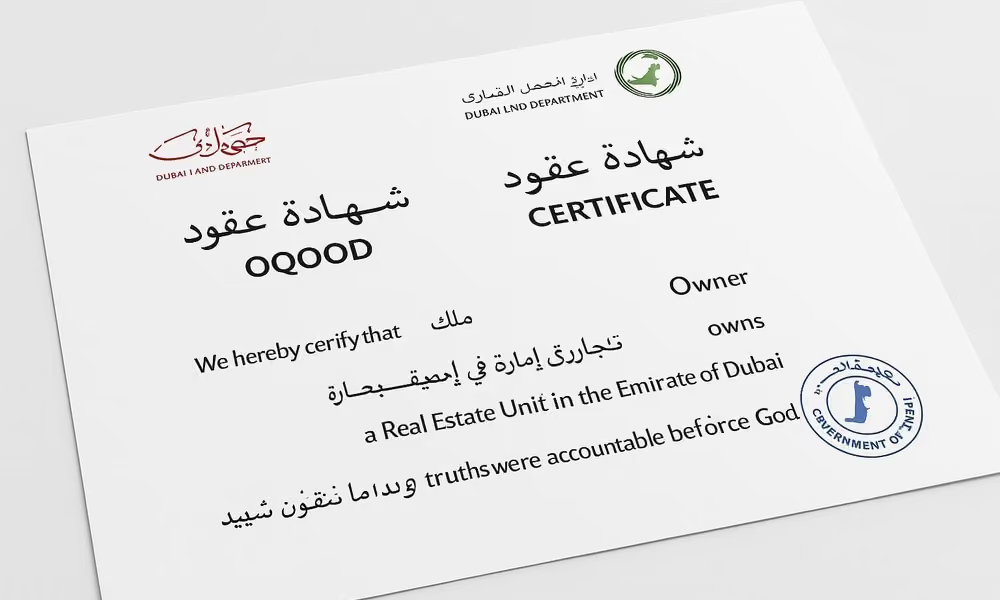
Oqood is the Dubai Land Department’s (DLD) system for registering off-plan property sales in its provisional register. The developer files the signed sale contract through the Oqood portal within 90 days of signing, and DLD issues a provisional registration e-certificate to the buyer. Oqood is not a title deed. It records your off-plan purchase while the property is being built, and ownership is evidenced by a title deed once the completed property is registered in your name.
Information as of October 2026. Primary sources: DLD’s initial sale registration service and property sale registration service pages (dubailand.gov.ae).
Oqood at a Glance
| Question | Answer |
|---|---|
| What is Oqood? | DLD’s system for registering off-plan property transactions in the interim property register |
| Who uses it? | Buyers of qualifying off-plan property in Dubai |
| Issued by | Dubai Land Department |
| Property stage | Off-plan / under construction |
| Final document | Title Deed, issued after handover once the developer completes final registration |
| Registration handled by | The developer files the sale through the Oqood portal (DLD’s Real Estate Developers Portal); DLD records it in the provisional register and the certificate is emailed to the purchaser |
| Registration deadline | Within 90 days of signing the sale contract, per DLD’s official process |
| Cost | 2% of the sale value from the seller and 2% from the purchaser, plus AED 10 knowledge and AED 10 innovation fees (DLD, as of October 2026) |
| Certificate | Provisional registration e-certificate, sent to the purchaser by email |
| Can foreigners register? | Yes, subject to the property being in a designated freehold area and standard DLD ownership rules |
| Where to check it? | Your certificate email, your developer, or DLD support on +971 8004488 (see the check section below) |
What Does Oqood Mean in Dubai?
Oqood (Arabic: عقود, meaning “contracts”) is the Dubai Land Department’s system for registering the sale of off-plan property (units or plots whose value has not yet been fully paid) in the interim (provisional) property register. The developer files the signed sale and purchase agreement (SPA) with DLD through the Oqood portal, and the certificate is the output of that filing.
Oqood is not a Title Deed. It is official evidence that your off-plan purchase has been recorded with DLD. Once the project is completed and the developer finalizes registration, Oqood is replaced by a Title Deed in your name. Our title deed guide covers the title deed itself.
Why Is Oqood Important When Buying Off-Plan?
Before Oqood existed, off-plan sales in Dubai were harder to verify, which left room for disputes such as a single unit being sold to more than one buyer. Registering the sale with DLD creates a single, centralized record of who purchased which unit and on what terms, which:
- Gives buyers official, DLD-recorded evidence of their purchase
- Reduces the risk of a unit being sold to multiple parties
- Creates a paper trail DLD can reference if a dispute arises
- Works alongside Dubai’s escrow account rules, which govern how developers can use buyer payments during construction
Who Needs Oqood Registration?
- Buyers purchasing an off-plan apartment, villa, or plot directly from a developer
- Investors buying a primary off-plan unit before it is completed
- Anyone reselling or transferring an off-plan unit before handover
Ready (completed, secondary-market) properties do not go through Oqood. Those transactions are registered directly against a Title Deed.
How Does Oqood Registration Work?
The path from booking a unit to holding a Title Deed generally follows this sequence. DLD’s service terms add that the contract must be signed by both the developer and the purchaser before it is registered.
- Booking: you reserve a unit with the developer, usually with a booking payment.
- Sale and Purchase Agreement (SPA): you and the developer sign the SPA setting out price, payment plan, and handover terms.
- Developer submits registration: the developer logs in to the Oqood portal, selects the property, attaches the documents, pays the fees and submits the application, within 90 days of signing the contract per DLD’s published process.
- DLD interim registration: DLD records the transaction in the interim property register.
- Oqood output issued: DLD issues the provisional registration e-certificate, and the output is sent to the purchaser by email.
- Construction continues: the developer draws on the project’s escrow account against verified construction milestones.
- Completion and handover: the project is completed and handed over to buyers.
- Title Deed issued: the developer completes final registration with DLD and a Title Deed is issued in the buyer’s name.
What Documents Are Required?
Per DLD’s published requirements for registering an off-plan sale, buyers typically need:
- A copy of the signed sale and purchase contract
- A valid Emirates ID (for UAE residents)
- A valid passport copy (for non-residents/foreign buyers)
Company buyers face additional requirements, including a valid trade license, ID or passport of the license holder, power of attorney where relevant, and (for foreign companies) a No Objection Certificate. The developer compiles and submits these documents to DLD as part of the Oqood filing. Confirm the exact checklist with your developer or DLD before signing.
How Much Does Oqood Cost in Dubai?
As of October 2026, DLD’s page for registering an initial (off-plan) sale lists these charges:
| Item | Amount (as of October 2026) | Who pays, per DLD |
|---|---|---|
| Registration fee, seller | 2% of the sale value | Seller |
| Registration fee, purchaser | 2% of the sale value | Purchaser |
| Knowledge fee | AED 10 | Not stated on the DLD page |
| Innovation fee | AED 10 | Not stated on the DLD page |
| Developer self-registration fee on the Oqood portal | AED 1,000 | Developer |
Together the two registration fees come to 4% of the sale value, 2% for the seller and 2% for the purchaser on DLD’s schedule. Who bears each share is agreed in the contract, so confirm the split with your developer before signing. DLD’s page lists no separate fee for the Oqood certificate, which is the output of the registration. Fees can be paid from a Noqodi wallet or deducted from the project’s escrow account, per DLD. Confirm the current amounts on the DLD page before you pay, because fee schedules can change.
Some developers and trustee offices also charge their own processing or admin fees on top of the DLD registration fee. These vary by developer and are not a fixed DLD charge, so ask for the exact figure in writing before you pay.
Keep Oqood registration costs separate from other purchase costs. Real estate agent commission is a separate cost of the transaction, not part of the DLD Oqood registration fee, and shouldn’t be added into an “Oqood-related total.” For an AED 750,000 property, for example, DLD’s registration fee works out to AED 30,000 (4% of the sale value, made up of 2% for the seller and 2% for the purchaser on DLD’s schedule) plus AED 20 in knowledge and innovation fees. Agent commission, developer admin fees, and any mortgage registration fee are separate line items on top of that. For the full list of purchase costs, see our guide to DLD fees in Dubai.
How Do I Get an Oqood Certificate?
The buyer does not file for the Oqood certificate. DLD describes the service as one used by the real estate developer: the developer logs in to the Oqood portal, which DLD lists as its Real Estate Developers Portal, submits the sale, and the output, a provisional registration e-certificate, is sent to the purchaser by email. That is also why a search for an “Oqood login” leads to a developer portal rather than a buyer account.
To make sure the certificate reaches you:
- Give the developer the exact email address, name and ID or passport details you want on the registration when you sign the SPA
- Ask for the e-certificate in writing once the 90-day window has passed, and keep a copy with your SPA
- Check that your name, ID details and unit details on the certificate match the SPA
If the email has not arrived, ask the developer’s customer care first. See the next section for how to check with DLD.
How Can I Check My Oqood Registration?
DLD’s service pages do not describe a self-service Oqood lookup for buyers, so the reliable route is a short checklist:
- Find the provisional registration e-certificate DLD emails to the purchaser after the developer files the sale, and compare it with your SPA
- Ask the developer’s customer care for written confirmation of the registration status
- Contact DLD support on +971 8004488, which DLD lists on its service pages, and ask whether your sale contract appears in the provisional register
- Try DLD’s Property Status Enquiry on the DLD website or the Dubai REST app. DLD’s page does not say whether it covers off-plan units, so treat a blank result as inconclusive, not as proof that your sale is unregistered
- To see how far construction has progressed, use DLD’s Project Status Enquiry with the land number, project number or project name
If you can’t confirm your unit is registered and it has been more than 90 days since you signed the SPA, contact your developer first. See the section below on what to do if your Oqood hasn’t been registered.
Oqood vs Title Deed: What’s the Difference?
| Oqood | Title Deed | |
|---|---|---|
| Property stage | Off-plan / under construction | Completed and registered property |
| Registration type | Interim (provisional) registration | Final registration |
| Issuing authority | Dubai Land Department | Dubai Land Department |
| Typical use | Evidence of a registered off-plan sale | Legal proof of full, registered ownership |
| Resale / transfer | Possible before handover, subject to developer and DLD requirements | Standard resale/transfer process |
Sale Deed vs Title Deed, and How to Verify a Title Deed
The sale contract and the title deed are different documents. For an off-plan purchase the contract is the SPA, the agreement between buyer and developer. The title deed is the ownership document issued by DLD: u.ae states that title deeds in Dubai “are issued by the Land Department,” and DLD’s property sale registration service lists the electronic title deed as its output. DLD’s sale registration pages do not list a separate document called a “sale deed.”
Foreign nationals can hold freehold ownership in the areas designated for it (u.ae). DLD also registers usufruct rights, the right to use and benefit from another party’s property for up to 99 years, and musataha rights, the right to build on land and benefit from the building for up to 50 years (DLD).
To verify a title deed, use DLD’s Verify Title Deed service. You enter the title deed number, the year and the property type, plus the owner’s name if you want to validate the owner, and complete the captcha. A match returns a title deed certificate that DLD says is digitally validated by blockchain.
Can You Sell an Off-Plan Property With Oqood?
Yes, off-plan resale before handover is generally possible in Dubai, but it isn’t automatic. In practice it typically requires:
- A No Objection Certificate (NOC) from the developer. DLD’s FAQ says resale is possible after obtaining it and states no minimum percentage paid. Any payment threshold comes from your SPA or the developer’s own policy, so confirm it directly with your developer
- Settling any outstanding fees owed to the developer or DLD
- Completing the transfer through DLD’s registration process, with the new buyer’s details recorded against the unit
Because resale conditions vary by developer and project, treat any specific payment percentage you’re quoted as project-specific guidance rather than a universal Oqood rule.
What Are Your Cancellation & Refund Rights?
Cancelling an off-plan purchase in Dubai is governed by specific legislation, primarily Law No. (13) of 2008 Regulating the Interim Real Property Register, whose Article 11 was replaced by Article 1 of Law No. (19) of 2020 (issued 24 November 2020), together with Law No. (8) of 2007 concerning escrow accounts for real estate development. The rules depend heavily on the circumstances, and DLD is directly involved in the process. A buyer cannot simply cancel and expect an automatic, fixed refund.
If a developer moves to cancel for buyer default, the law sets out a defined process rather than an outright right to keep all funds. The developer must notify DLD, and DLD verifies the breach, serves the buyer a written notice giving 30 days to perform and, where possible, mediates a settlement. If the 30 days pass without performance or settlement, DLD issues an official document confirming that the procedure was followed and stating the project’s percentage of completion. Only then can the developer act, and what it may do depends on how far the whole project has progressed:
- Project more than 80% complete: the developer may keep the agreement, retain all amounts paid and claim the balance of the contract value; ask DLD to sell the unit by public auction to recover what is owed; or terminate and retain up to 40% of the unit value stated in the sale agreement
- Project 60% to 80% complete: the developer may terminate and retain up to 40% of the unit value stated in the sale agreement. The option to keep the agreement and claim the balance is only available above 80%
- Project below 60% complete, with the developer having started construction: the developer may terminate and retain up to 25% of the unit value stated in the sale agreement
- Developer has not started work for reasons beyond its control and without its own negligence: the developer must refund all payments made, under the procedures of the escrow law
Where the developer terminates and retains a capped percentage, it must refund the excess to the buyer within one year of termination or within 60 days of reselling the unit to another buyer, whichever is earlier. The buyer can still go to court or arbitration. These tiers and the refund timing come from Article 11(a)(4) and 11(g) of Law No. (13) of 2008 as replaced by Law No. (19) of 2020 on the Dubai Legislation Portal, as of October 2026. The portal notes that the Arabic text prevails if there is a conflict. Al Tamimi & Company’s summary of the amendment adds that before Law No. 19 of 2020 a developer could retain up to 30% whether or not construction had started, and that the completion test now looks at the whole project rather than the individual unit.
If a project is cancelled by RERA under a final reasoned decision, the developer must refund all payments made by buyers under the procedures of Law No. (8) of 2007 governing escrow accounts (Article 11(b), as replaced by Law No. (19) of 2020).
Because the applicable outcome depends on your specific contract terms, construction progress, and the reason for cancellation, confirm your exact position with DLD or a qualified real estate lawyer before assuming a particular outcome.
What Happens to Oqood After Handover?
At handover, the developer completes final registration of the completed unit with DLD. Once that’s done, your Oqood interim registration is replaced by a Title Deed issued in your name, provided all payments under the SPA have been settled and any outstanding fees are cleared. This typically follows shortly after the project receives its completion certificate, though exact timing depends on the developer’s registration process.
What If Your Oqood Has Not Been Registered?
DLD’s published process requires the sale contract to be registered in the interim register within 90 days of signing. If that window has passed and you can’t confirm that your unit is registered:
- Contact your developer’s sales or customer care team first and ask for written confirmation of the registration status
- Check that the SPA and payment details on file match what you signed
- If the developer doesn’t resolve it, raise the issue directly with DLD, which can confirm whether the registration was filed. DLD’s FAQ page says that where a developer refuses or delays registering the sale contract, an application can be submitted to its Real Estate Registration Assurance section, supported by the relevant documents
Don’t assume a delay means anything specific about your legal position. Confirm the facts with DLD or a qualified advisor before drawing conclusions.
Oqood and Project Escrow Accounts
Oqood registration and project escrow accounts are related but separate parts of Dubai’s off-plan framework, and it’s worth keeping them apart:
- Oqood is the record of your specific sale in DLD’s interim property register. It’s about your transaction.
- The escrow account, regulated separately under Law No. (8) of 2007, is the mechanism through which all buyer payments for a project are held and released to the developer only against verified construction milestones. It’s about how the whole project’s funds are controlled.
Both exist to protect off-plan buyers, but Oqood doesn’t itself hold or release your money; the escrow account does. For the wider list of off-plan risks to check before you sign, see our guide to off-plan property risks in Dubai.
Oqood for Foreign Property Buyers
Foreign buyers can register off-plan purchases through Oqood in Dubai’s designated freehold areas, following the same DLD process as UAE nationals and residents, with the documentation noted above (passport copy, SPA, and any company documents where relevant). For a fuller look at ownership rules for non-resident buyers, see our guide to buying property in Dubai as a foreigner, and for the legal steps in order, our guide to the legal steps of buying property in Dubai.
Common Oqood Problems & What Buyers Should Check
- Incorrect buyer details: check your name, passport/Emirates ID number, and unit details match your SPA exactly.
- Registration delay: if you’re past the 90-day window with no confirmation, follow up with your developer in writing.
- Payment or SPA mismatch: confirm the payment schedule shown against Oqood matches what you actually signed and paid.
- Certificate not received: DLD sends it to the purchaser by email, so check the address you gave the developer, including spam, before assuming an error.
- Resale/transfer restrictions: confirm your developer’s NOC requirements before agreeing to sell an off-plan unit.
FAQs
What is Oqood in Dubai?
Oqood is Dubai Land Department's system for registering off-plan property sales in the provisional property register. It provides official evidence that your off-plan transaction has been recorded with DLD before a final Title Deed is issued at handover.
What does Oqood mean in Dubai?
Oqood is the Arabic word for contracts. In Dubai property it refers to DLD's off-plan registration system, where the developer registers your signed sale contract in the provisional register. The Oqood certificate you receive is DLD's provisional registration e-certificate, sent to the purchaser by email.
Is Oqood the same as a Title Deed?
No. Oqood is an interim registration for off-plan property, while a Title Deed is the final ownership document issued by DLD after the property is completed and the developer finalizes registration.
What are the Oqood charges in Dubai?
As of October 2026, DLD lists a registration fee of 2% of the sale value for the seller and 2% for the purchaser, plus AED 10 knowledge and AED 10 innovation fees. Developers pay a separate AED 1,000 self-registration fee on the Oqood portal. DLD lists no separate certificate fee. Confirm current amounts on the DLD page.
Who pays the Oqood fee, buyer or developer?
DLD's fee structure splits the registration fee between seller and purchaser (2% each). Who bears each share is agreed in the contract, so check your specific SPA.
How can I check my Oqood registration online?
DLD's service pages do not describe a self-service Oqood lookup for buyers. Check the provisional registration e-certificate emailed to you against your SPA, ask your developer for written confirmation, and contact DLD support on +971 8004488 if you cannot confirm it.
How can I verify an Oqood certificate?
Match the name, ID details and unit on the e-certificate against your SPA, then ask DLD to confirm the registration on +971 8004488. DLD's public Verify Title Deed tool is for title deeds, not Oqood certificates, so do not rely on it for an off-plan unit that has no title deed yet.
Are a sale deed and a title deed the same?
No. The sale contract is the agreement between buyer and seller, which for off-plan is the SPA. The title deed is the ownership document DLD issues once a sale is registered. DLD's sale registration service lists the electronic title deed as its output, not a separate sale deed.
What is a title deed in the UAE?
In Dubai, a title deed is the ownership document issued by the Dubai Land Department. It identifies the property and its registered owner. You can check one on DLD's Verify Title Deed service by entering the title deed number, year and property type. Property rules differ by emirate.
Can I sell an off-plan property before receiving a Title Deed?
Yes, once you have a No Objection Certificate from your developer and complete the transfer through DLD. DLD’s FAQ says resale is possible after obtaining that certificate and states no minimum percentage paid. Any payment condition comes from your SPA or the developer’s policy, so confirm it with your developer.
What happens to Oqood after property handover?
Once the developer completes final registration at handover and all payments are settled, your Oqood interim registration is replaced by a Title Deed issued in your name.
What should I do if my property is not registered in Oqood?
DLD requires the sale contract to be registered within 90 days of signing. If that window has passed and you can't confirm registration, contact your developer in writing first, then escalate to DLD if it isn't resolved.
Buying Off-Plan Property in Dubai?
Pearlshire’s current residential developments include Bond Enclave in Arjan and Bond Living in DLRC. To ask about project details and payment plans, contact the Pearlshire team.
For the full buying process from booking through handover, see our guide to booking, Oqood and handover in Dubai. First-time buyers may also find our complete roadmap to buying property in Dubai useful, alongside our guide to RERA, buyer rights and escrow rules. If you’re exploring residency options tied to property investment, see our Golden Visa through property guide.