Dubai Service Charges 2026: What Property Owners Actually Pay (Area-by-Area Breakdown)
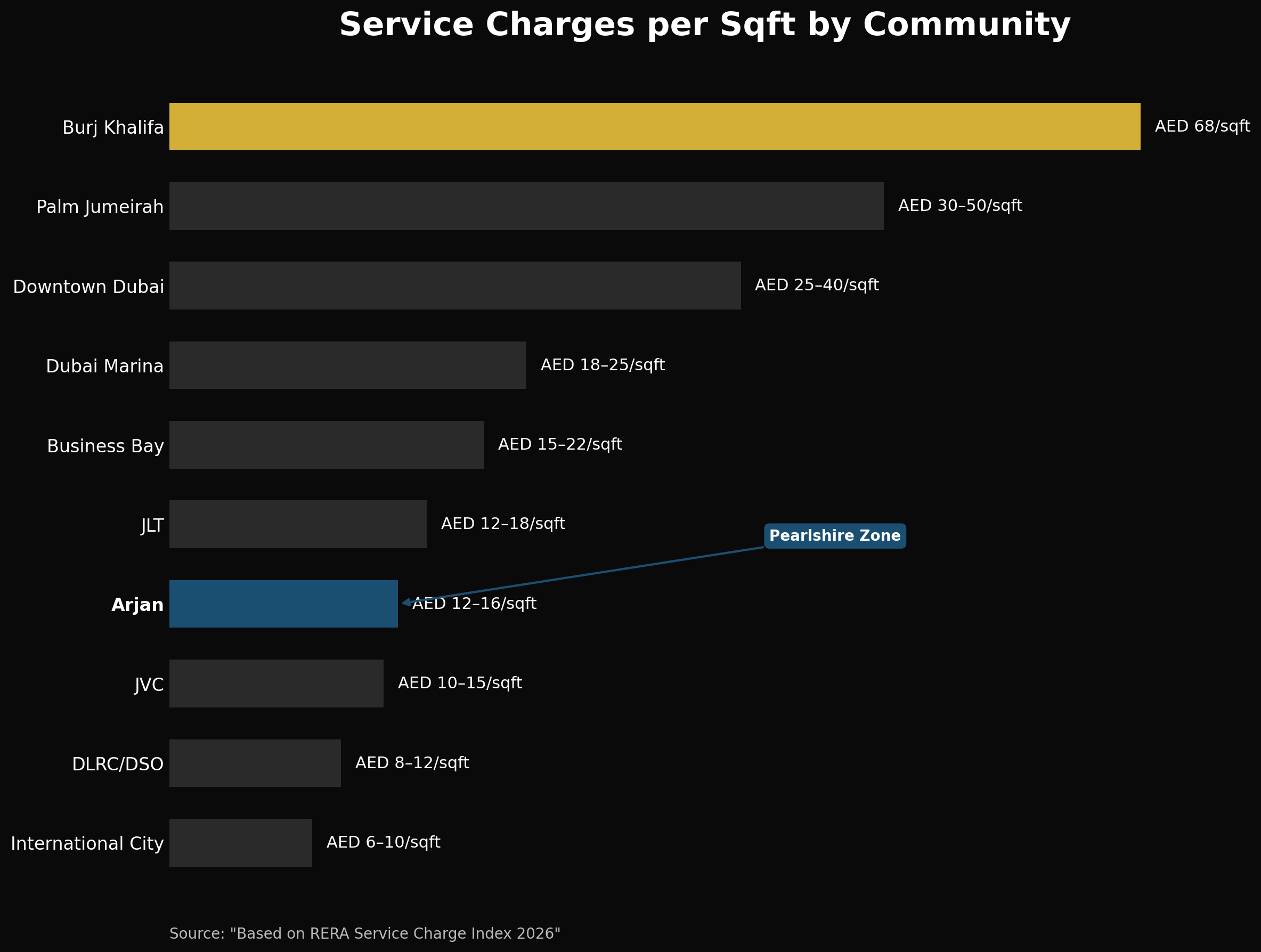
Dubai service charges in 2026 range from AED 6-10 per sqft in International City to AED 68 per sqft at Burj Khalifa. Arjan runs AED 12-16 per sqft with modern amenities, delivering net yields 1.87 percentage points higher than Downtown Dubai. Service charges directly compress rental yield and are mandatory under RERA regulation.
Your property's rental yield looks stellar on paper. You've found a 2-bedroom apartment, done the math, watched the ROI calculations light up. Then comes the email from your property manager: service charges.
And suddenly that 6% yield becomes 4.8%. Or 3.9%.
This is the conversation most property investors avoid. Dubai service charges 2026 aren't glamorous. They're not what gets discussed at networking events. But they're the difference between a property that actually makes money and one that looks good in a spreadsheet while quietly eroding your returns.
Here's what property owners need to know: service charges aren't optional. They're enforced by law, tracked by RERA, and they vary wildly depending on where you buy. The same rent in Downtown Dubai might cost you 3x the service charges as the same rent in Arjan. Over a decade, that difference could exceed your entire property appreciation.
This guide breaks down exactly what you'll pay in 2026, by community, and more importantly, how to calculate the service charge impact on your actual net yield before you commit to a purchase.
What Are Service Charges in Dubai? (And Why They Matter More Than You Think)
Service charges are annual fees every property owner pays for the maintenance and operation of their building and community infrastructure. Think of it as the membership fee to live in a managed building. Security, elevator maintenance, landscaping, building insurance, sinking fund contributions—it all comes from service charges.
In Dubai, these aren't optional. They're mandatory, regulated by RERA (Real Estate Regulatory Agency), and calculated per square foot annually. If you don't pay them, the system escalates: late fees, legal notices, and eventually a registration block that prevents you from selling or refinancing your property.
The Mollak system—Dubai's centralized service charge platform—tracks every charge, budget variance, and owner contribution. It's transparent by design, though most owners still don't know how to read it.
Why does this matter more than most people think? Because service charges directly compress your net rental yield. A property might command AED 85,000 annual rent but cost AED 12,000 in service charges. That's 14% of gross income gone before you even pay mortgage interest, property tax, or vacancy costs. In some premium communities, service charges consume 30-40% of rental income.
For investors betting on Dubai property for cash flow, not capital appreciation, this number makes or breaks the deal.
How Dubai Service Charges Are Calculated in 2026
Service charges follow a straightforward formula: building gross annual cost ÷ total built-up area (in square feet) = per sqft annual rate.
Here's how it works in practice:
A 30,000 sqft apartment building has annual operating costs of AED 400,000 (security, cleaning, maintenance, sinking fund, management). Divide that across the built area and you get AED 13.33 per square foot per year.
Own a 1,500 sqft apartment? Your annual service charge is roughly AED 20,000.
But here's where it gets nuanced. RERA publishes the Service Charge Index annually via the Dubai REST app and DLD website. This index sets benchmarks per community and building type, and serves as a reference for reasonableness. Developers and owners' associations must justify charges that deviate significantly from the index.
The Mollak platform tracks the actual vs. budgeted charges. Each year, the owners' association publishes a statement showing where money was spent: security (often 40-50% of total), cleaning (15-20%), landscaping (5-10%), maintenance reserves and sinking fund (15-25%), and management fees (5-10%).
Here's the critical part: not all buildings in the same community charge the same rate. A new, efficient apartment block with modern systems might run at AED 12/sqft. An older building with aging infrastructure and higher maintenance demands might hit AED 18/sqft in the same community. Amenity level matters too. A building with a gym, pool, and concierge will always cost more than a residential-only block.
Dubai Service Charges by Community: 2026 Rates Per Square Foot
This is the section that changes investment decisions. Here are real 2026 service charge ranges across Dubai's major communities:
| Community | Apartments (AED/sqft) | Villas (AED/sqft) | Key Notes |
|---|---|---|---|
| Arjan | 12–16 | 8–12 | Newer builds, efficient management, lower island infrastructure costs |
| JVC (Jumeirah Village Circle) | 10–15 | 6–10 | Varies by phase; older areas cheaper than newer zones |
| Dubai Marina | 18–25 | N/A | Waterfront premium, extensive shared amenities, higher maintenance |
| Downtown Dubai | 25–40 | N/A | Iconic location, premier amenities, highest density infrastructure |
| Palm Jumeirah | 30–50 | 25–40 | Island infrastructure costs, private beach/beach club maintenance |
| Burj Khalifa Residences | ~68 | N/A | Highest in Dubai; premium concierge, building systems complexity |
| DLRC / DSO | 8–12 | 5–8 | Budget-friendly, basic amenities, lower maintenance demand |
| Business Bay | 15–22 | N/A | Mixed-use infrastructure, moderate waterfront proximity |
| JLT (Jumeirah Lake Towers) | 12–18 | N/A | Lake maintenance costs, mid-range amenity levels |
| International City | 6–10 | 4–7 | Lowest in Dubai; minimal shared amenities, basic maintenance |
The gap is dramatic. An owner in International City might pay AED 7,500 annually for a 1,250 sqft apartment. That same apartment in Burj Khalifa would cost AED 85,000. The same property size. Different building, different charge.
For investors, the sweet spot isn't always the cheapest. It's the balance of charge-to-amenity-to-demand. Arjan sits in that middle ground: newer construction (so systems are efficient), modern amenities (appealing to renters), but positioned outside the Dubai Marina / Downtown premium (so charges don't spiral).
What's Included in Dubai Service Charges (And What's Not)
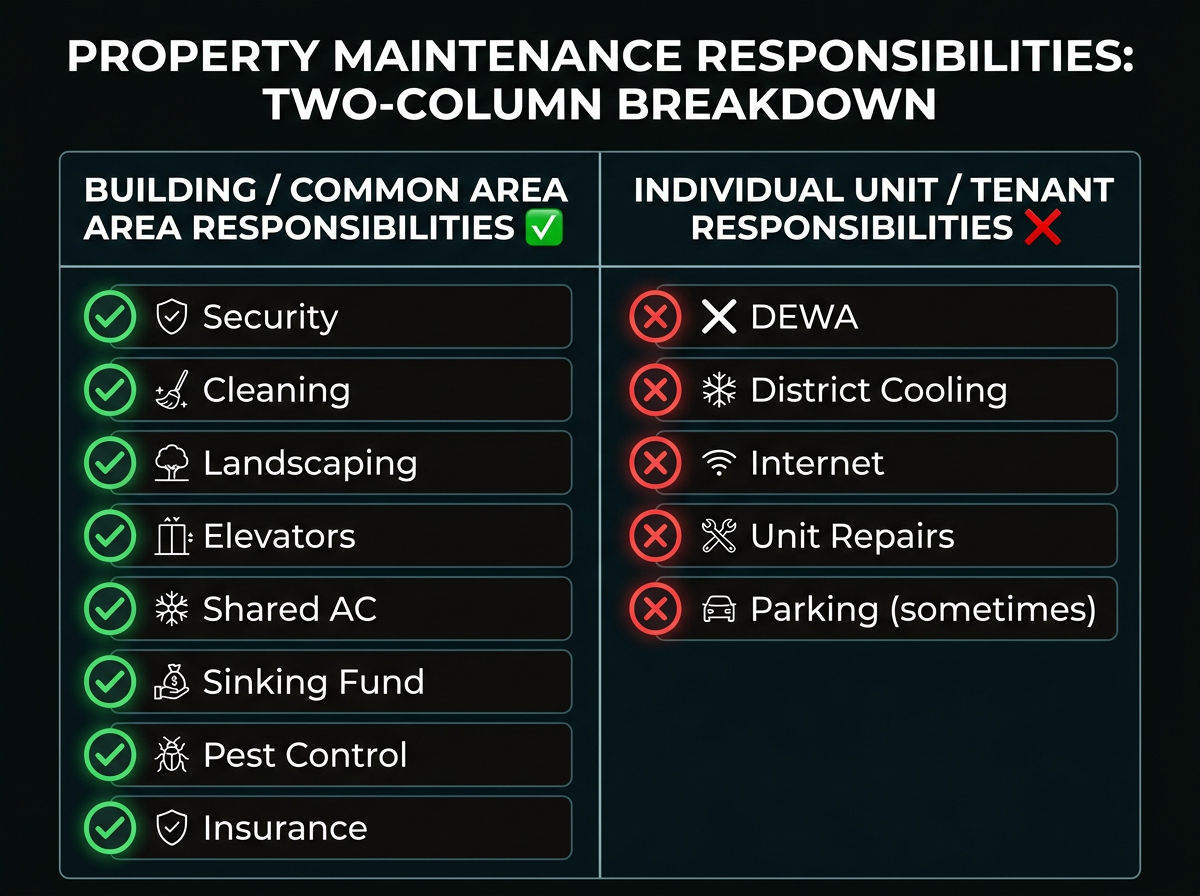
Service charges cover specific categories. Understanding what's included—and what isn't—prevents budget surprises.
Included in service charges:
- Security (gate, patrol, surveillance)
- Building cleaning and common area maintenance
- Landscaping and external areas
- Elevator and mechanical systems maintenance
- Shared air conditioning systems (in older centralized systems)
- Pest control
- Building insurance and liability coverage
- Sinking fund (reserve for major repairs)
- Owners' association management fees and administration
- Water for common areas and landscaping
NOT included in service charges:
- DEWA (electricity and water for your unit) – separate monthly bill
- District cooling charges (Empower, Emicool) – separate utility billing
- Internet and telecom
- Individual unit repairs or maintenance
- Parking fees (sometimes included, sometimes separate)
- Optional services like concierge premium requests
- Renovation or structural work
The district cooling point deserves attention. Many newer Dubai buildings don't use traditional building AC units; instead, they connect to a district cooling network (Empower or Emicool). This is billed separately at approximately AED 0.10–0.15 per BTU. For a typical 2-bedroom apartment, this adds AED 3,000–8,000 annually—a line item often overlooked in yield calculations.
Similarly, DEWA charges are separate and typically AED 150–400 monthly per unit depending on consumption and season.
How Service Charges Impact Your Net Rental Yield
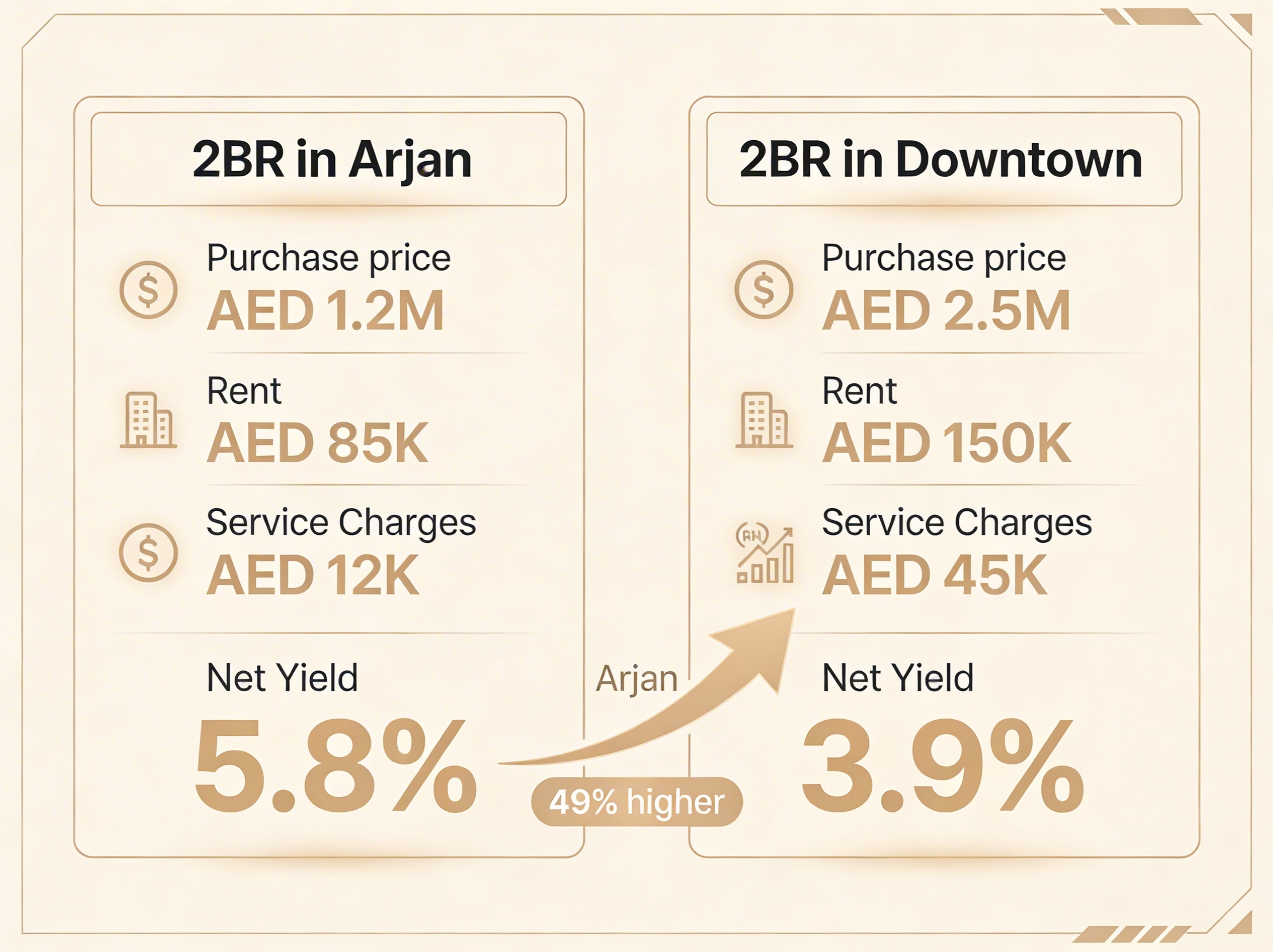
This is where the math gets real.
Most investors calculate gross yield: annual rent ÷ property price. A AED 1.2M apartment renting for AED 85,000 shows a 7.08% gross yield. Looks solid.
But net yield is the number that matters: (annual rent minus all expenses) ÷ property price.
Let's run two scenarios:
Scenario 1: 2-Bedroom in Arjan
- Property price: AED 1,200,000
- Annual rent: AED 85,000 (AED 7,083/month)
- Service charges: AED 14,400 (1,200 sqft × AED 12/sqft)
- District cooling: AED 5,500
- DEWA estimate: AED 3,000
- Property management (6% of rent): AED 5,100
- Maintenance reserve (2% of rent): AED 1,700
- Total annual expenses: AED 29,700
- Net annual income: AED 55,300
- Net yield: 4.61%
Scenario 2: 2-Bedroom in Downtown Dubai
- Property price: AED 2,500,000
- Annual rent: AED 150,000 (AED 12,500/month)
- Service charges: AED 60,000 (1,500 sqft × AED 40/sqft)
- District cooling: AED 6,000
- DEWA estimate: AED 3,500
- Property management (6% of rent): AED 9,000
- Maintenance reserve (2% of rent): AED 3,000
- Total annual expenses: AED 81,500
- Net annual income: AED 68,500
- Net yield: 2.74%
The Arjan property delivers 1.87 percentage points higher net yield despite commanding lower absolute rent. Over 10 years, that difference compounds into hundreds of thousands of dirhams in additional cash flow.
This is why investors who chase Dubai Marina or Downtown primarily for capital appreciation often struggle with cash flow. The rents are higher, but so are the operating costs. For yield-focused strategies, mid-tier communities with efficient buildings often outperform premium locations.
How to Check Service Charges Before Buying
Before committing to a property, investigate its service charge history and projected costs. Here's the checklist:
1. Request the RERA Service Charge Index for the specific building
Contact the developer or owners' association and ask for the historical and current RERA index rate. This is public data and sets the baseline for what's reasonable.
2. Check the Dubai REST app or DLD website
Both platforms publish service charge indices by community. Search your specific building to see benchmark rates and historical trends.
3. Ask for 3-year historical charge statements
One year's charge is a snapshot. Three years show the trend. Is it growing 3% annually (reasonable), 8% (moderate concern), or 15% (red flag)? Rapid increases signal aging infrastructure, poor management, or inefficient budget planning.
4. Review the detailed annual budget breakdown
Request the owners' association's most recent budget, which should itemize:
- Security (% of total)
- Cleaning and maintenance (%)
- Landscaping (%)
- Sinking fund contribution (%)
- Management fee (%)
A sinking fund between 15–25% is healthy. Less than 10% suggests future surprises. Management fees above 10% are bloated.
5. Compare actual vs. budgeted charges
Are the owners' association coming in under budget (efficient) or over-running (management issues)? Consistent over-runs indicate problems.
6. Red flags to watch:
- Service charges increasing faster than 10% year-on-year
- No sinking fund contribution or sinking fund below 10%
- Management fees exceeding 12% of total charges
- Building age over 15 years with service charges below area average (suggests deferred maintenance)
- Owners' association disputes or high turnover in management companies
Can You Dispute Service Charges in Dubai?
Yes. Owners have rights, and RERA enforces them.
If you believe service charges are inflated, misallocated, or poorly justified, you can formally dispute them through three channels:
Owners' Association
Raise concerns at annual general meetings (AGM) or through the committee. Request an audit of the budget and actual spending. Transparent owners' associations will provide detailed breakdowns.
RERA Mediation
If the association doesn't respond satisfactorily, file a formal complaint with RERA. Include evidence: budget comparisons, maintenance quotes, benchmarking data from comparable buildings. RERA can order an independent audit.
Legal Action
For egregious mismanagement, owners can pursue legal remedy through Dubai courts, though this is expensive and typically reserved for systemic fraud.
Common dispute triggers include:
- Management companies charging inflated fees without justification
- Unnecessary or redundant spending
- Lack of competitive bidding for contractors
- Sinking fund misappropriation
- No clear audit trail
Recent regulatory updates (2024–2025) have strengthened owner protections. RERA now requires:
- Annual audited service charge accounts
- Open-book budgeting with line-item transparency
- Mandatory competitive bidding for contracts above set thresholds
- Owner approval for major discretionary spending
This doesn't eliminate disputes, but it makes frivolous charges harder to hide.
FAQ: Dubai Service Charges 2026
Q: How much are service charges in Dubai per square foot in 2026?
A: It depends entirely on location and building type. Budget-friendly communities like International City range AED 6–10/sqft. Mid-tier areas like Arjan and JVC run AED 10–16/sqft. Premium waterfront areas start at AED 18/sqft and climb to AED 68/sqft for ultra-luxury addresses like Burj Khalifa. Always check the specific building's RERA index before assuming a community average applies to your property.
Q: What is the cheapest area for service charges in Dubai?
A: International City has the lowest service charges in Dubai, typically AED 6–10/sqft for apartments. DLRC and DSO also rank among the cheapest at AED 8–12/sqft. The trade-off is minimal shared amenities, older infrastructure, and less premium rental demand. For investors seeking lower charges without sacrificing rental appeal, Arjan and JVC offer better value: AED 10–16/sqft with modern amenities and strong tenant demand.
Q: Do service charges include electricity and water in Dubai?
A: No. Service charges cover building maintenance and common areas. DEWA bills separately for electricity and water consumption in your unit. Additionally, if your building uses district cooling (Empower or Emicool), those charges come on a separate utility bill. Always budget for all three bills independently: service charges, DEWA, and district cooling.
Q: How do I check the RERA service charge index for my building?
A: Use the Dubai REST app (available on iOS and Android) or visit the DLD website (dld.gov.ae). Search your community and building name to view the official RERA index and historical trends. You can also contact your property management company or owners' association to request the current index documentation. This is public data and they're legally required to provide it upon request.
Q: Can service charges increase every year in Dubai?
A: Yes, but there are limits. RERA permits annual increases tied to inflation and justified operational costs. Increases of 5–7% annually are typical. However, increases above 10% year-on-year should trigger scrutiny—request an explanation from the owners' association. If increases consistently exceed inflation, demand an independent audit or file a RERA complaint. Transparent management should justify every significant jump.
The Arjan Advantage: Service Charges and Net Yield
Here's the reality that separates informed investors from those chasing premium addresses.
Bond Enclave and Bond Living in Arjan were designed with service charge efficiency built in. Modern building systems, efficient management structures, and strategic community positioning keep per-sqft costs in the AED 12–16 range. This isn't by accident—it's by design.
When your property's service charges stay competitive while Downtown competitors pay double or triple, the cash flow advantage compounds every single year. Over a decade, that difference isn't thousands. It's hundreds of thousands of dirhams.
For investors calculating net rental yield—not gross yield, not price appreciation, but actual annual cash flow—this matters more than almost any other factor. A property that produces consistent 4.5%+ net yield in a lower-risk, efficiently managed building beats a property commanding higher rents but saddled with premium service charges and uncertain appreciation.
Arjan's value proposition isn't just location. It's fundamentals.
Explore Bond Enclave and Bond Living today. See how smarter design translates to better returns.