DIFC Wills & Dubai Property Inheritance 2026: Complete Guide for Expat Owners

Here is a question that most Dubai property buyers never think to ask until it is too late: what happens to your apartment, villa, or off-plan unit if you die tomorrow?
The answer, for the majority of expatriates who own property in Dubai without a registered will, is uncomfortable. UAE courts apply Sharia succession law by default. That is not a policy choice or a penalty. It is simply the legal framework that operates in the absence of any other instruction. For a married expat with two children, Sharia distribution means your spouse inherits roughly one-eighth of the property value. The remainder passes to your children and parents according to a fixed formula that you cannot alter after the fact.
Your bank accounts freeze. Your property cannot be sold, rented, or refinanced. Your family cannot access the asset until Dubai Courts complete the succession process, which routinely takes 6 to 18 months. If you have a mortgage, the bank continues to expect payments on a property your family cannot touch.
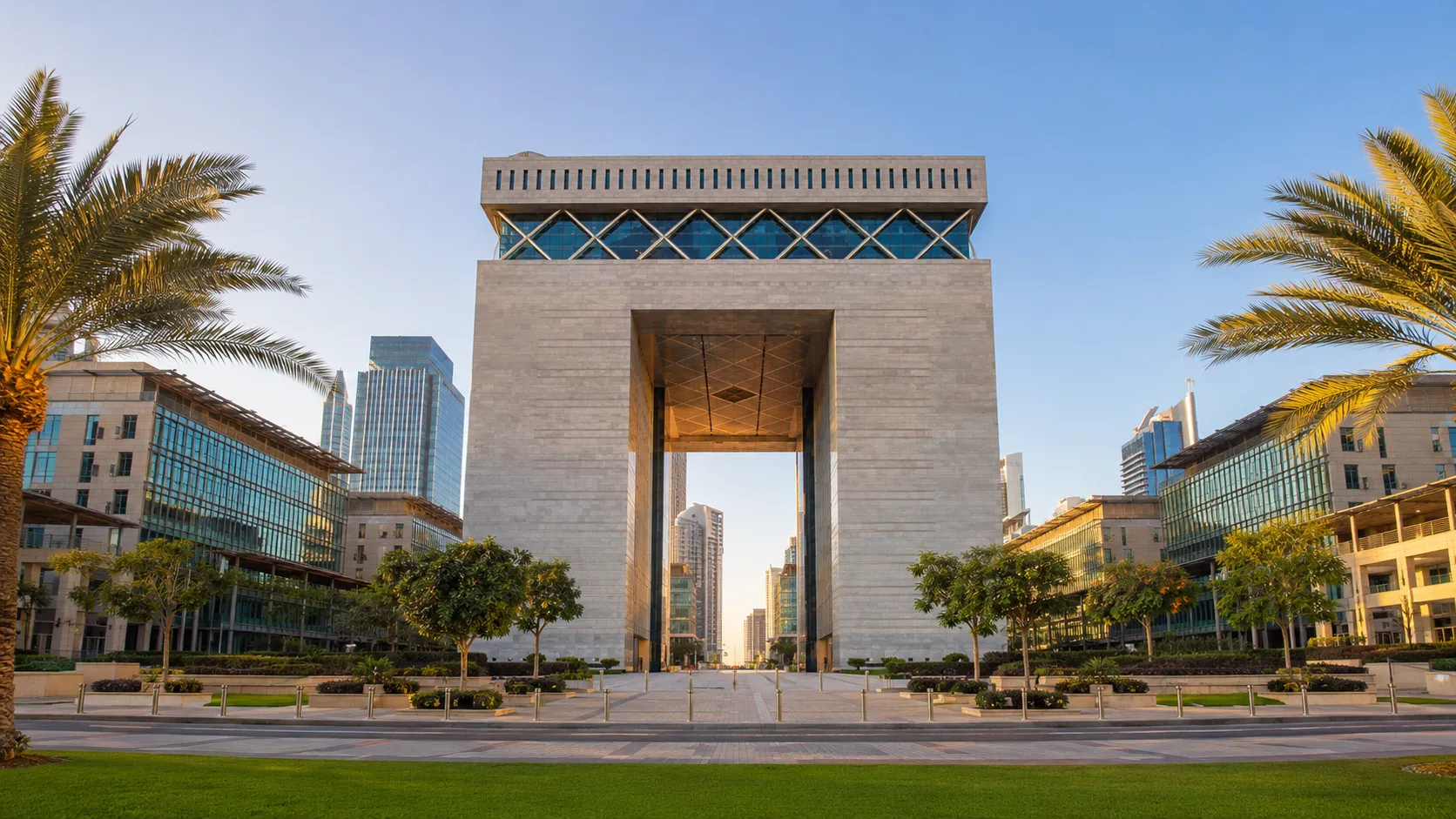
The DIFC Wills and Probate Registry exists specifically to solve this problem. Established in 2014 within the Dubai International Financial Centre, it operates under English common law and gives non-Muslim expatriates (and, optionally, Muslim residents) the ability to dictate exactly how their UAE assets are distributed. For property owners, it is not a luxury. It is a basic piece of financial infrastructure that sits alongside your title deed and insurance policy.
This guide covers everything you need to know: the types of DIFC wills available, what each costs, the registration process step by step, how off-plan property under Oqood is handled, common mistakes that invalidate wills, and the alternatives you might consider depending on your circumstances.
Key Takeaways
- Without a registered will, UAE courts apply Sharia succession law to your property regardless of your nationality, religion, or home-country documentation.
- The DIFC Wills and Probate Registry operates under English common law and covers all UAE assets, not just those within DIFC.
- A Property Will (real estate only) costs AED 7,500 for a single person or AED 10,000 for a mirror couple will. A Full Will covering all assets plus guardianship costs AED 10,000-15,000.
- Registration is a one-time fee with no annual renewal. Your will remains valid indefinitely unless you choose to amend it (AED 1,500 per amendment).
- Off-plan property registered under Oqood is a UAE asset and can be included in a DIFC will. No amendment is needed when the Oqood converts to a title deed at handover.
- The process takes 2-3 weeks from first contact to registered will. Overseas residents can complete it via video appointment.
- Non-Muslim residents, non-residents with UAE property, and Muslim residents (with certain conditions) can all register DIFC wills.
What Happens to Your Dubai Property If You Die Without a Will
Let us be specific about the mechanics, because vague warnings about inheritance are easy to dismiss.
When a property owner dies in the UAE without a registered will, the Dubai Courts assume jurisdiction over their estate. The court appoints a guardian for the estate and applies Federal Law No. 28 of 2005 (the Personal Status Law), which codifies Sharia succession principles. This applies to all non-Muslim expatriates unless they have registered a will that explicitly states otherwise.
The Sharia Distribution Formula
The fixed shares under Sharia law depend on your family structure. For the most common scenario of a married expatriate with children:
- Surviving spouse receives 1/8 of the estate (12.5%) if there are children, or 1/4 (25%) if there are no children
- Sons receive double the share of daughters
- Parents of the deceased receive a fixed share if they are alive
- The remaining estate is distributed according to a detailed formula that considers all surviving relatives
For a property worth AED 2 million, that means a surviving spouse with children inherits approximately AED 250,000 worth of the asset. The rest passes to children and potentially parents. There is no option to leave everything to your spouse. There is no option to distribute based on your own preference. The formula is the formula.
The Asset Freeze
Beyond distribution, the immediate practical impact is that all UAE assets freeze upon notification of death. Bank accounts become inaccessible. Property cannot be sold, transferred, or mortgaged. If there is an outstanding mortgage, the lending bank expects continued payments on an asset the family cannot access or liquidate.
The succession process through Dubai Courts typically takes 6 to 18 months. During this period, your family may need to continue paying service charges, mortgage installments, and maintenance costs on a property they cannot live in, rent out, or sell. For families without substantial liquid savings outside the UAE, this creates genuine financial hardship.
Cross-Border Complications
A common misconception is that a will registered in your home country covers your UAE assets. In most cases, it does not. UAE courts do not automatically recognise foreign wills, and even where reciprocal enforcement treaties exist, the process of proving a foreign will in Dubai Courts is lengthy, expensive, and uncertain. Unless your home-country will was specifically drafted by a solicitor experienced in UAE cross-border estates, assume it does not cover your Dubai property.
What Is the DIFC Wills and Probate Registry
The DIFC Wills and Probate Registry was established in 2014 as a division of the DIFC Courts. It operates under English common law, which means wills are interpreted and enforced using the same legal principles that apply in England, Wales, Australia, and much of the Commonwealth.
This is significant because English common law allows testamentary freedom. You can distribute your assets however you choose. You can leave everything to your spouse, split it equally among children, provide for a dependent parent, or leave your property to a charitable trust. The decision is entirely yours.

Jurisdiction and Coverage
Despite being physically located within the DIFC, the Registry's jurisdiction extends far beyond that district. A DIFC will can cover:
- All real estate in Dubai (freehold and leasehold)
- Property in Abu Dhabi, Sharjah, and other emirates
- Bank accounts and deposits across the UAE
- Investments, shares, and business interests in any emirate
- Vehicles, personal belongings, and valuables
- Off-plan property registered under Oqood
In practice, the DIFC Wills Registry is the primary estate planning tool for expatriates who own any asset in the UAE. It is not limited to DIFC residents or financial sector workers.
Who Can Register a DIFC Will
- Non-Muslim expatriates resident in the UAE (the most common registrants)
- Non-Muslim non-residents who own property or assets in the UAE (overseas investors)
- Muslim residents (optional, but the will must comply with Sharia principles for the portions involving Muslim beneficiaries)
There is no minimum asset value requirement. Whether you own a studio apartment worth AED 400,000 or a portfolio of properties worth AED 20 million, the same registry and fee structure applies.
Types of DIFC Wills
The Registry offers four types of will, each designed for different circumstances. You can register more than one type if your situation requires it (for example, a Property Will and a separate Guardianship Will).
1. Full Will
Covers all UAE assets plus guardianship of minor children. This is the comprehensive option for residents with families. It addresses property, bank accounts, investments, personal belongings, and names a guardian for any children under 21 in the UAE.
Cost: AED 10,000 (single) | AED 15,000 (mirror couple will)
2. Property Will
Covers real estate assets only. This is the most relevant option for property investors, particularly non-residents who own Dubai property but live overseas. It specifies exactly who inherits each property and in what shares.
Cost: AED 7,500 (single) | AED 10,000 (mirror couple will)
3. Guardianship Will
Covers only the guardianship of minor children in the UAE. It does not distribute assets. Parents use this when they want to ensure their children are cared for by a named guardian rather than becoming subject to court-appointed guardianship proceedings. This is particularly important for single parents or families where both parents travel frequently.
Cost: AED 5,000
4. Business Owners Will
Covers business interests, company shares, and commercial assets in the UAE. Business owners with partnerships, LLC shares, or free zone company interests use this to ensure smooth business succession without disrupting operations or triggering forced liquidation.
Cost: AED 10,000
How Much Does a DIFC Will Cost? Complete Breakdown
One of the most common questions about DIFC wills is the total cost. Here is the full picture, with nothing hidden.
Full Will registration: AED 10,000 single / AED 15,000 couple (mirror) — covers all assets plus guardianship.
Property Will registration: AED 7,500 single / AED 10,000 couple (mirror) — real estate only.
Guardianship Will: AED 5,000 — children only.
Business Owners Will: AED 10,000 — commercial interests.
Amendment fee: AED 1,500 per change.
Annual renewal: None — registration is one-time.
Probate grant fee: 0.5% of estate, payable at execution only.
The probate grant fee (charged when the will is actually executed after death) is calculated at 0.5% of the estate value declared in the probate application, with a minimum of AED 2,000 and a maximum of AED 50,000. This fee is not paid at registration. It only becomes relevant when the will is enforced.
Mirror wills for couples are nearly identical wills that leave everything to each other, with the same secondary beneficiaries if both pass. They are the standard choice for married property owners. The couple rate represents a significant saving compared to two individual registrations.
Hidden Costs to Budget For
- Will-writing advisor fee (optional but recommended): AED 2,000-5,000 for professional drafting advice
- Witness expenses: you need two witnesses who are not beneficiaries. If using professional witnesses, budget AED 500-1,000
- Travel to DIFC: the signing appointment must be at Gate Village, Building 4 (or via video for overseas residents)
Step-by-Step Registration Process
The registration process is straightforward but requires attention to detail. Here is exactly what happens from start to finish.
Step 1: Choose Your Will Type
Decide which will type matches your situation. Most property investors choose the Property Will (AED 7,500) because it directly addresses their real estate assets. Families with children typically opt for the Full Will (AED 10,000) because it combines property distribution with guardianship provisions. If you have both property and minor children, the Full Will is the more practical and cost-effective route.
Step 2: Draft Your Will
You have three drafting options:
- Self-draft using DIFC templates: The Registry provides standard templates on their website. These are free and cover most straightforward situations. You fill in your details, beneficiaries, and distribution preferences.
- Use a DIFC-registered will-writing service: Companies like Sovereign Group, Fragomen, and Globalaw offer will-drafting services specifically for DIFC registration. Expect to pay AED 2,000-5,000 depending on complexity.
- Engage a UAE-qualified solicitor: For complex estates (multiple properties, business interests, cross-border considerations), a solicitor can draft a bespoke will. Costs range from AED 5,000-15,000 depending on the firm and complexity.
For a single property with straightforward distribution (everything to spouse, then to children equally), the DIFC template is perfectly adequate. Save the solicitor fees for complex estates.
Step 3: Book Your Appointment
Contact the DIFC Wills Registry to schedule a signing appointment. This can be done by email (wills@difccourts.ae) or through their online booking system. Appointment slots are typically available within 5-10 business days. The Registry is located at Gate Village, Building 4, Level 3, DIFC, Dubai.
Step 4: Attend in Person with Two Witnesses
On your appointment date, you attend the Registry with two witnesses. Your witnesses must be:
- Over 21 years of age
- Not named as beneficiaries in the will
- Not your spouse (if your spouse is a beneficiary)
- Able to attend in person or via video link
The Registry provides professional witnesses if you cannot bring your own. Bring your original passport, Emirates ID (if resident), and a copy of your property title deed or Oqood certificate for reference.
Step 5: Sign and Register
At the appointment, a DIFC Wills officer reviews the will for completeness, verifies your identity, administers an oath, and witnesses the signing. The will is then entered into the DIFC Registry system. The entire appointment takes approximately 30-45 minutes.
Step 6: Receive Your Registered Will Certificate
Within 2-5 business days after your appointment, you receive a confirmed registered will certificate. This document confirms your will is legally registered and enforceable. Store it safely and inform your executor of its existence and location.
Total Timeline
From first contact to registered will certificate: 2-3 weeks. This includes time for drafting, booking the appointment, and processing. If you use a DIFC template and book quickly, it can be completed in as little as 10 days.
Remote Option for Overseas Residents
Non-residents who own UAE property can complete the process via video appointment. This was introduced during COVID-19 and has remained as a permanent option. You will need to arrange for your will to be signed before a notary in your home country and transmitted to the Registry, or attend a video call during which the signing is witnessed remotely. Contact the Registry directly to confirm current remote signing procedures.
Can You Include Off-Plan Property (Oqood) in a DIFC Will?
Yes. This is one of the most frequently asked questions from investors who have purchased off-plan but not yet received handover, and the answer is unambiguous.
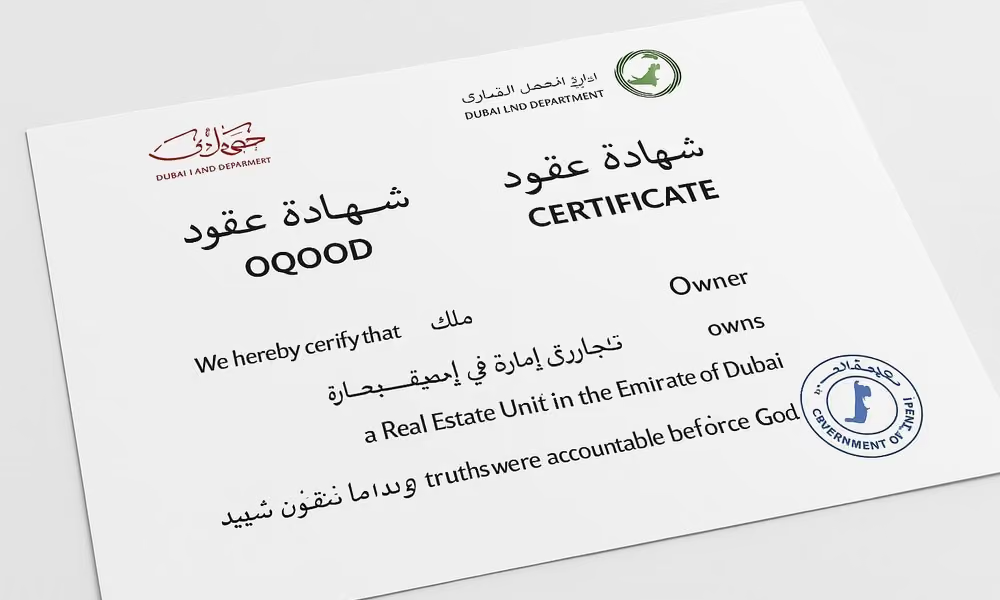
Off-plan property registered under Oqood (the Dubai Land Department's interim registration system for properties under construction) is a UAE asset. It has a registration number, a recorded owner, and a defined value. It can be included in a DIFC will just like any completed property with a title deed.
How to Include Oqood Property
- Specify the Oqood registration number in your will (found on your Oqood certificate)
- Describe the property by project name, unit number, and developer name
- Name your beneficiary and the share they receive
What Happens at Handover
When your off-plan property completes and the Oqood converts to a full title deed, your DIFC will continues to cover it automatically. The will references the property by its identifying details, and the Oqood-to-title-deed conversion does not change the underlying asset. You do not need to amend your will or pay any additional fees.
Why This Matters for Bond Enclave and Bond Living Buyers
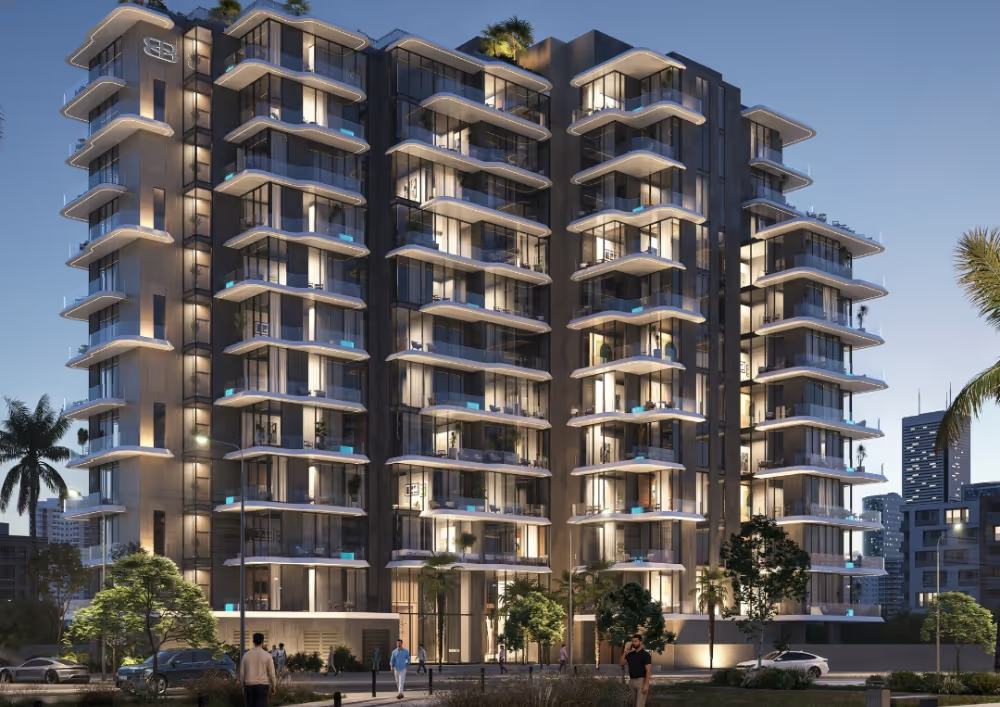
If you have purchased a unit in Bond Enclave (Arjan) or Bond Living (DLRC) and are awaiting handover, your Oqood-registered interest is already a UAE asset that should be covered by a will. Do not wait for handover to register your DIFC will. The risk exists from the moment you own the Oqood registration, not from the moment you collect your keys.
DIFC Wills vs Other Options
The DIFC Registry is not the only estate planning option for UAE property owners. Here is how it compares to the alternatives.
Legal system: DIFC Will uses English common law; Abu Dhabi JCC Will uses Abu Dhabi civil law; Dubai Courts Arabic Will uses UAE civil law; a home-country will varies by country.
Language: DIFC Will is in English; Abu Dhabi JCC Will is English/Arabic; Dubai Courts Arabic Will is Arabic only; a home-country will is in your local language.
Covers Dubai property: DIFC Will yes; Abu Dhabi JCC Will no (Abu Dhabi only); Dubai Courts Arabic Will yes; a home-country will not automatically.
Covers other emirates: DIFC Will yes (all UAE); Abu Dhabi JCC Will Abu Dhabi only; Dubai Courts Arabic Will Dubai only; a home-country will rarely.
Testamentary freedom: DIFC Will full; Abu Dhabi JCC Will full (non-Muslims); Dubai Courts Arabic Will limited; a home-country will full (typically).
Cost (single): DIFC Will AED 7,500-10,000; Abu Dhabi JCC Will AED 5,000-7,000; Dubai Courts Arabic Will AED 1,500-3,000; a home-country will varies.
Enforcement speed: DIFC Will 4-8 weeks; Abu Dhabi JCC Will 4-8 weeks; Dubai Courts Arabic Will 6-18 months; a home-country will 12-24+ months.
Guardianship provision: DIFC Will yes; Abu Dhabi JCC Will yes; Dubai Courts Arabic Will limited; a home-country will is not UAE-enforceable.
When DIFC Is the Best Choice
- You own property in Dubai and want English-language, common-law distribution
- You want full testamentary freedom (leave assets to whoever you choose)
- You want your will enforced quickly (4-8 weeks rather than 6-18 months through Dubai Courts)
- You own property across multiple emirates (DIFC covers all UAE)
- You have minor children and want to name a guardian under a legally enforceable framework
When Alternatives Make Sense
- Abu Dhabi JCC will: if your only UAE property is in Abu Dhabi and you do not own assets in other emirates
- Dubai Courts Arabic will: if you are comfortable with Arabic-language proceedings and your estate is simple
- Home-country will with UAE clause: only if drafted by a solicitor experienced in cross-border estates and specifically referencing UAE assets (still recommend a DIFC will as primary protection)
Common Mistakes That Undermine Your DIFC Will
A registered will is only as effective as its drafting. These are the errors that practitioners see regularly, and each one can cause delays, disputes, or unintended distribution.
1. Not Updating After Buying New Property
Your will covers the assets described in it. If you buy a second property after registration and do not add it to your will, that new property falls outside the will's scope and reverts to the default Sharia distribution. Every time you acquire a new UAE asset, review whether your will still covers it. If not, file an amendment (AED 1,500).
2. Naming Only One Executor
Your executor is the person who applies for probate and administers your estate. If you name only one executor and that person is unable to act (because they have died, become incapacitated, or simply cannot be located), the probate process stalls. Always name a substitute executor. Consider naming a professional executor service as backup.
3. Not Specifying Substitute Beneficiaries
What happens if your primary beneficiary predeceases you? Without a substitute beneficiary named in the will, that share becomes part of the residuary estate or triggers intestacy rules for that portion. Name at least one alternative for each major bequest.
4. Forgetting Jointly Owned Property
If you own property jointly with another person (for example, a spouse listed as co-owner on the title deed), your will only covers your share. The other owner's share is governed by their own will or intestacy rules. Make sure both owners have registered wills that align.
5. Assuming Your Home-Country Will Covers UAE Assets
This is the most dangerous assumption. A standard will drafted by a solicitor in the UK, India, Australia, or the US does not automatically extend to UAE-based assets. UAE courts will not enforce a foreign will without a lengthy and expensive ratification process. Even if your home-country solicitor has added a clause about overseas assets, the practical enforcement in Dubai Courts is unreliable. Register a DIFC will as your primary protection for UAE assets.
6. Leaving the Will in a Drawer Without Telling Anyone
Your executor needs to know that a DIFC will exists and where to find the registered copy. If nobody knows you registered a will, nobody will apply for probate under it. Instead, the default succession process begins through Dubai Courts. Inform your executor, your spouse, and your financial advisor that a DIFC will is registered in your name.
Expert Insights
Estate planning for UAE property is one of those areas where the cost of inaction massively exceeds the cost of action. A DIFC Property Will costs AED 7,500 once. The cost of not having one — measured in frozen assets, court fees, legal representation, family stress, and months of delay — routinely exceeds AED 50,000 and sometimes reaches six figures for larger estates. The calculation is not close.
For off-plan buyers specifically, the timing question matters. Your Oqood registration creates an immediate asset interest. If construction takes three years and something happens during that period, your family inherits a complex situation: an incomplete property, outstanding payment obligations, and no clear succession path. The best time to register your DIFC will is immediately after your Oqood is confirmed. The second-best time is today.
How much does a DIFC will cost in Dubai?
A DIFC Property Will costs AED 7,500 for a single registration or AED 10,000 for a mirror couple will. A Full Will (covering all UAE assets plus guardianship) costs AED 10,000 single or AED 15,000 for couples. Registration is a one-time fee with no annual renewal. Amendments cost AED 1,500 each. The probate grant fee at the time of execution is 0.5% of estate value, capped at AED 50,000.
Do I need a DIFC will for off-plan property?
Yes. Off-plan property registered under Oqood is a UAE asset from the moment of registration. If you die without a will while holding an Oqood certificate, that interest is subject to Sharia succession rules and asset freezing, exactly the same as completed property. Register your DIFC will as soon as your Oqood is confirmed, not after handover.
What happens to my Dubai property if I die without a will?
UAE courts apply Sharia succession law. Your spouse inherits 1/8 of the property value (if you have children) or 1/4 (no children). The remainder is distributed to children and parents per Sharia formula. All assets are frozen until the court process completes, typically 6-18 months. During the freeze, your family cannot sell, rent, or access the property.
Can Muslims register a DIFC will?
Yes. Muslim UAE residents can register DIFC wills. However, the distribution must comply with Sharia principles for portions involving Muslim beneficiaries. In practice, Muslim registrants use DIFC wills to ensure clear documentation and faster probate processing rather than to alter the Sharia distribution formula. The Registry accepts Muslim registrations but requires compliance with applicable succession rules.
How long does it take to register a DIFC will?
The full process from first contact to receiving your registered will certificate takes 2-3 weeks. This includes will drafting (1-5 days), booking an appointment (5-10 business days depending on availability), attending the signing (30-45 minutes), and processing (2-5 business days). If you use a ready-made template and secure an early appointment, the process can be completed in 10 days.
Does a DIFC will cover property in Abu Dhabi?
Yes. Despite being based in Dubai, the DIFC Wills Registry's jurisdiction covers assets across all UAE emirates, including Abu Dhabi, Sharjah, Ajman, and the northern emirates. You do not need a separate will for each emirate. A single DIFC Full Will or Property Will can cover your entire UAE property portfolio regardless of which emirate each property is located in.