Dubai Property Snagging Checklist 2026: What to Inspect Before & After Handover
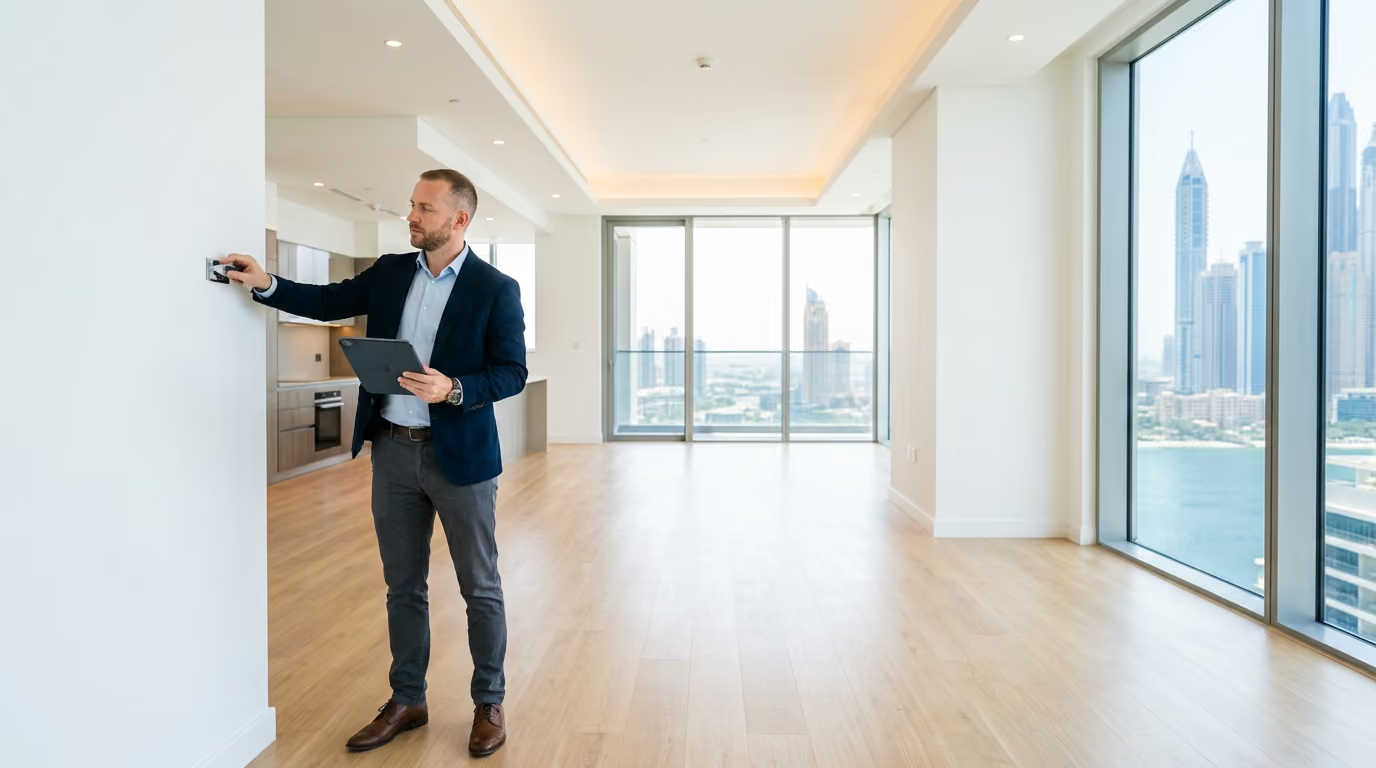
Property snagging in Dubai covers 30+ inspection points across entrance, living rooms, kitchen, bathrooms, balcony, and electrical systems. Professional snagging costs AED 500-1,200 and uncovers 25-35 defects per average apartment. The defect liability period covers mechanical issues for 12 months and structural defects for 10 years under UAE law.
Introduction
You've waited months—maybe years—for your off-plan property to be built. The developer says it's ready. But "ready" and "ready to move in" are two different things. That gap is where snagging comes in.
Property handover in Dubai is a milestone moment. It's also a critical decision point. What happens in the first 24 hours—whether you thoroughly inspect or simply accept the keys—can affect your living experience for the next decade. A small plumbing issue missed during snagging becomes a ceiling stain in the bedroom. A misaligned kitchen cabinet stays misaligned. Electrical outlets that don't work stay non-functional unless you fight for them later.
This checklist is built for everyone: first-time buyers, repeat investors, and overseas purchasers approaching handover. It's practical, legal, and non-negotiable. Consider it your systematic audit of what you've paid for.
What Is Property Snagging in Dubai? (And Why It's Non-Negotiable)
Property snagging is a systematic inspection to identify construction defects before or immediately after handover. It's not a casual walkthrough. It's a forensic audit of your unit's condition—walls, finishes, plumbing, electrical systems, appliances, and every fixture in between.
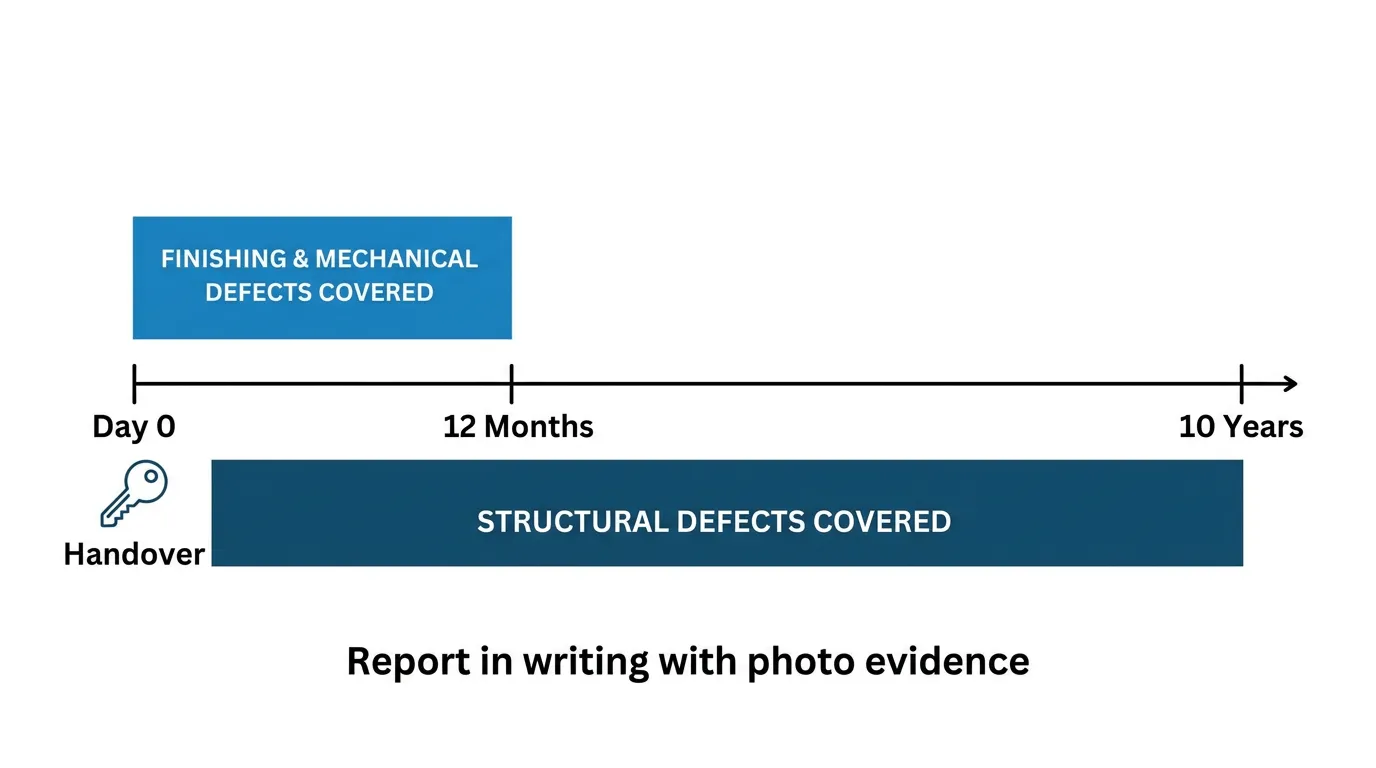
Under UAE property law, snagging is your legal right. Law No. 16 of 2007 (the Real Estate Law) and the Defect Liability Period framework make clear: developers are obligated to deliver defect-free properties. If defects exist, the developer must fix them during the defect liability period, which runs 12 months for most mechanical and finishing issues.
But developers can't fix what they don't know about. If you accept handover without documentation, you lose leverage. A defect found six months into occupancy—one that could have been caught at handover—is harder to attribute to construction. It becomes your problem, not theirs.
Skipping snagging costs more later. A professional inspection typically runs AED 500–1,200 for a standard apartment. Finding even one plumbing leak, electrical fault, or structural hairline crack pays for itself immediately. The return on investment is almost always positive.
When to Schedule Your Property Snagging Inspection
Timing matters. The ideal window is 1–2 weeks before your final handover date. This gives you enough time to raise issues with the developer before they legally hand over the keys, when they have the most incentive to cooperate.
Allow 3–4 hours minimum for a thorough inspection. If you rush, you'll miss problems. A typical two-bedroom apartment needs at least this window to check every outlet, tap, door, window, and surface.
Daylight hours are non-negotiable. Natural light reveals water stains, paint defects, and surface irregularities that artificial light masks. Schedule for morning or early afternoon, never at dusk.
Bring a second person. Two sets of eyes catch twice as much. One person photographs while the other notes defects. One person tests the shower while the other checks water pressure at the kitchen sink. Divisions of labor make the process faster and more thorough.
If you're an overseas investor without the ability to be present, hire a professional snagging company. The cost is low compared to the alternative: flying back to Dubai later to dispute a defect you should have caught at handover.
The Complete Dubai Property Snagging Checklist for 2026
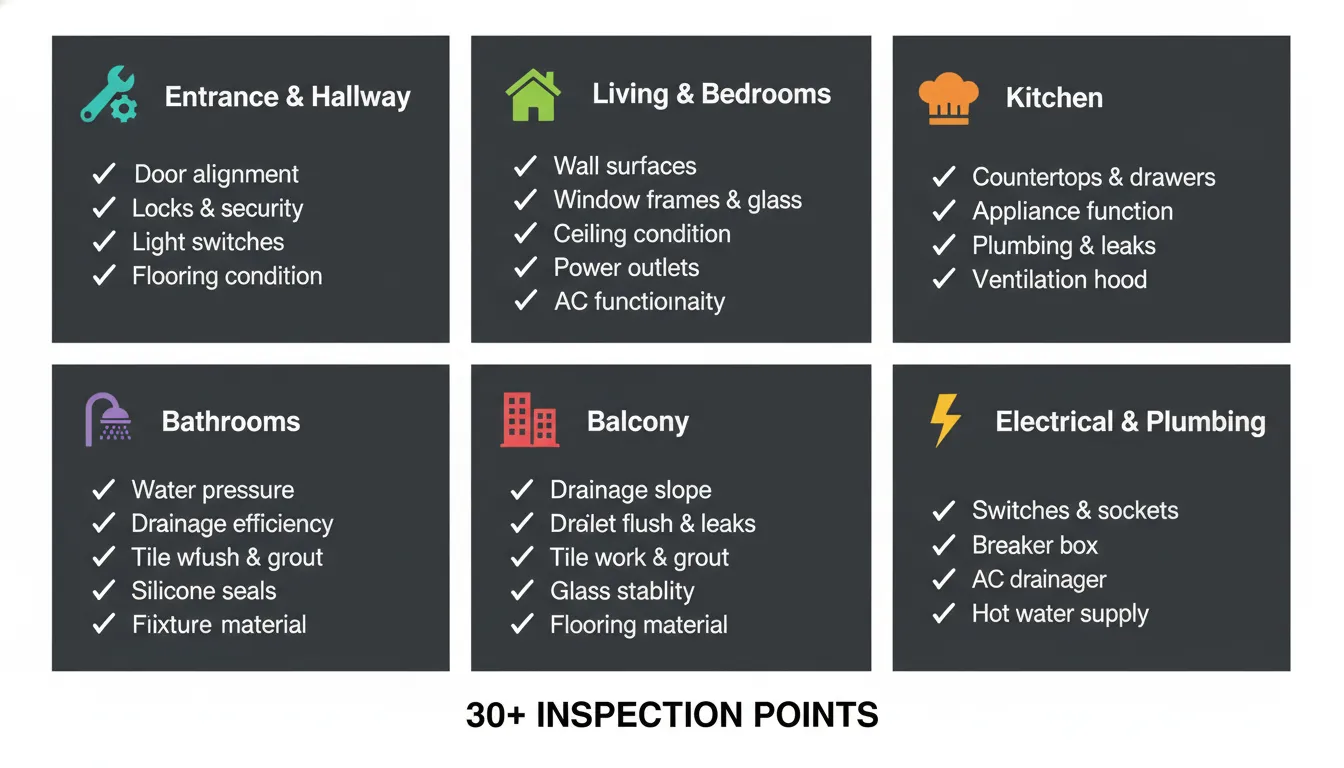
This checklist covers every room and system. Print it, bring it with you, and check off items as you go.
Entrance & Hallway
- Front door: Does it open and close smoothly? Test the lock mechanism multiple times. Check the handle for damage or poor installation. Is the peephole clean and functional? Run your hand along the door seal—should be smooth and consistent with no gaps.
- Doorframe: Look for scratches, scuffs, or areas where paint coverage is thin. Sight down the frame to check for warping. Gaps between frame and wall should be consistent on all sides.
- Light switches and outlets: Test every single one. Flip every switch. Plug a phone charger into every outlet. If it doesn't work, document it.
- Flooring: Walk the hallway and check for level surfaces. Look for chips, cracks, or grout lines that are inconsistent. If tiled, tap on a few tiles to check for hollowness (a sign of poor installation).
Living Room & Bedrooms
- Walls: Scan walls in raking light (stand to the side and look along the surface). Cracks, uneven paint, plaster bumps, and "screw pops" (where drywall fasteners protrude through paint) are common defects. Check corners and around outlet boxes.
- Windows: Open and close every window. They should move smoothly without resistance or squeaking. Check that locks engage properly. Close windows and look for light gaps around frames—drafts are not acceptable in finished units. Wipe the glass with your finger—it should be clean.
- Ceiling: Is it level? Walk around and look at shadows along the ceiling line. Water stains or discoloration are red flags. Check that light fixtures are flush against the ceiling (not recessed or protruding).
- Skirting boards: Look for gaps between skirting and wall or floor. Paint drips are common—these should be cleaned. Skirting should be aligned at corners without visible mismatches.
- Built-in wardrobes: Open and close every door multiple times. Doors should align perfectly. If soft-close hinges are specified, they must function. Check that shelves are level by placing a small object on each one. Hardware (handles, rails) must be secure and not loose.
- AC vents: Check positioning—vents should direct airflow into the room, not toward walls. Turn on the unit and listen for rattling. Feel airflow at the vent outlet. The room should cool within 15 minutes.
Kitchen
- Countertops: Run your hand along the surface. Look for chips, scratches, or areas where the finish is compromised. Check seam alignment—seams should be invisible or nearly so. Measure height consistency across the counter.
- Cabinets: Open and close every door. They should close smoothly and align perfectly. Check hinges—they should be tight and not rattle. If soft-close is specified, test it. Pull out each drawer and check that it glides smoothly.
- Sink: Turn on the tap and test water pressure in both hot and cold. Run water into the basin and check drainage speed. It should drain quickly without pooling. Open the cabinet below and look for water leaks or stains, which indicate slow drainage or a hidden plumbing issue.
- Appliances (if included): If the developer has installed an oven, hob, extractor hood, fridge, or dishwasher, test every function. Run the oven. Test the burners. Run the dishwasher on a cycle. These are warranty items, and any defect should be documented now.
- Splashback: Check tile alignment and grout consistency. Look for cracks, especially around the sink. Silicone seals around the splashback edge should be smooth and continuous with no gaps.
- Ventilation/hood: The extractor fan must work. Listen for unusual noises. Feel for airflow. If it's a ducted hood, check that there are no visible obstructions.
Bathrooms
- Water pressure: Turn on the hot and cold taps separately. Pressure should be consistent. If there's a shower, test pressure there too. Hot water should reach the tap within 60 seconds (if it's taking minutes, there's an issue with the hot water supply).
- Drainage: Fill the basin or tub completely. Drain it and watch the speed. It should empty within a few seconds without pooling. Do the same in the shower—water should drain, not accumulate around your feet.
- Toilet: Flush it multiple times. The mechanism should be smooth and complete. Sit on the seat and check that it's stable (not rocking). Look at the base where the toilet meets the floor—there should be no water pooling or seeping (a sign of a leak).
- Tiles: Look for cracks. Tap on tiles with your knuckle—if they sound hollow, the adhesive failed during curing. This is a defect. Check grout lines for gaps or missing grout.
- Silicone seals: Look around the tub, shower enclosure, and where the sink meets the wall. Silicone should be continuous with no gaps, voids, or mold (black spots). If seals are incomplete, water will get behind finishes and cause damage.
- Mirror and accessories: Check that soap dispensers, towel rails, and mirrors are secure. Try to wiggle them—there should be no movement.
- Ventilation: The extractor fan must work. If there's no extractor, that's a defect (adequate ventilation is a requirement). Listen and feel for airflow.
Balcony & External Areas
- Drainage slope: Pour a cup of water onto the balcony floor. Watch where it flows. It should migrate toward the drain, not pool in corners or low spots. Pooling water is a major defect because it leads to waterproofing failure.
- Railing: Lean against it firmly. It should not wobble or move. Check height—it should meet UAE building code (typically 1.1 meters). Look for damage, rust, or loose bolts.
- Glass: If the balcony has glazing, check for scratches, cracks, or poor sealing. Wipe your hand along the seal—it should be continuous.
- Flooring: Check for cracks, uneven surfaces, or areas where the finish is wearing. Balcony flooring is exposed to weather and must be durable.
- External walls: Look at the wall finish. Paint should have consistent coverage with no bare spots. Check for visible cracks or water stains running down the facade.
Electrical & Plumbing Systems
- Every switch, socket, and light: This deserves its own section. Go to each room and test every single switch and outlet. Use a simple device tester (most hardware stores sell them for under AED 50). If a light doesn't work, document it. If an outlet isn't powered, document it. Circuit labeling is a common issue—switches are often mislabeled, which creates confusion during move-in.
- Circuit breaker: Open the electrical panel (usually near the front door or in a utility area). Check that every breaker is labeled clearly. Test that the main breaker trips and resets properly (ask the developer to supervise this).
- Water heater: If there's a dedicated heater, check that it's operational. Set a temperature and wait for hot water to reach the taps. The thermostat should be responsive.
- AC system: This is critical. Turn on the unit in every room. Close the doors and wait 15 minutes. Every room should feel cool within this timeframe. If one bedroom stays warm while others cool quickly, there's an airflow problem that needs fixing.
- Hot water supply: Turn on the tap in the farthest bathroom from the heater. Time how long it takes for hot water to arrive. It should take no more than 60 seconds. Longer wait times indicate a plumbing layout or insulation issue.
How to Document Snagging Issues (The Right Way)
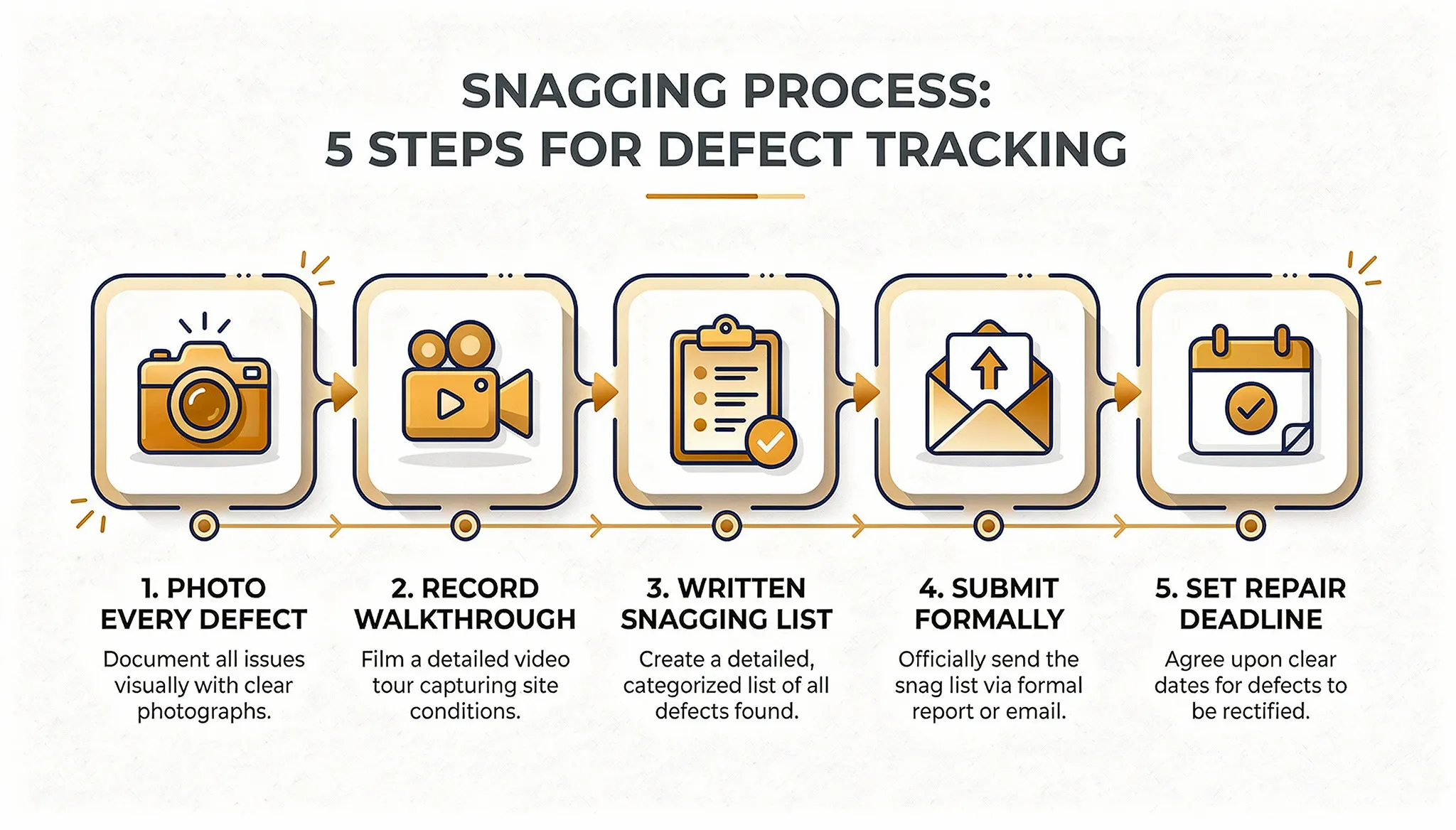
Documentation is everything. A defect without evidence is a dispute. A defect with clear documentation is a fix.
Photograph every defect. Use your phone camera and photograph from multiple angles. Include context shots (showing the location within the room) and close-up shots (showing the defect clearly). Enable timestamps on your camera—this becomes your legal proof of when the defect was observed.
Shoot video. Walk through each room with your phone camera rolling. Narrate what you're seeing: "Entering the master bedroom. Testing the air conditioning. AC vent positioned at the window. Fan is running. Temperature reads 22 degrees on the thermostat." Narration creates an unambiguous record.
Create a written snagging list. Format it like this:
Room: Master BedroomLocation: AC vent, exterior wall near windowDefect: Vent is positioned incorrectly and directs airflow toward the window wall instead of into the room. Room takes 25 minutes to cool instead of 15.Severity: Functional defectPhoto reference: IMG_001, IMG_002
Severity matters for prioritization. Cosmetic defects (paint touch-up, minor scuff) are lower priority. Functional defects (AC not cooling, outlet not working, tap leaking) are medium priority. Safety defects (exposed electrical wiring, unstable railing, cracked structural element) are critical and must be fixed immediately.
Submit formally to the developer. Email your snagging list and photos to the developer's defect reporting system (most developers have a portal) or send via email with a read receipt. Include the unit number, your name, contact information, and the date of inspection. Request acknowledgment within 48 hours.
Keep copies of everything. Screenshots of emails, PDFs of submitted lists, backups of photos. If a dispute arises later, you need to prove you reported the issue at the correct time.
Set a repair deadline. UAE law allows 30–60 days for repairs (depending on the developer's Daman guarantee terms). Be explicit: "Request completion of repairs by [specific date]."
Professional Snagging Companies in Dubai: Costs & What They Cover
If you're not comfortable conducting your own inspection, professional snagging companies exist for exactly this reason.
Cost: AED 500–1,200 for a standard two-bedroom apartment. Larger units or luxury properties run AED 1,200–2,500. This is a one-time fee.
What they check: Professional inspectors use a standardized checklist covering 200–400 inspection points. They bring specialized equipment: moisture meters (to detect hidden water damage), electrical testers, spirit levels, and thermal imaging cameras (to identify cooling inefficiencies or hidden moisture).
What you receive: A professional snagging report—typically a 10–30 page PDF with high-resolution photos, annotated diagrams, and a prioritized defect list. Severity levels are clearly marked. The report is formatted for submission to the developer.
When to hire:- You're an overseas investor who can't be present for handover.- You're a first-time buyer and want peace of mind.- The property is a luxury unit (villas, penthouses, complex finishes).- You're unfamiliar with Dubai construction standards.
ROI: Professional snagging typically uncovers 15–40 defects per unit in Dubai. If even one of those defects is a plumbing leak, electrical fault, or HVAC issue, the inspection cost is recouped immediately.
Finding statistics from recent Dubai developments show that approximately 30–35 snagging items are identified per average apartment. High-rise developments tend to average 25–30 items, while villa developments average 35–45 (due to more complex finishes and landscaping).
Defect Liability Period in Dubai: Your Legal Rights After Handover
Snagging doesn't end at handover. It extends into what's called the Defect Liability Period (DLP).
Duration and scope:- 12 months for mechanical defects (HVAC, plumbing, electrical), finishes (paint, tiles, flooring), and fixtures (doors, windows, handles, appliances).- 10 years for structural defects (foundations, load-bearing walls, waterproofing, concrete strength).
This is not the developer being generous. It's the law. RERA (Real Estate Regulatory Agency) enforces these timelines.
Developer obligations: During the DLP, the developer must repair defects at their cost and without charging you. If a tap leaks, they fix it. If the AC unit fails, they replace it. If tiles crack from poor installation, they re-tile. You don't pay.
How to report: Write a formal notice to the developer. Include:- Date of the defect discovery- Precise location within the unit- Description of the defect- Photos or video evidence- Request for repair with a reasonable deadline (typically 7–14 days for urgent issues, 30 days for non-urgent)
Send via email with read receipt or through the developer's online portal. Keep records.
What if the developer doesn't fix it: File a complaint with RERA. Include your evidence (photos, correspondence with the developer, the repair request). RERA has authority to compel repairs or issue financial compensation. If RERA mediation doesn't work, you can pursue legal action through the Dubai courts.
Why baseline documentation matters: This is why snagging at handover is so important. When you accept the keys, you're essentially saying "the unit is in acceptable condition as of [date]." If you document the unit's condition at handover via photos, video, and a professional snagging report, you have an ironclad baseline. Any defect that appears later can be traced to either construction (covered by DLP) or to post-occupancy damage (your responsibility).
Post-Handover: First 30 Days Checklist
Handover is the beginning, not the end. Your first 30 days involve administrative and functional tasks.
Register your title deed. Take your purchase agreement and handover document to the Dubai Land Department (DLD) to register ownership. This typically takes 1–3 days. You need this to prove legal ownership.
Set up DEWA account. Go to any DEWA office or apply online (dewa.gov.ae). Provide your title deed copy and ID. DEWA will assign meter numbers and calculate your first bill based on readings taken at handover.
Activate district cooling (if applicable). Some new developments use district cooling instead of individual AC units. Contact the district cooling company directly to activate service. You'll receive the first bill shortly after.
Set up internet and telecom. Contact Etisalat or du to activate home broadband. This can often be done online. Speeds and plans vary; compare options before committing.
Register your tenancy with Ejari, if renting out. If you plan to lease the unit rather than occupy it yourself, the tenancy contract must be registered before you can activate DEWA for the tenant or sponsor visas. See our Ejari registration guide for the full step-by-step process.
Get building access cards. Visit the building management office to request access cards for the main entrance, parking, and amenities. There's usually a small fee per card.
Review owners' association rules. Read the community rules carefully. They govern parking, pet policies, noise restrictions, and maintenance charges. Ignorance is no excuse for violations.
Take meter readings on day one. Record DEWA meter readings, cooling meter readings (if applicable), and any other utility meters. This becomes your baseline for determining your monthly usage and bills. Take photos of the meter displays.
Submit additional snagging items during move-in. You'll likely discover additional defects during the moving process—light switch issues that only show up when you flip multiple times, strange noises in the HVAC that only become apparent when you're living there. Document and submit these within the first week of occupancy, while they're still within the DLP window.
FAQ: Property Snagging in Dubai
What is property snagging and is it mandatory in Dubai?
Property snagging is the systematic inspection of a newly constructed or renovated property to identify defects before or after handover. It's not legally mandatory—no regulation says you must conduct snagging. However, it's strongly advised. Skipping snagging means accepting the property "as-is," which removes your leverage to demand repairs. From a practical standpoint, everyone should snag.
How much does professional snagging cost in Dubai?
Standard apartments: AED 500–1,200. Larger units or luxury properties: AED 1,200–2,500. The cost is a one-time fee that typically yields 15–40 identified defects. Most buyers find the ROI positive.
What is the defect liability period for new properties in Dubai?
12 months for mechanical, electrical, plumbing, and finish defects. 10 years for structural defects (foundation, load-bearing walls, waterproofing). The developer bears repair costs during this period under UAE Real Estate Law No. 16 of 2007 and RERA regulations.
Can I refuse handover if snagging issues aren't fixed?
Yes. If defects are safety-critical or make the unit uninhabitable, you can refuse handover. However, for cosmetic or minor functional issues, most developers request handover with the understanding that repairs will be completed within 30–60 days. Document everything in writing. If the developer consistently fails to honor repair timelines, escalate to RERA.
How many snagging items are normal for a new apartment in Dubai?
Data from recent Dubai developments suggest 25–35 items per average apartment is normal. This includes paint touch-ups, misaligned doors, missing fixtures, and minor electrical issues. 15–20 items is excellent. 40+ suggests construction quality issues. Zero items is virtually impossible—even luxury developments find 10–15 defects during professional inspections.
Choose Quality. Choose Pearlshire.
At Pearlshire, we don't just welcome snagging inspections. We encourage them.
Bond Enclave and Bond Living are designed and built to the highest standards—smart apartments with precision finishes, premium materials, and rigorous quality control. Our development process includes multiple inspections at construction stages. Our contractors are vetted and tracked. Our warranty coverage exceeds legal minimums.
That said, we expect you to snag. We want you to find zero defects, but we want you to look. Quality construction means transparency. It means inviting scrutiny and passing it. It means we're confident enough in our work to support your independent inspection and stand behind every unit.
If you're approaching handover at Bond Enclave or Bond Living, take this checklist with you. If you find snagging items, report them. We'll repair them quickly. If you want professional snagging, we'll support your choice and work with the inspector. Your new home is too important for shortcuts.
Explore Bond Enclave | Explore Bond Living