
Pet-Friendly Apartments in Dubai: Rules, Registration and Dog Parks (2026)

Table of contents
- Are Pets Allowed in Dubai Apartments?
- How to Rent Pet-Friendly Apartments in Dubai
- Dubai Municipality Registration and Banned Breeds
- Dubai Communities With a Dog Park
- Moving to Dubai with Pets: Import Rules
- FAQ: Pet Ownership in Dubai
When looking for pet-friendly apartments in Dubai, note there is no blanket ban on pets in apartments. Whether you can keep one depends on the landlord, the building and its owners association, so get permission in writing and add it to your tenancy contract before you sign. Dogs and cats must also be registered with Dubai Municipality, and some dog breeds are banned nationwide. Details are as of October 2026.
Finding a great apartment in Dubai is one challenge. Finding one that also welcomes your dog, cat or rabbit narrows the search. This guide covers what the rules say, how to check a building, how to register a pet, where Dubai's listed dog parks are and what moving to Dubai with a pet involves.
Are Pets Allowed in Dubai Apartments?
It depends on your building and your landlord. Property Finder (February 2026) reports that, for residential buildings, residents need permission from the property owner before keeping a pet. Buildings and communities can also set their own house rules, so the policy can differ from one tower to the next.
Here is what to check:
Landlord permission. Ask for it in writing, by email or in the contract. A verbal yes is hard to rely on later.
Building and owners association rules. Ask the building management or your agent for the pet rules: whether pets are allowed, any limits on size or number, any extra deposit, and where pets may go in common areas.
Breed rules. Federal law bans certain dog breeds (see the section on Dubai Municipality registration below).
Dubai Municipality registration. Dogs and cats must be microchipped, vaccinated and registered (see below).
How to Rent Pet-Friendly Apartments in Dubai
Step 1: Ask for the pet policy before you fall for the apartment. Contact the building management or your agent and ask: are pets allowed, are there size, weight or breed limits, and is an extra deposit required? Ask for the answer in writing.
Step 2: Get the landlord's permission in writing. An email or signed document stating which pet, and on what terms, is better than a verbal agreement.
Step 3: Add the pet to the tenancy contract. Dubai tenancy contracts can carry extra terms. Dubizzle explains that additional terms can be added through an addendum signed by both landlord and tenant. State the type and number of pets and any building rules or deposit that apply. For example: "The tenant may keep one dog, subject to Dubai Municipality regulations and building rules." Specific wording is clearer than "pets allowed".
Step 4: Make sure the contract is registered in Ejari. Registering a tenancy contract in Ejari is mandatory, and the landlord is responsible for registering it through the Dubai Land Department. Keep a copy of the registered contract and any addendum.
Step 5: Register your dog or cat with Dubai Municipality. See the next section.
Step 6: Follow the building rules. Ask what the building expects for leashes in common areas, cleaning up after your pet and noise. If a deposit applies, ask for the refund terms in writing.
Dubai Municipality Registration and Banned Breeds
Property Finder reports that dogs and cats in Dubai must be licensed, microchipped and vaccinated, and lists a registration fee of AED 10 for dogs and cats plus AED 50 per microchip, plus a knowledge and innovation fee and 5% VAT (February 2026). Gulf News (updated September 2024) describes the process:
1. Have your pet microchipped at a veterinary clinic. 2. Apply for registration through the Dubai Municipality website (dm.gov.ae) with UAE Pass, or at a clinic. 3. Bring the rabies vaccination record, your Emirates ID and proof of microchip. 4. Renew the registration tag every year when the rabies vaccination is renewed.
Fees change, so confirm the current amount on dm.gov.ae before you pay.
Banned breeds. Under Federal Law No. 22 of 2016, MOCCAE bans the import of these dog breeds: Staffordshire Bull Terrier, American Pit Bull Terrier, American Staffordshire Terrier, American Bully, Brazilian Mastiff (Fila Brasileiro), Argentinian Mastiff (Dogo Argentino), Tibetan Mastiff, Neapolitan Mastiff, French Mastiff (Dogue de Bordeaux), Boerboel, Bullmastiff, Cane Corso, Bully Kutta, Perro de Presa Canario and Japanese Tosa. The exception is dogs used as service animals, emotional support animals or for medical purposes under the regulating requirements. Check the current list before you move or buy a dog.
Dubai Communities With a Dog Park
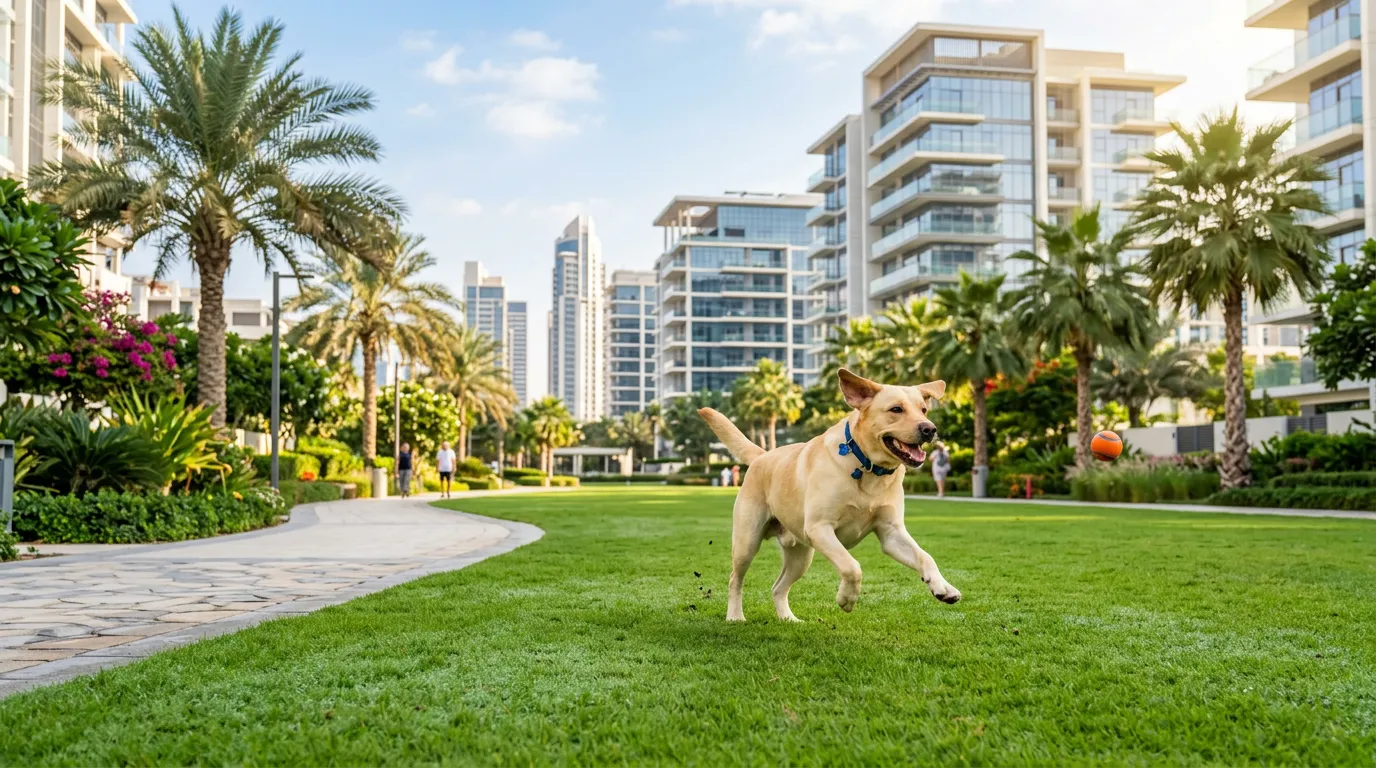
The dog parks below are named in Sotheby's International Realty Journal (June 2023) and Gulf News (updated August 2024). A dog park in a community says nothing about the pet policy of an individual building, so the building check above still applies.
| Community | Dog park named in the sources |
|---|---|
| The Springs | Springs Dog Park (Springs 8) |
| The Greens | The Greens Dog Park |
| Jumeirah Lake Towers | JLT Dog Park (near Cluster H) |
| JBR | JBR Dog Park (Sadaf) |
| Dubai Hills Estate | Dubai Hills Estate Dog Park |
| DAMAC Hills | DAMAC Hills Dog Park |
Gulf News also lists BarkPark in Al Awir, described as a large, fully enclosed off-leash area on a farm, and a leash-free dog area at Dubai Islands Beach. Check hours and rules with the operator before you go.
Arjan
The sources above do not list a dog park in Arjan, so check the pet rules of each Arjan building directly. Bond Enclave is Pearlshire's boutique development in Arjan.
Moving to Dubai with Pets: Import Rules
The official MOCCAE service page for importing cats and dogs sets these rules (as of October 2026):
Import permit. You must get an import permit through the MOCCAE website before shipping. The permit is valid for 90 days, and pets cannot be imported with an expired permit. The federal fee is AED 200 per animal for the permit, plus a release permit of AED 500 per dog or AED 250 per cat.
Limit. Individuals may import a maximum of 2 companion animals per year (2 cats, 2 dogs, or 1 of each), excluding resident animals returning to the UAE.
Microchip and papers. The animal needs a permanent microchip whose number matches the health certificate, a certified health certificate from the veterinary authority, and a vaccination document or passport.
Vaccinations. Dogs need rabies, canine distemper, canine parvovirus and infectious canine hepatitis (and leptospirosis unless replaced by a lab test). Cats need rabies, feline panleukopenia, rhinotracheitis and calicivirus. The first rabies vaccine must not be given before 12 weeks of age. Imports from countries classed as high risk also need a rabies antibody titration test.
Minimum age. 12 weeks from low-risk countries and 15 weeks from high-risk countries.
Parasite treatment. Preventive doses for internal and external parasites during the 14 days before shipment, stated in the health certificate or passport.
Shipping. Cats and dogs are shipped according to IATA conditions for pet animal transport. Pets that do not meet the import requirements are rejected at the owner's expense or confiscated.
Rules and the list of low-risk countries change, so check the MOCCAE page and your airline before you book.
FAQ: Pet Ownership in Dubai
Q: Are pets allowed in all Dubai apartments?
No. There is no blanket ban, but residents of residential buildings need the property owner's permission, and buildings can set their own pet rules. Ask for the policy in writing before signing a lease.
Q: Do I need a pet clause in my Dubai tenancy contract?
It is the clearest way to record the landlord's permission. Tenancy contracts can carry additional terms through a signed addendum, and the contract must be registered in Ejari. State the type and number of pets and any building rules.
Q: Do dogs and cats have to be registered in Dubai?
Yes. Dogs and cats must be licensed, microchipped and vaccinated, and registered with Dubai Municipality. The tag is renewed every year with the rabies vaccination.
Q: Can I move to Dubai with my pet from another country?
Yes, with a MOCCAE import permit, a microchip, a health certificate and vaccination records that meet the ministry's requirements. Individuals can import up to 2 companion animals per year.
Q: Are certain dog breeds banned in Dubai?
Yes. Federal Law No. 22 of 2016 bans several breeds, including American Pit Bull Terrier, American Bully, several mastiff types and Japanese Tosa, with exceptions for service, emotional support and medical dogs. Check the current list on the MOCCAE page.