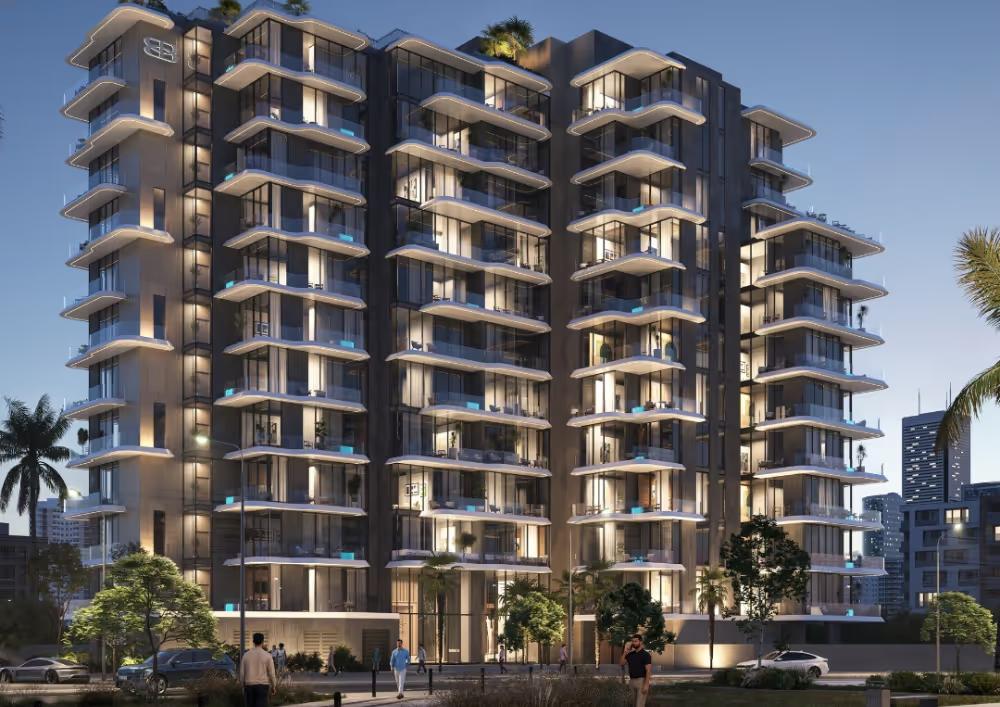
Buying Dubai Property With Crypto: What Is Actually Possible in 2026

Virtual assets such as Bitcoin are not UAE legal tender, and the Dubai Land Department currently lists dirham-denominated payment channels for property registration. In practice a crypto-funded purchase therefore requires an AED settlement route somewhere in the chain. Some developers accept crypto through regulated payment routes, and a separate VARA-licensed platform now lets UAE residents buy fractional shares of title-deeded Dubai property.
The question gets answered badly in both directions. One version says you can wire Bitcoin to a developer and receive a title deed. The other says crypto is banned. What actually exists is a regulated middle path, and the useful detail is where the conversion happens and why.
The legal position, stated precisely
Holding and conducting permitted activities involving virtual assets is not prohibited in the UAE, but virtual-asset services and payment activities are regulated and can require licensing. Separately, virtual assets are not legal tender.
The current federal framework is Federal Decree-Law No. 6 of 2025, which replaced the 2018 central bank law. Its definitions do the work: Currency means the State's official national currency in notes, coins and digital form, while Virtual Assets are defined as a digital representation of value or rights transferable and stored electronically using distributed ledger technology, expressly excluding currency issued in digital form. Article 54 makes currency notes and digital currency issued by the Central Bank legal tender.
Is there a rule requiring conversion to AED before registration?
This is worth being careful about, because it is widely stated as a legal requirement and we could not find a rule behind it.
There is no published Dubai Land Department circular or regulation saying crypto-funded purchases must be converted to AED before title registration. What exists is the DLD's current Property Sale Registration service, which lists ePay, Dubai Pay, Noqodi Wallet and manager's cheque as accepted payment methods, with fees denominated in dirhams and no virtual-asset payment method listed.
So the conversion is a consequence of two things together, the legal status of virtual assets and the DLD's payment infrastructure, rather than a command in a published rule. The practical outcome is the same. The reason matters if anyone tells you a different route exists.
Confirm the developer's current payment process, conversion mechanics and registration requirements before transferring any funds.
Who regulates what
VARA, established under Dubai Law No. 4 of 2022, is the sole authority regulating virtual assets across Dubai's mainland and free zones, except within the jurisdiction of the Dubai International Financial Centre, which has its own framework. VARA licenses virtual asset service providers: exchanges, custodians, brokers.
VARA regulates the virtual-asset side of a transaction. Real estate registration and title remain within Dubai's real-estate regulatory framework, including the Dubai Land Department. The two layers sit alongside each other rather than being wholly disconnected.
How a crypto-funded purchase can work
The exact route varies by developer and provider, but the shape is consistent:
- Confirm in writing that the developer currently accepts crypto and for which project.
- Confirm the licensed or approved payment provider handling the transaction.
- Complete KYC and source-of-funds checks.
- Agree the conversion and settlement mechanics, including when the rate is fixed and who bears exchange-rate risk.
- Payment is processed through the developer's accepted route.
- Complete the SPA, Oqood or title registration through the normal property framework.
Do Dubai developers accept cryptocurrency?
Some developers have announced crypto-payment arrangements through payment partners. Availability varies by developer, project, virtual asset and provider, and several widely repeated claims do not hold up when checked against the developers' own current sources.
As at September 2026, DAMAC maintains current published material on its own site referring to crypto property transactions. Other widely cited examples rely on older announcements or could not be confirmed from current developer sources.
The practical instruction is the same regardless: get written confirmation of the current payment route from the developer before transferring anything.
Does the DLD accept crypto for government fees?
Not as at September 2026. The DLD signed a memorandum of cooperation with Crypto.com in July 2025 framed around exploring potential use, and conducted a pilot in October 2025 which the DLD itself described as testing in a secure environment prior to official launch in the future. The settlement in that pilot was in UAE dirhams. The payment methods currently listed for property registration remain the four dirham channels above.
Source of funds and AML
Real-estate professionals in the UAE are subject to anti-money-laundering and counter-terrorist-financing obligations. Crypto-origin funds can require detailed source-of-funds and transaction documentation. Expect to provide wallet and exchange records, transaction histories, and evidence of how the virtual assets were acquired and converted.
On the figure that circulates: AED 55,000 is real, but it is narrower than usually described. It comes from a UAE Ministry of Economy circular requiring brokers and agents to file a Real Estate Activity Report through the goAML platform on freehold sale and purchase transactions in three cases: cash transactions at or above AED 55,000 for all or part of the property value, transactions where the payment method is virtual assets, and transactions where funds are converted from virtual asset into cash. Note the second case has no monetary floor at all.
That threshold is a reporting trigger, not the boundary of AML obligations. Suspicious transaction reporting applies regardless of value. Customer due diligence applies to real estate brokers and agents without a monetary threshold. Enhanced due diligence, record retention and goAML registration carry no threshold either. Below AED 55,000 a broker escapes one filing, not the regime.
The governing instruments are Federal Decree-Law No. 10 of 2025 and Cabinet Resolution No. 134 of 2025, which replaced the 2018 and 2019 framework.
Crypto-funded purchase versus tokenised property
These are two different products and they get conflated constantly.
- Crypto-funded conventional purchase: you acquire a conventional unit and ultimately receive the applicable ownership and registration documentation for that whole property.
- Tokenised property: you acquire a fractional interest through a regulated tokenisation structure. This is not the same transaction as buying an apartment from a developer using Bitcoin.
What is Prypco Mint?
A real estate tokenisation platform launched by the Dubai Land Department in May 2025, built with Ctrl Alt on the XRP Ledger, operating under a VARA broker-dealer licence. It fractionalises title-deeded Dubai properties.
Current position as at September 2026, and several commonly quoted details have moved:
- Eligibility is Emirates ID holders only, aged at least 21. The age floor was 18 earlier in 2026 and has since risen. International investors cannot currently access the real estate product.
- Registration on the Dubai REST app is required.
- Phase II went live on 20 February 2026, activating secondary-market resale of approximately 7.8 million tokens within a controlled pilot framework, with listings within 15% of the latest DLD valuation and a three-month lock-in from purchase.
- Ten properties have been tokenised, representing AED 18.5 million. No official figure dated after February 2026 exists, and all ten listings currently show as funded.
The DLD stated in March 2025 that tokenised real estate could reach AED 60 billion by 2033, around 7% of Dubai's property transactions. That is a stated long-term projection rather than a guaranteed market outcome, and it has not been revised. Separately, the latest official platform figure identified for Prypco Mint remains AED 18.5 million across ten tokenised properties.
Residency and funding source
Using crypto-origin funds does not by itself create a separate property-visa category. Eligibility is assessed under the applicable property-investment residency criteria once the qualifying ownership and other requirements are satisfied. AML and source-of-funds requirements still apply to the transaction. See our Golden Visa property guide for the current thresholds.
Volatility and settlement risk
Crypto prices can move materially during a property transaction. Before committing, establish when the conversion rate is fixed, who bears exchange-rate risk between agreement and settlement, and whether the developer or payment provider imposes settlement deadlines or conversion fees. Those three answers determine your actual exposure far more than the headline price does.
Can I buy Dubai property with cryptocurrency?
Some developers accept crypto through payment providers. Virtual assets are not UAE legal tender and the Dubai Land Department's published property-registration payment channels are dirham-denominated, so in practice the purchase requires an AED settlement route before completing registration. Confirm the current route with the developer in writing.
Is there a law requiring conversion to AED?
We found no published DLD rule requiring it. The need for an AED settlement route follows from virtual assets not being currency under Federal Decree-Law No. 6 of 2025, combined with the DLD currently listing ePay, Dubai Pay, Noqodi Wallet and manager's cheque as its registration payment methods.
Does VARA regulate property transactions?
No. VARA regulates virtual-asset activities and service providers across Dubai mainland and free zones except the DIFC. Property registration and title remain with the Dubai Land Department.
Do I need to prove where my crypto came from?
Yes. Crypto-origin funds can require detailed source-of-funds and transaction documentation, and brokers must file a Real Estate Activity Report on any freehold transaction where the payment method is virtual assets, with no monetary floor on that trigger.
What is the AED 55,000 threshold?
It is a Ministry of Economy circular trigger for filing a Real Estate Activity Report on cash freehold transactions. It is not a statutory figure and it does not mean no checks apply below it. Suspicious transaction reporting and customer due diligence carry no threshold.
Can international investors use Prypco Mint?
Not for the real estate product. Access is currently limited to Emirates ID holders aged 21 and over, with Dubai REST registration required.
Does buying with crypto affect residency eligibility?
Funding source does not create a separate visa category. Eligibility is assessed against the applicable property-investment criteria once qualifying ownership is established, and AML requirements still apply.