Branded Residences Dubai 2026: Worth the Premium?
Branded residences in Dubai command a 25% to 45% price premium over comparable non branded properties. Hotel branded residences (Four Seasons, Dorchester, Bulgari) typically sit at the higher end, while designer branded projects offer similar lifestyle positioning at a lower entry point. Dubai leads globally with over 70 branded residence projects as of 2026.
The term "branded residence" gets thrown around loosely in Dubai. Developers slap a luxury name onto a tower and suddenly everything from the lobby marble to the payment plan carries a premium. But the branded residence market in 2026 is more nuanced than that, and if you are spending anywhere from AED 1.5 million to AED 50 million on a home, you deserve a clearer picture of what you are actually buying.
Dubai now has over 70 branded residence projects either completed or in development, more than any other city in the world. That number alone should raise questions. Not all branded residences are created equal, and the gap between a genuine hotel managed property on Palm Jumeirah and a loosely affiliated designer label in a secondary location is vast. This guide breaks down the differences, the real costs, and who these properties actually serve.
1. What Are Branded Residences and Why Does Dubai Lead the World?
A branded residence is a privately owned property that carries the name, design standards, and often the operational oversight of an established brand. That brand might be a five star hotel group like Four Seasons or Dorchester Collection, a fashion house like Cavalli or Missoni, or a design studio creating a lifestyle identity from scratch.
The concept started in the 1920s with the Sherry Netherland in New York, but Dubai turned it into an industry. The city's combination of tax free ownership, high rental demand, a transient population that values turnkey luxury, and developers competing on brand cachet has made it the global capital for branded living. By mid 2026, Dubai accounts for roughly 15% of the world's entire branded residence inventory.
What makes a branded residence different from simply buying a premium apartment? Three things. First, there is a contractual relationship between the developer and the brand that governs everything from interior finish standards to common area maintenance. Second, the brand typically provides ongoing management or quality oversight after handover. Third, the brand's reputation is, at least in theory, a guarantee that design and service standards will hold.
The operative phrase there is "at least in theory." The strength of that guarantee depends entirely on which brand is behind it and how deep the partnership runs. A Four Seasons Private Residence with full hotel integration is a fundamentally different product from a fashion branded tower where the label's involvement ended at the mood board stage. Understanding that spectrum is the starting point for making an informed decision.
2. Hotel Branded vs Designer Branded: What Is the Difference?
The branded residence market in Dubai splits into three distinct categories, and each one delivers a different value proposition.
Hotel Branded Residences
These are properties developed in partnership with established hotel groups. Four Seasons, Dorchester Collection, St Regis, Bulgari, and The Lana by Dorchester Collection on Bluewaters are prime examples. The defining feature is operational integration. Residents typically have access to hotel services: concierge, housekeeping, valet, spa, dining. The hotel brand manages common areas and, in many cases, offers a rental management program for owners who want yield without the hassle.
The premium is highest here, often 35% to 45% above comparable non branded properties in the same location. You are paying for service infrastructure, brand consistency, and the ability to rent through the hotel's own distribution network. These properties tend to cluster in prime locations: Palm Jumeirah, Downtown Dubai, DIFC, and Dubai Marina.
Designer Branded Residences
Fashion and design houses entered the Dubai market aggressively over the past decade. Missoni, Roberto Cavalli, and Armani Casa have all lent their names and design sensibilities to residential towers. The brand involvement here is primarily aesthetic: curated interiors, bespoke material palettes, and a design narrative that runs through the entire building.
What you generally do not get is ongoing hotel style service. There is no concierge picking up your dry cleaning or a Michelin starred restaurant in the lobby. The premium is lower, typically 25% to 35%, and the target buyer is someone who values design provenance over operational luxury. These projects work well in emerging luxury corridors where the brand name helps anchor the building's identity in a developing neighbourhood.
Lifestyle Branded Residences
This is the newest and fastest growing category. Rather than borrowing an existing name from hospitality or fashion, these projects create a dedicated lifestyle brand built around a specific design philosophy and living experience. The brand is conceived specifically for residential living, not adapted from hotels or handbag lines.
The advantage is focus. A lifestyle brand designed for residences does not carry the operational overhead of a hotel or the aesthetic constraints of a fashion label. It can deliver design quality and lifestyle amenities at a more accessible price point, which matters in locations outside Dubai's ultra prime corridor. Bond Residences by ZN|ERA is a clear example of this approach, and we will examine it in detail later in this guide.
3. How Much More Do Branded Residences Cost in Dubai?
Let us put actual numbers on the premium. The table below compares branded and non branded properties across the metrics that matter to both investors and end users.
| Metric | Branded Residence | Non Branded Equivalent | Difference |
|---|---|---|---|
| Price Premium | AED 1,800 - 4,500/sqft | AED 1,200 - 2,800/sqft | +25% to 45% |
| Gross Rental Yield | 5.5% - 7.2% | 6.0% - 8.5% | -0.5% to -1.3% |
| Capital Appreciation (3yr) | 18% - 32% | 12% - 22% | +6% to +10% |
| Resale Liquidity | High (branded demand) | Moderate | Faster resale |
| Annual Maintenance (per sqft) | AED 18 - 35 | AED 12 - 20 | +40% to 75% |
| Management Fees | 2% - 5% of rental income | 0% - 2% | +2% to 3% |
The numbers tell a clear story. Branded residences cost more to buy and more to run. But they also appreciate faster and sell quicker. The question is whether the delta justifies the entry price, and that depends entirely on what you are optimizing for.
If you are a pure yield investor looking for cash on cash return, a non branded apartment in Business Bay or JVC will outperform most branded properties on annual rental yield alone. Branded residences are not yield plays in the traditional sense. They are capital appreciation and lifestyle plays, and they work best for buyers who plan to hold for three to five years and who value the quality of ownership experience alongside the financial return.
4. What Do You Actually Get for the Premium?
Beyond the price tag, the tangible benefits of a branded residence vary significantly by category. Here is what the premium typically covers.
For Hotel Branded Properties
- Access to hotel amenities: pool, gym, spa, restaurants, business centre
- Dedicated concierge and housekeeping services
- Professional rental management through the hotel's booking network
- Consistent maintenance of common areas to hotel standards
- Brand recognition that supports resale value globally
For Designer Branded Properties
- Interiors designed by an internationally recognized design house
- Custom finishes, fixtures, and material selections not available in standard projects
- Curated common areas with distinctive design identity
- Brand association that differentiates the project in the market
For Lifestyle Branded Properties
- Purpose built amenities designed around how residents actually live
- Design standards that prioritize function and daily experience
- Community programming and lifestyle management
- Lower operational overhead passed on as lower service charges
The key distinction is between brand involvement that touches daily life and brand involvement that stops at the front door. A hotel branded residence gives you services you use every day. A designer branded residence gives you a beautiful space to live in. A lifestyle branded residence tries to deliver both, calibrated for people who live in their homes rather than visit them between trips.
5. Do Branded Residences Deliver Better ROI?
This is the question every investor asks, and the honest answer is that it depends on your time horizon and your definition of ROI.
On pure rental yield, branded residences typically underperform. The higher purchase price dilutes the return, even when rental rates are above market. A branded one bedroom in Downtown Dubai might rent for AED 130,000 annually while a comparable non branded unit achieves AED 105,000. But the branded unit costs AED 2.2 million against AED 1.5 million for the non branded one. The math favours the cheaper asset if yield is your only metric.
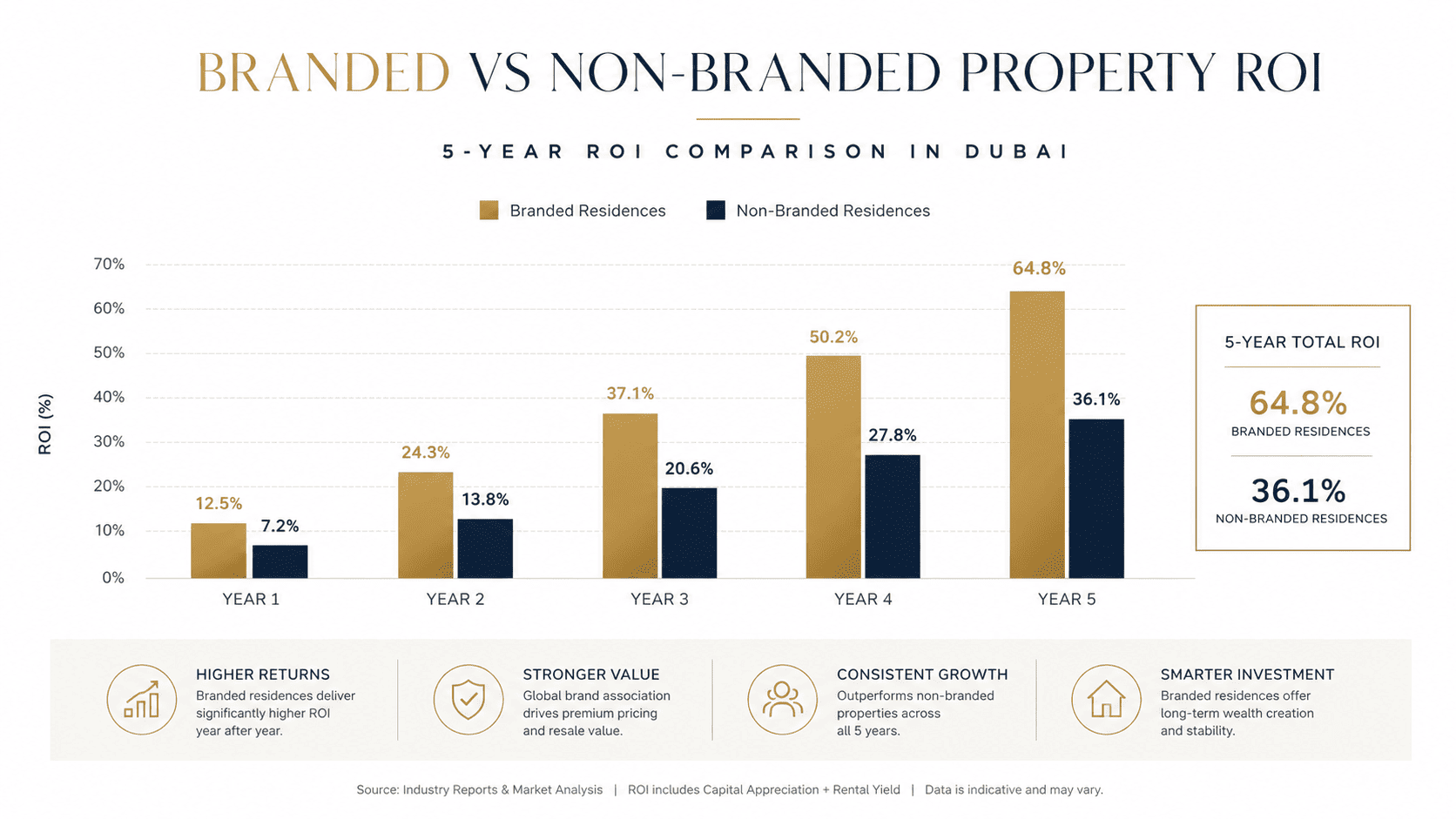
Where branded residences outperform is capital appreciation. Between 2022 and 2025, branded properties in prime Dubai locations appreciated 28% on average, compared to 19% for non branded equivalents in the same areas, according to Knight Frank's 2025 Branded Residences Report. That gap widens in downturns. Branded properties held value 12% to 15% better during Dubai's 2019 to 2020 correction than comparable non branded stock.
Resale liquidity is another advantage that is hard to quantify but real. Branded units in well located projects sell 30% to 40% faster than non branded equivalents. For an investor who needs to exit, that speed has monetary value, particularly in a market as cyclical as Dubai.
The total return picture, combining rental income, capital appreciation, and liquidity premium, generally favours branded residences over a five year hold period. Over shorter periods, the higher entry cost can eat into returns. This is not a flip play.
6. Which Branded Residence Projects Are Launching in 2026?
The pipeline for 2026 is stacked. Dubai's branded residence inventory is growing faster than any other global market, and this year's launches span every category and price bracket. Here are the notable projects.
| Project | Brand Type | Location | Price Range | Completion |
|---|---|---|---|---|
| Dorchester Collection | Hotel | Business Bay | AED 5M - 40M | Q4 2027 |
| Four Seasons DIFC | Hotel | DIFC | AED 8M - 55M | Q3 2027 |
| Bulgari Lighthouse | Hotel | Jumeirah Bay | AED 15M - 80M | 2028 |
| Cavalli Tower | Designer | Dubai Marina | AED 2M - 12M | Q2 2026 |
| Missoni Residences | Designer | Business Bay | AED 1.8M - 8M | Q1 2027 |
| Bond Enclave | Lifestyle | Arjan | AED 1,149,777 to 2.5M | 30th November 2027 |
| Bond Living | Lifestyle | DLRC | AED 773,000 to 2.5M | 30th September 2028 |
| St Regis Residences | Hotel | Palm Jumeirah | AED 6M - 35M | 2028 |
What is notable about this list is the price spread. The top end, Bulgari and Four Seasons, starts where most investors stop counting. The middle tier of designer branded projects clusters in the AED 2 to 12 million range. And the lifestyle branded category opens up branded living at accessible entry points. That diversification is new. Five years ago, branded residence meant paying north of AED 3 million. The market is evolving.
7. The Rise of Designer Branded Residences in Dubai
Designer branded residences exploded in Dubai between 2020 and 2025. The appeal is straightforward: buyers get a design pedigree and a story to tell without the ongoing service charges that hotel branded properties carry. A Cavalli Tower apartment comes with interiors influenced by the fashion house's signature aesthetic, custom lobby installations, and branding throughout the common areas. The lifestyle is aspirational but the operational model is closer to a standard luxury development.
The challenge with designer branded residences is longevity. Fashion brands operate on seasonal cycles. What feels cutting edge at launch can feel dated in five years, and the brand's involvement in ongoing maintenance or design updates is often limited by contract. The initial design package is typically frozen at handover, meaning common areas age according to the developer's budget, not the brand's standards.
That said, the market has responded well. Designer branded units in Dubai Marina and Business Bay have outperformed non branded stock on both rental yield and capital appreciation. The brand name attracts a specific buyer profile, typically younger, design conscious, and willing to pay for differentiation. For developers, the economics work because the brand licensing fee is a fraction of the premium they can charge per square foot.
The question for buyers is whether the premium you pay for a designer label delivers proportional value compared to a well designed, unbranded luxury project. In many cases, the interiors in a premium non branded development are comparable in quality. What you are really buying is the narrative, and in a resale market where buyers make emotional decisions, that narrative has measurable value.
8. Bond Residences: A New Category of Branded Living
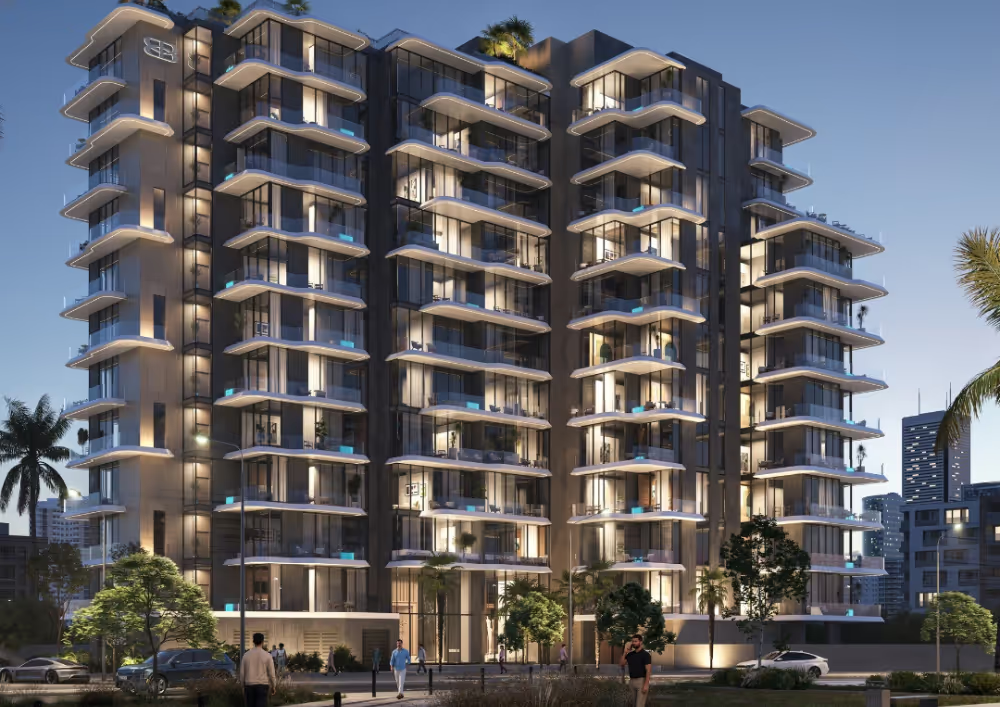
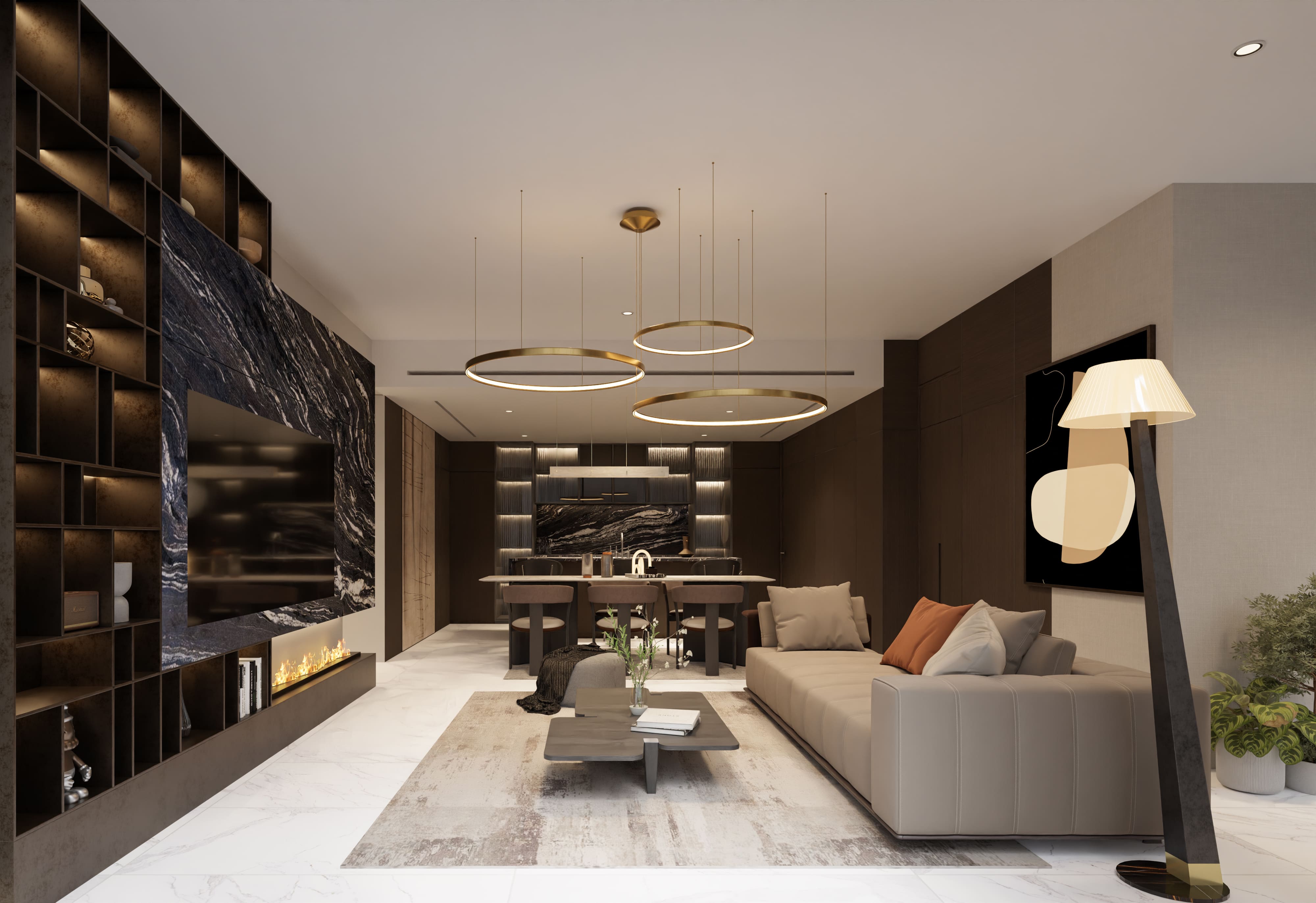
Bond Residences represents something genuinely different in Dubai's branded landscape. Rather than licensing an existing name from hospitality or fashion, Bond was conceived from the ground up as a residential brand by ZN|ERA, a design studio whose focus is creating spaces built around how people actually live.
The approach flips the traditional branded residence model. Instead of starting with a hotel's service framework or a fashion house's visual identity and adapting it to residential living, Bond starts with the resident. The design philosophy centres on daily rituals, movement through space, and the balance between private retreat and communal experience. Every material choice, layout decision, and amenity placement is filtered through that lens.
Two projects are currently in development, each serving a distinct market position.
Pearlshire Spotlight: Bond Enclave | Arjan
158 branded residences designed by ZN|ERA
Location: Arjan, one of Dubai's fastest growing residential corridors
Payment Plan: 30/70 with 4% DLD waiver
Completion: 30th November 2027
Studios, 1BR, and 2BR configurations
Rooftop infinity pool, co-working lounge, wellness studio, outdoor cinema
Starting prices from AED 1,149,777
Explore Bond Enclave: pearlshire.com/bondenclave
Bond Enclave positions itself at the intersection of branded design and accessible pricing. The 30/70 payment plan with a 4% DLD waiver reduces the cost of entry significantly, a structure that hotel branded properties at double or triple the price point rarely offer. The Arjan location matters here: it sits within one of Dubai's most active development zones with strong rental demand from professionals working in nearby Business Bay, Motor City, and Dubai Sports City.
Pearlshire Spotlight: Bond Living | Dubai Land Residence Complex (DLRC)
94 branded residences
Location: DLRC, a rapidly developing residential community
Payment Plan: 30/70
Completion: 30th September 2028
Thoughtfully designed studios and 1BR layouts
Community pool, fitness centre, landscaped gardens, smart home integration
Starting prices from AED 773,000
Explore Bond Living: pearlshire.com/bondliving
Bond Living takes the branded concept into DLRC, an area that has seen over 40% year on year growth in transaction volume. The 30/70 payment plan spreads the financial commitment further post handover, which appeals to both end users and investors who want to manage cash flow. The smaller unit count, 94 residences, means a more intimate community and better control over the living experience.
What both projects share is a commitment to design quality that typically costs more in other branded frameworks. Because Bond does not carry the licensing overhead of a hotel or fashion brand, the savings flow into better materials, more thoughtful layouts, and lower ongoing management fees. For buyers priced out of hotel branded residences but unwilling to settle for generic developer spec, this is a category worth examining closely.
9. How to Evaluate a Branded Residence Before Buying
Not all branded residences are worth their premium. Here is a framework for evaluating any branded property, whether it carries a five star hotel name or a lifestyle brand.
Check the Brand Agreement
Ask to see the actual agreement between the developer and the brand. How long does the brand commitment run? Is it 10 years, 20 years, or perpetual? What happens when it expires? Some agreements allow the developer to drop the brand name after a set period, which can affect resale value and service quality.
Evaluate Ongoing Involvement
There is a significant difference between a brand that manages the property post handover and one that approved the design package and moved on. Ask specifically what the brand will be responsible for after you receive your keys. If the answer is nothing, you are paying a premium for a logo, not an experience.
Compare Service Charges
Hotel branded residences carry meaningfully higher service charges because they maintain hotel level infrastructure. Get the projected annual service charge per square foot and compare it against the services included. A charge of AED 30 per square foot is reasonable if it includes concierge, housekeeping, and facility management. It is excessive if it covers basic maintenance only.
Assess Location Independently
A brand name does not override a weak location. A Four Seasons residence in DIFC benefits from the brand and the address. A designer branded project in a developing area needs the location fundamentals, schools, retail, transport links, to support the premium independently. Do not assume the brand compensates for infrastructure gaps.
Review the Payment Plan Structure
In Dubai's off plan market, the payment plan is as important as the sticker price. A 20/80 plan gives you significant leverage but concentrates risk at handover. A 60/40 plan reduces completion risk but ties up more capital during construction. The structure should match your financial position and investment timeline.
10. Is a Branded Residence Right for You?
After all the analysis, this is the question that matters. Branded residences are not universally better investments. They are a specific product for specific buyers, and understanding where you fall on that spectrum determines whether the premium is money well spent or money wasted.
A Branded Residence Makes Sense If...
- You plan to hold for three years or more and prioritize capital appreciation over yield
- You value design quality and are willing to pay for spaces that feel intentionally crafted
- You want a turnkey ownership experience without managing renovations or finding tenants yourself
- You are buying a home, not just an asset, and the living experience matters to you
- You want stronger resale liquidity when you eventually exit
A Branded Residence May Not Be Right If...
- You are optimizing purely for rental yield and short term cash flow
- You plan to flip within 12 to 18 months
- You are uncomfortable with higher service charges and management fees
- The brand name matters more to you than the actual product quality
Dubai's branded residence market has matured beyond the point where a luxury name alone justifies a premium. The best branded properties in 2026 deliver measurable value through design quality, operational excellence, and financial performance. The worst simply charge more for the same product with a nicer logo in the lobby.
Do your due diligence. Compare the branded premium against what you are actually getting. And if you find a project where the brand, the design, the location, and the financials all align, you are looking at one of the strongest asset classes in Dubai real estate.
1. What makes a residence "branded" in Dubai?
A branded residence is a privately owned property that operates under a formal agreement with an established brand. That brand contributes design standards, quality specifications, and often ongoing management or service delivery. The brand name is contractually tied to the project and typically governs everything from interior finishes to common area maintenance. In Dubai, the branding partner can be a hotel group, a fashion house, or a purpose built lifestyle brand.
2. Do branded residences come fully furnished?
It depends on the project and the brand. Hotel branded residences often include full furnishing packages as standard, since the units may feed into the hotel's rental pool. Designer branded residences sometimes offer furnished options but frequently deliver a finished shell with branded kitchen and bathroom specifications. Lifestyle branded residences vary, some include furniture packages while others provide a specification that meets brand standards with the flexibility for owners to customize.
3. Can I rent out my branded residence on Airbnb?
Many branded residences allow short term rental, but the mechanism varies. Hotel branded properties typically route rentals through the hotel's own booking system rather than third party platforms like Airbnb. Designer and lifestyle branded residences may permit Airbnb rentals subject to Dubai's short term rental regulations, which require a DTCM permit. Check the community rules and the brand agreement before assuming short term rental is available.
4. What are the management fees for branded residences?
Management fees for branded residences in Dubai range from 2% to 5% of rental income for hotel branded properties and 0% to 2% for designer or lifestyle branded projects. Hotel branded fees are higher because they cover hotel grade services like concierge, housekeeping, and facility management. Some properties charge a flat annual fee per square foot instead. Always ask for a detailed breakdown before purchase to understand exactly what the fee covers.
5. Do branded residences hold value better than regular apartments?
Historically, yes. Data from Knight Frank and Savills shows branded residences in Dubai experienced 6% to 10% higher capital appreciation over three year periods compared to non branded equivalents in the same locations. They also demonstrated 12% to 15% better value retention during the 2019 to 2020 market correction. The brand name creates a perception of quality that supports pricing during downturns and drives premiums during upswings.
6. Are branded residences available off plan in Dubai?
Yes. The majority of branded residences currently entering the Dubai market are sold off plan, meaning you purchase before construction is complete. This is standard practice in Dubai and offers access to developer payment plans, lower entry prices compared to completed inventory, and the potential for capital appreciation during the construction period. Bond Enclave and Bond Living, for example, are both available off plan with structured payment plans.
7. What is the difference between a branded residence and a serviced apartment?
A branded residence is a property you own outright, with freehold or leasehold title. A serviced apartment is typically a rental product managed by a hospitality company. While some branded residences include hotel style services, you hold the title deed and can sell, rent, or occupy the property as you choose. Serviced apartments offer flexibility without ownership. The investment profile, tax implications, and lifestyle experience are fundamentally different.
8. How do I finance a branded residence in Dubai?
UAE residents can typically finance up to 80% of a completed branded residence's value through a local mortgage. Non residents can access financing up to 50% to 60% from select banks. For off plan branded properties, most buyers use the developer's payment plan during construction and arrange a mortgage at handover. Interest rates in the UAE currently range from 4.5% to 6.5% depending on the lender and term. Some branded developers, particularly those offering 60/40 or 40/60 plans, reduce the immediate need for mortgage financing by spreading payments across the construction and post handover periods.
9. What are the best areas for branded residences in Dubai?
The highest concentration of branded residences is on Palm Jumeirah, Downtown Dubai, and DIFC, which are also the most expensive. Dubai Marina and Business Bay offer strong branded options at relatively lower entry points. For emerging value, areas like Arjan and DLRC are attracting lifestyle branded projects like Bond Enclave and Bond Living, offering branded living from AED 773,000 with strong rental demand from a growing professional population.
10. Is it better to buy a hotel branded or designer branded residence?
Neither is universally better. Hotel branded residences suit buyers who want ongoing services, rental management through an established network, and the assurance of five star operational standards. They cost more and carry higher service charges. Designer branded residences suit buyers who value aesthetic distinction and brand cachet without the ongoing service overhead. Lifestyle branded residences offer a middle path: design focus with purpose built residential amenities at more accessible price points. Your choice should align with how you plan to use the property, whether for personal residence, investment, or a combination of both.