
Bounced Cheque Law UAE 2026: Penalties & Tenant Rights
Bounced Cheque Law in UAE 2026: Decriminalisation, Penalties and Tenant Rights
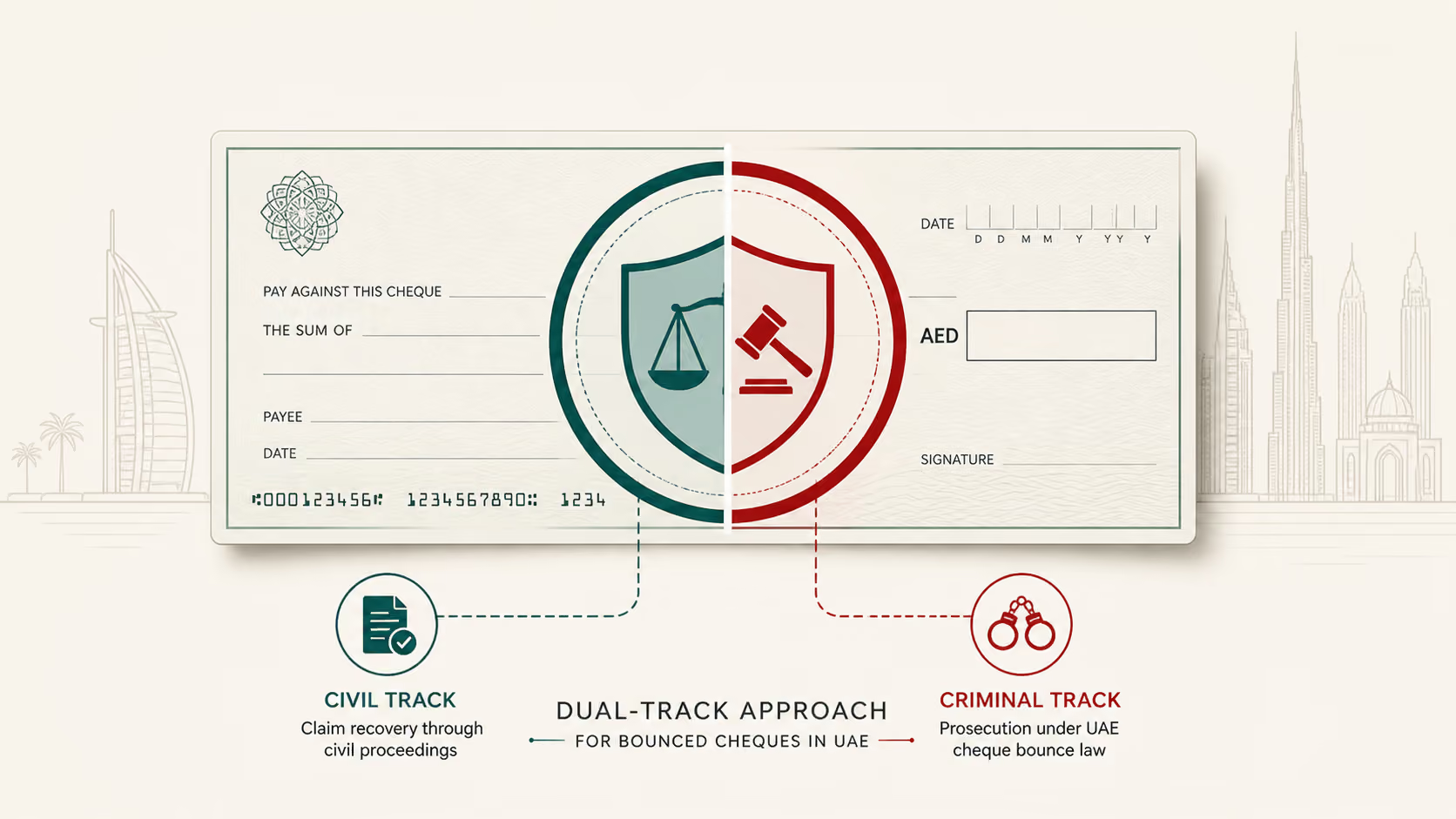
The UAE completely rewrote its bounced cheque laws in 2020 with Federal Decree-Law No. 14. The old system treated every dishonoured cheque as a criminal offence that could land you in prison. The new system draws a clear line: most bounced cheques are now a civil matter, handled through courts and fines. Criminal prosecution still exists, but only in specific circumstances.
For tenants and landlords in Dubai, this matters enormously. Security cheques and post-dated rent cheques are the backbone of the rental system. If you are a tenant whose cheque bounced, or a landlord holding a dishonoured cheque, the rules have changed. Here is what you need to know.
What Changed: The 2020 Decriminalisation
Before 2020, issuing a cheque that bounced was a criminal offence under Article 401 of the UAE Penal Code, regardless of the reason. Insufficient funds, a closed account, even a bank error could result in criminal charges, a travel ban, and jail time.
Federal Decree-Law No. 14 of 2020, which took effect on 2 January 2022, changed the default from criminal to civil. The new Article 635 of the amended Commercial Transactions Law establishes that a bounced cheque is now primarily a civil debt unless specific aggravating conditions are met.
What Triggers Criminal Liability (Still)
A bounced cheque can still be criminal if:
- The cheque was issued with the deliberate intent to defraud (issuer knew the account was empty or closed)
- The issuer ordered the bank to stop payment without a legally valid reason
- The issuer deliberately closed the account before the cheque was presented
- The cheque was issued using a fraudulent identity or forged signature
What Is Now Civil Only
- Cheques that bounce due to insufficient funds (the most common scenario)
- Post-dated cheques where the issuer's financial circumstances changed
- Security cheques that a landlord presents after the tenant has vacated and returned keys
- Business-to-business payment cheques that bounce for cash flow reasons
The distinction comes down to intent. If you issued a cheque in good faith and it bounced because your finances changed, it is a civil matter. If you knowingly issued a cheque you could never honour, it may still be criminal.
Penalties for Bounced Cheques in 2026
Civil Penalties
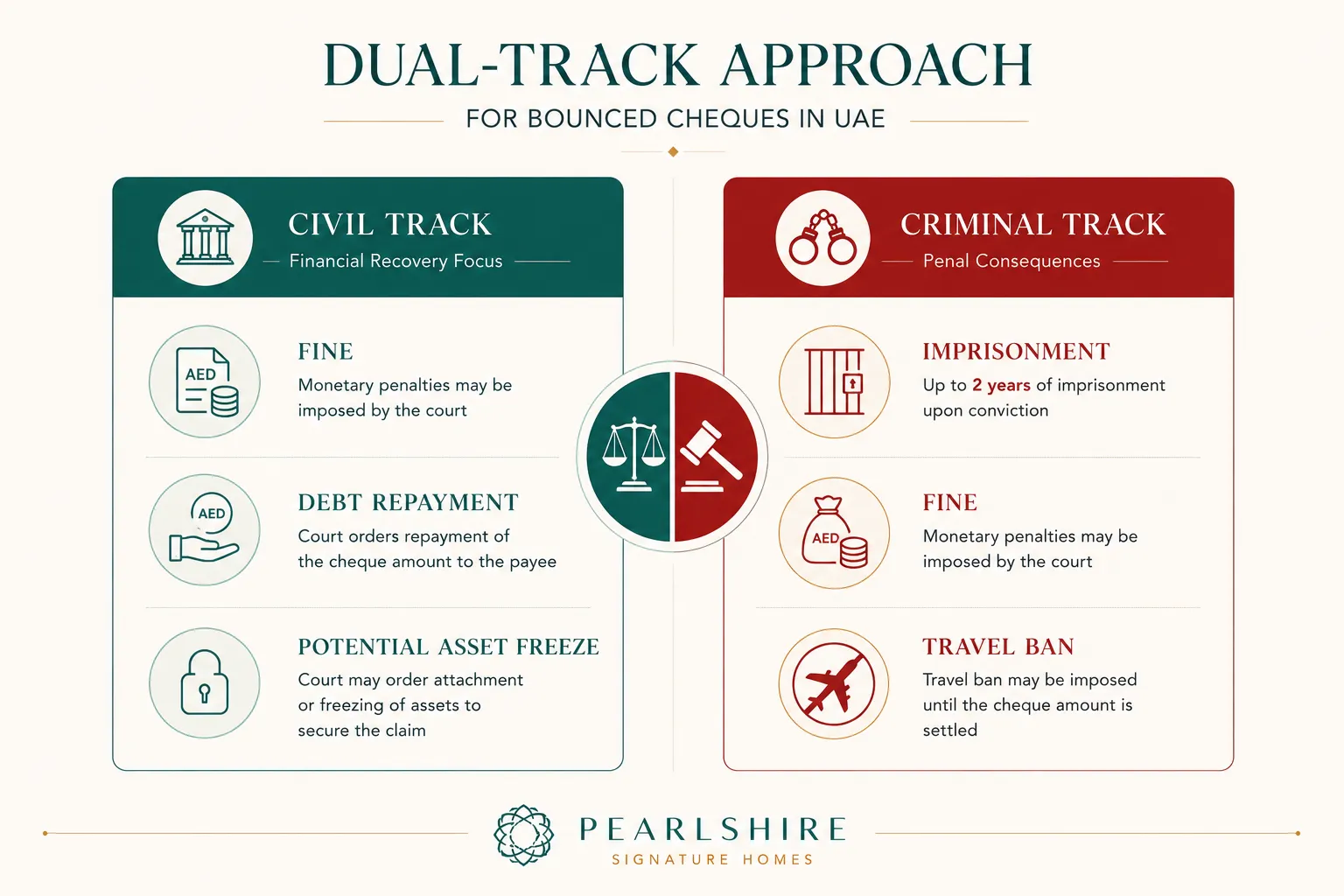
- The payee (person holding the cheque) files a civil case to recover the debt
- The court can order the cheque issuer to pay the full amount plus legal costs
- A travel ban may be issued against the debtor until the amount is settled
- Assets can be frozen to secure the debt
- The dishonoured cheque itself serves as an executable instrument, meaning the payee can request execution without a full trial
Criminal Penalties (Where Applicable)
- Imprisonment of up to 2 years
- Fine equal to or exceeding the cheque amount (minimum AED 5,000)
- Travel ban pending investigation and trial
- Criminal record that affects future banking, residency, and employment
The key change is this: under the old law, every bounced cheque went criminal first. Under the new law, civil enforcement is the default, and criminal prosecution requires the payee to file a separate criminal complaint with evidence of fraudulent intent.
How This Affects Tenants
If you are a tenant in Dubai, you almost certainly have post-dated rent cheques and a security deposit cheque in your landlord's hands. Here is what happens if one bounces.
Scenario 1: Rent Cheque Bounces Due to Insufficient Funds
Your landlord will be notified by the bank. Under the new law, this is a civil matter. Your landlord can file a case to recover the rent amount. You will not be arrested, but you may face a travel ban, and the debt will accrue legal costs. The best course of action is to contact your landlord immediately, arrange payment, and replace the cheque.
Scenario 2: Security Cheque Is Presented After You Move Out
This happens when a landlord cashes your security cheque after you have vacated. If the cheque bounces because you closed the account or withdrew funds, the landlord can file a civil case. If you can prove you returned the property in good condition and the cheque should not have been presented, you have a defence.
Understanding how security cheques work in the first place is critical. Our security cheque guide for Dubai tenants covers the mechanics, common disputes, and your rights.
Scenario 3: Landlord Tries to File Criminal Charges
Your landlord can attempt to file a criminal complaint, but the police and prosecution will assess whether there is evidence of deliberate fraud. A cheque that bounced because your salary was delayed or your account was temporarily underfunded does not meet the criminal threshold. The burden is on the complainant to prove intent.
How This Affects Landlords
If you are a landlord holding a dishonoured cheque from your tenant, here is your updated playbook:
- Present the cheque to the bank and obtain the official returned cheque memo
- Send a formal notice to the tenant demanding payment within a specified period (typically 7-15 days)
- If the tenant does not pay, file an Execution Case at the court using the dishonoured cheque as an executable instrument
- The court can issue a payment order, travel ban, and asset freeze without a full trial
- If you believe the tenant acted fraudulently (closed account intentionally, fake cheque), file a separate criminal complaint
The civil Execution Case route is faster and more straightforward than the old criminal complaint process. Most landlords recover their money within 30-60 days through the execution track.
Preventing Bounced Cheques
For Tenants:
- Maintain sufficient funds in the cheque account at all times, especially around payment dates
- Set up alerts with your bank for when the account balance drops below the cheque amount
- If you know a cheque will bounce, contact your landlord before the presentation date to arrange alternatives
- Never close a bank account that has outstanding post-dated cheques, even after moving out
- Consider switching to a single annual payment to reduce the number of cheques in circulation
For Landlords:
- Verify the tenant's bank account details and employment status during screening
- Set up reminders for cheque presentation dates
- Present cheques on time. Holding cheques past their date weakens your civil claim
- Keep copies of all cheques and the tenancy contract for enforcement
- Consider requiring bank guarantees for high-value tenancies instead of post-dated cheques
Your Ejari registration must be valid for any rental dispute. Our Ejari guide covers registration, renewal, and cancellation.
The Role of Police Stations and Courts
Under the old system, the first stop for a bounced cheque was the police station. Now, for civil cases, you go directly to court. The police station is only involved if you are filing a criminal complaint alleging fraud.
Dubai Courts have a dedicated Execution Department that handles dishonoured cheque cases. The process is streamlined: you submit the returned cheque memo, the court issues an execution order, and the debtor must pay or face asset freezing and a travel ban. There is no need for a full trial in most cases.
Impact on Credit and Banking Relationships
A bounced cheque in the UAE does not just create a legal problem. It creates a banking problem. Al Etihad Credit Bureau, the UAE's national credit reporting agency, records every dishonoured cheque. This entry stays on your credit report and directly affects your ability to open bank accounts, obtain credit cards, secure personal loans, and get mortgage approvals.
For tenants, a bounced rent cheque on your credit file can disqualify you from renting in certain buildings where landlords or property management companies run credit checks during tenant screening. For business owners, a bounced cheque can trigger a review of your banking facilities and potentially lead to reduced credit lines or account closure.
The credit impact is separate from the legal proceedings. Even if you settle the civil case and pay the full amount, the bounced cheque entry remains on your credit report for a period of time. Rebuilding your credit standing after a bounced cheque requires consistent positive payment behaviour over 12-24 months.
Key Takeaways
- Bounced cheques are primarily a civil matter in the UAE since 2022. Criminal prosecution requires evidence of deliberate fraud.
- Tenants: a bounced rent cheque will not get you arrested, but it can lead to a travel ban, asset freeze, and damaged credit score.
- Landlords: use the court's Execution Department for fast recovery. The dishonoured cheque itself is an executable instrument.
- Prevention is better than cure. Maintain account balances, communicate proactively, and never close accounts with outstanding cheques.
- Always keep your Ejari current. It is required for any rental dispute, whether civil or at the Rental Disputes Centre.
Pearlshire Real Estate Development builds luxury residences in Dubai. Explore our projects at pearlshire.com.
Can I still go to jail for a bounced cheque in the UAE?
Yes, but only if there is evidence of deliberate fraud, such as knowingly issuing a cheque on a closed account or with forged details. Standard insufficient funds cases are now civil.
Does a bounced cheque affect my credit score in the UAE?
Yes. Al Etihad Credit Bureau records dishonoured cheques, and a bounced cheque will negatively impact your credit score, affecting future banking relationships, credit card applications, and loan approvals.
Can I stop payment on a post-dated cheque?
Only with a valid legal reason. If you stop payment without justification, the payee can file both a civil claim and potentially a criminal complaint. Valid reasons include proven fraud by the payee or a court order.
What if the cheque amount is wrong?
If there is a genuine dispute about the amount owed, you should not simply let the cheque bounce. Instead, resolve the dispute with the payee before the presentation date, or apply to the court for an injunction to prevent presentation while the dispute is heard.
How long does the civil recovery process take?
Through the Execution Department, most cases are resolved in 30-60 days. If the debtor contests the claim, it may go to a full hearing, which can take 3-6 months.
Do these rules apply to all emirates?
Yes. Federal Decree-Law No. 14 of 2020 applies across all seven emirates. However, court procedures and enforcement timelines may vary between Dubai, Abu Dhabi, and other emirates.