Is Airbnb Legal in Dubai? Short-Term Rental Rules, DET Permits & Profitability Guide 2026

Airbnb is legal in Dubai with a DET Holiday Homes permit costing AED 1,520-3,720 annually. Hosts must collect Tourism Dirham at AED 10-15 per bedroom per night and report guest check-ins within 24 hours. Short-term rentals generate 20-50% higher income than long-term leasing at 75%+ occupancy in prime areas.
Introduction
A 1-bedroom in Dubai Marina can earn AED 500–700 per night on Airbnb during peak season. That's more in a week than most long-term tenants pay in a month. The numbers look compelling, and they are—but there's a licensing process you need to get right first.
For years, Dubai's short-term rental market operated in a gray zone. Property owners listed on Airbnb, Booking.com, and HomeAway without formal permits, banks turned a blind eye, and buildings tolerated it quietly. That era has ended.
In 2024–2025, Dubai formalized its approach to holiday home rentals under the Department of Economy and Tourism (DET) Holiday Homes 2.0 system. It's not a ban. It's not even overly restrictive. It's a framework—one designed to protect guests, ensure tax compliance, and give property owners clarity on exactly what they can do, how they can do it, and what it costs.
This guide walks you through the current legal landscape, the permit process, the actual costs involved, and whether short-term rental income stacks up against traditional long-term leasing. If you're an investor evaluating your portfolio or a landlord trying to decide between Airbnb and a fixed tenant, this is the information you need.
Is Airbnb Legal in Dubai in 2026? (Yes, With a Permit)
The short answer: Yes. Airbnb and short-term rentals are completely legal in Dubai—but they're regulated.
Dubai's Department of Economy and Tourism now manages all holiday home rentals through a formal permit system. To operate legally, you must:
- Hold a valid DET Holiday Homes permit
- Rent the entire unit only (no room-only lets, no co-living)
- Register all occupancy and guest information with DET
- Collect and remit the Tourism Dirham fee monthly
- Maintain safety compliance standards
Operating without a permit is not a gray area anymore. The penalties are real: fines starting at AED 5,000, permit suspension, and in persistent cases, permanent revocation. Guest refunds, listing removal, and reputational damage follow.
The regulatory shift reflects Dubai's maturity as a tourism destination. The emirate saw the revenue potential of short-term rentals, but also the operational challenges—tax evasion, safety violations, building complaints, and guest disputes. Formalization solved that. Now everyone operates by the same rules.
How to Get a DET Holiday Home License in Dubai (Step-by-Step)
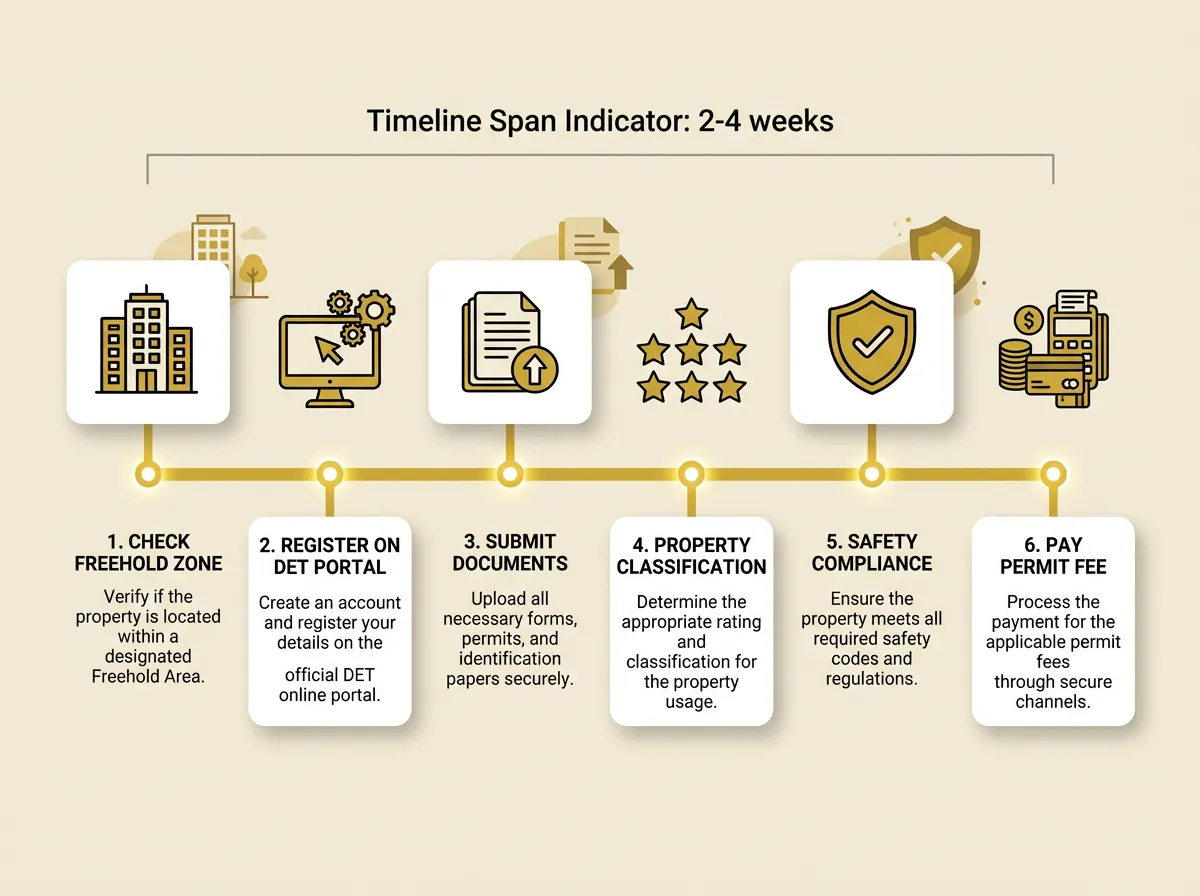
The permit process is straightforward, but it requires documentation and patience. Here's exactly what to do.
Step 1: Confirm Your Property is in an Eligible Area
Not all Dubai properties can be rented short-term. Some residential communities and towers have explicit restrictions. Villas in certain communities, apartments in some towers, and plots zoned solely for residential use may be off-limits.
Before you invest time in the application, confirm with your developer, owners' association, or building management that short-term rentals are permitted. Get this in writing (a "No Objection Certificate" or letter) because you'll need it later.
Step 2: Register on the DET Holiday Homes Portal
Visit the DET Holiday Homes website and create an account. You'll need:
- Your passport number and a scanned copy
- Your Emirates ID and a scanned copy
- Your residential address
- Email and mobile number
Step 3: Submit Required Documentation
Once registered, upload:
- Title deed or tenancy contract (proof of ownership or legal occupancy rights)
- No Objection Certificate from the developer, owners' association, or building management (confirming STR is allowed)
- Property photos (all rooms, outdoor spaces, safety equipment)
- Floor plan showing room layouts and square footage
- Details on furnished amenities (kitchen appliances, furniture, linens, etc.)
If you're renting a secondary property or own through a company, you'll need additional documentation (such as notarized authorization letters).
Step 4: Property Classification
DET classifies holiday homes into two categories:
- Standard: Basic furnishings, essential amenities, typical fittings
- Deluxe: High-end furnishings, premium finishes, additional services (concierge, housekeeping, etc.)
Your classification affects the Tourism Dirham fee per night. Choose honestly—misrepresenting a standard property as deluxe could result in fines and permit revocation.
Step 5: Safety and Compliance
Your property must meet basic safety standards:
- Fire extinguishers installed and accessible
- First aid kit on premises
- Emergency contact information posted
- Clear evacuation procedures
- Working locks, smoke detectors, and carbon monoxide detection (if applicable)
These are not optional. DET can conduct surprise inspections, and non-compliance results in permit suspension.
Step 6: Pay the Annual Permit Fee
The fee varies by property type and classification. Expect AED 1,520–3,720 annually (more on exact costs below).
Timeline
From application to approved permit: typically 2–4 weeks. DET is reasonably efficient, though peak season (winter months) can extend timelines.
A Note on Ownership Limits
Individual owners can hold permits for up to 8 units. Beyond that, you'll need to register a company with a proper trade license from the Department of Economy and Tourism. If you're building a portfolio of multiple properties, plan for this transition around property 8–9.
DET Holiday Home Permit Costs & Annual Fees
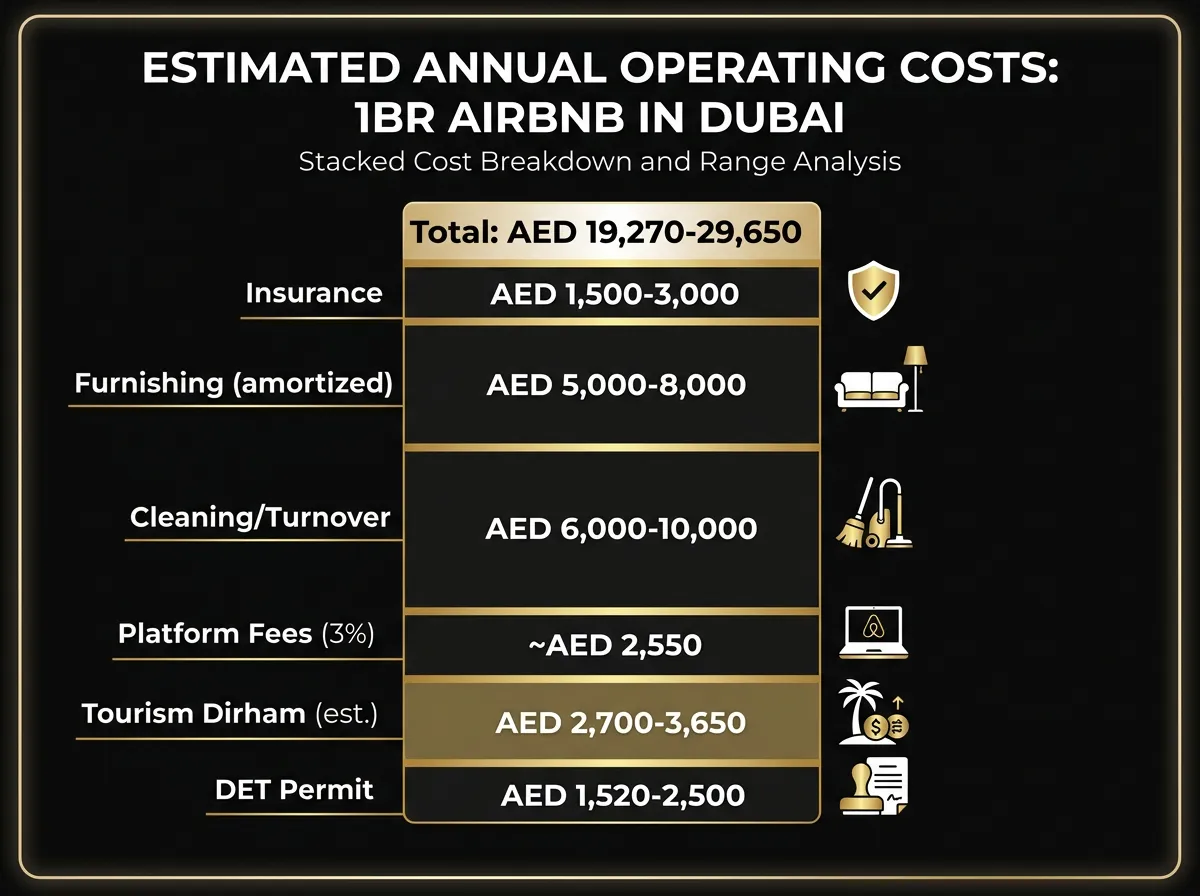
Many property owners focus on nightly Airbnb rates but overlook the true cost of operation. Here's the complete breakdown:
Permit and Registration Fees
- Annual DET Holiday Home Permit: AED 1,520–3,720 depending on property size and classification
- Studio to 1BR Standard: ~AED 1,520
- 2–3BR Standard: ~AED 2,500
- Any size Deluxe: ~AED 3,000–3,720
Tourism Dirham (Bed Tax)
This is per occupied bedroom per night:
- Standard property: AED 10 per bedroom per night
- Deluxe property: AED 15 per bedroom per night
On a 1-bedroom property with 80% occupancy (292 nights per year):- Standard: 292 nights × AED 10 = AED 2,920/year- Deluxe: 292 nights × AED 15 = AED 4,380/year
On a 2-bedroom property with the same occupancy:- Standard: 584 nights × AED 10 = AED 5,840/year- Deluxe: 584 nights × AED 15 = AED 8,760/year
You collect the Tourism Dirham from guests and remit it monthly to DET. It's a pass-through fee, but tracking and compliance is your responsibility.
Platform Commissions
- Airbnb: 3% host service fee
- Booking.com: 12–15% commission (varies by agreement)
- Other OTA platforms: 10–20%
If you list on multiple platforms (common strategy), these commissions stack across bookings.
Property Management Costs
If you outsource management:
- Full-service property management: 15–25% of gross revenue (includes guest communication, cleaning, maintenance, key exchange, restocking)
- Cleaning only: AED 100–250 per turnover
- Check-in/check-out facilitation: AED 50–150 per guest
For a 1-bedroom generating AED 200,000 in annual revenue, 20% management fees = AED 40,000.
Furnishings and Setup
- Initial furniture, bedding, kitchenware: AED 20,000–50,000 (one-time, amortized across 5 years)
- Annual replacements and repairs: AED 3,000–8,000
Estimated Annual Costs (1-Bedroom Example)
| Cost Category | Amount |
|---|---|
| DET Permit (annual) | AED 1,520 |
| Tourism Dirham (80% occupancy, Standard) | AED 2,920 |
| Airbnb commission (3%) | AED 5,400 |
| Cleaning and turnover | AED 8,000 |
| Maintenance and supplies | AED 4,000 |
| Furnishing amortization (5-year spread) | AED 6,000 |
| Total Annual Costs | AED 27,840 |
That's roughly 14% of revenue on a AED 180,000 annual gross figure (AED 500/night × 360 nights). Long-term rentals don't have these costs, which is a critical comparison point.
Short-Term Rental Profitability in Dubai: Airbnb vs Long-Term Rental
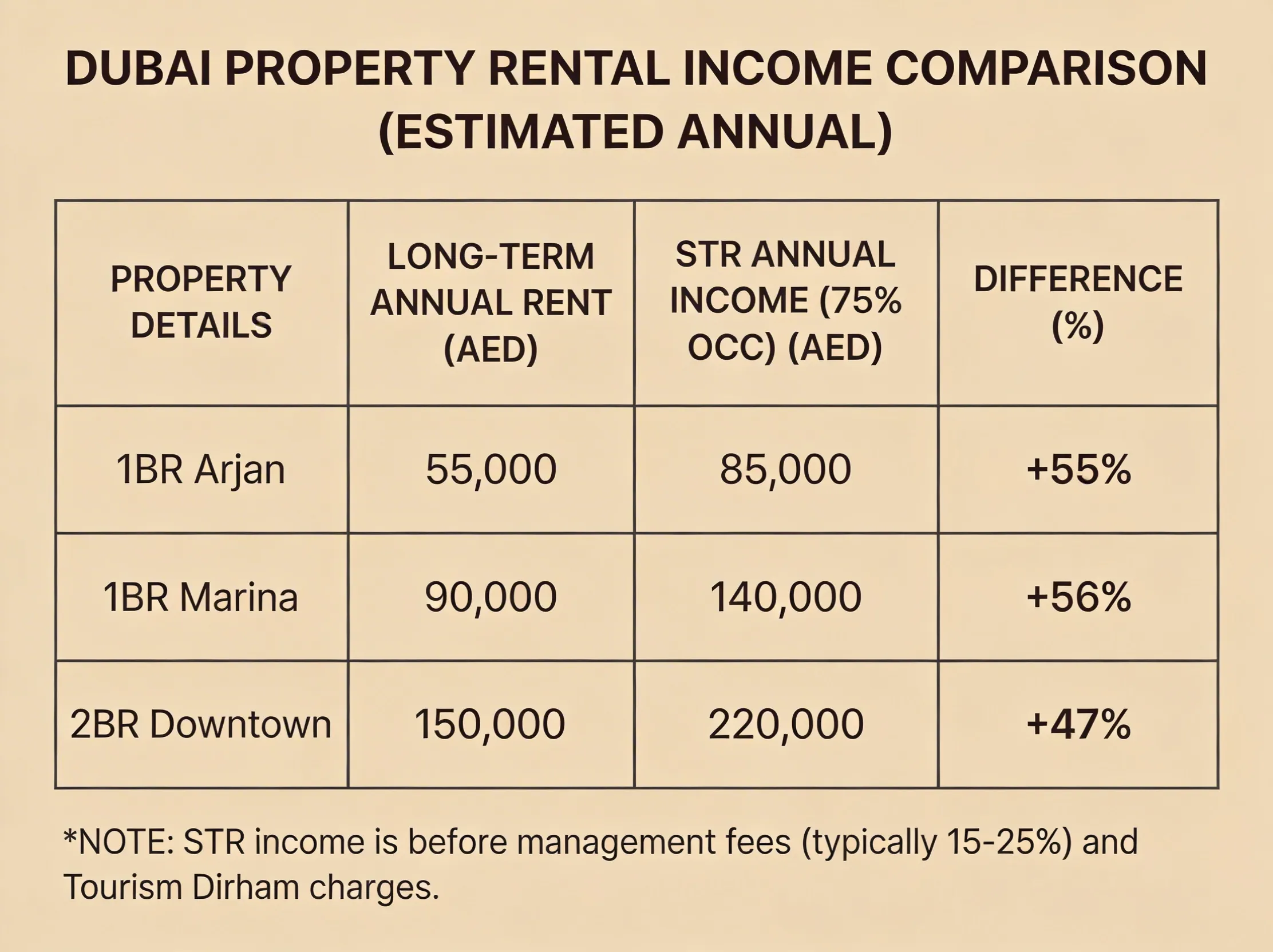
This is where the rubber meets the road. STR looks attractive on a per-night basis, but over a full year and after all costs, how does it really compare?
Income Potential: A Real-World Comparison
Let's model three scenarios based on current market rates (as of early 2026):
Scenario 1: 1-Bedroom, Arjan
Long-Term Rental:- Monthly rent: AED 4,000- Annual income: AED 48,000- Guaranteed, stable, minimal effort
Short-Term Rental (Airbnb):- Nightly rate: AED 200–280 (off-peak to peak season average)- 80% annual occupancy: 292 nights booked- Gross annual revenue: AED 58,400–81,760- Less all costs (27,840): AED 30,560–53,920 net- Break-even occupancy vs long-term: ~68% (below typical for Arjan)
Winner: STR, assuming you hit 75%+ occupancy and can absorb the operational load.
Scenario 2: 1-Bedroom, Dubai Marina
Long-Term Rental:- Monthly rent: AED 6,500- Annual income: AED 78,000
Short-Term Rental (Airbnb):- Nightly rate: AED 400–550- 80% occupancy: 292 nights- Gross: AED 116,800–160,600- Less costs (29,000): AED 87,800–131,600 net- Break-even vs long-term: ~72% occupancy
Winner: STR decisively, given Marina's strong tourist draw.
Scenario 3: 2-Bedroom, Downtown Dubai
Long-Term Rental:- Monthly rent: AED 9,000- Annual income: AED 108,000
Short-Term Rental (Airbnb):- Nightly rate: AED 600–850- 75% occupancy: 274 nights- Gross: AED 164,400–232,900- Less costs (42,000): AED 122,400–190,900 net- Break-even vs long-term: ~69% occupancy
Winner: STR by a wide margin, especially on the high end.
The Hidden Metrics You Need to Know
Occupancy Rate: Dubai's average holiday home occupancy ranges from 75–85% in prime areas (Marina, Downtown, JBR) and 65–75% in secondary areas (Arjan, Deira, Business Bay). Winter months (November–March) run 85%+; summer (June–August) drops to 50–60%.
Seasonal Variation: If you're relying on average rates, you'll underestimate winter and overestimate summer. A realistic model accounts for this volatility.
Wear and Tear: Short-term guests cycle through every 3–5 days. Furniture, appliances, linens, and fixtures wear faster than in long-term rentals. Budget 20–30% higher maintenance costs.
Vacancy Management: Cleaning, restocking, and turnover between guests takes time and costs money. A 80% occupancy rate actually means 20% of your nights are spent on cleaning, repairs, and re-preparation.
The Operational Question
Numbers favor STR, but only if occupancy stays above 70%. Below that, the advantage narrows quickly. And numbers don't account for the operational burden: responding to guest messages at midnight, handling complaints, managing cancellations, coordinating cleaners, and dealing with the occasional problem guest.
For an investor who owns multiple properties and outsources management, STR wins. For a busy professional or a remote owner, the operational overhead may outweigh the income gain.
Best Areas for Airbnb in Dubai 2026 (By Rental Yield)
Not all Dubai locations perform equally on Airbnb. Yield depends on nightly rates, occupancy reliability, and guest demand patterns.
Dubai Marina: Premium Rates, Strong Demand
- Nightly rate: AED 400–700 (1BR to 3BR)
- Occupancy: 80–85% year-round
- Why: Iconic location, beach access, restaurants, international appeal
- Best for: Multi-unit investors willing to pay premium entry prices
Downtown Dubai / Burj Khalifa: Prestige Pricing
- Nightly rate: AED 500–900 (1BR to 3BR)
- Occupancy: 75–85% in winter, 50–65% in summer
- Why: Views, luxury positioning, business travel, tourists
- Best for: Investors targeting luxury segment and corporate bookings
JBR (Jumeirah Beach Residence): Beach Access Premium
- Nightly rate: AED 350–600
- Occupancy: 78–82%
- Why: Beach, family-friendly, walkable community, predictable demand
- Best for: Mid-to-premium segment, consistent returns
Business Bay: Corporate Travel Anchor
- Nightly rate: AED 280–450
- Occupancy: 72–78%
- Why: Proximity to DIFC, financial district, business travelers mid-week
- Best for: Weekday-heavy bookings, less seasonal variation than leisure zones
Arjan: Emerging Opportunity (Highest Yield %)
- Nightly rate: AED 180–300
- Entry price: AED 900K–1.4M for 1BR
- Occupancy: 70–78%
- Yield: 8–12% gross
- Why: Lower acquisition cost + growing visitor demand + villa/community atmosphere + private amenities (pools, gyms)
- Best for: First-time STR investors, portfolio diversification, higher percentage returns on capital
Dubai Land Rent Court (DLRC) Areas: Budget Segment
- Nightly rate: AED 120–220
- Occupancy: 65–72%
- Why: Value travelers, workers, flexible travelers
- Best for: High-volume, low-margin strategy
Why Arjan Works for Short-Term Rentals
Arjan sits on the sweet spot for STR economics. Purchase prices are 30–40% lower than Marina or Downtown, which means a lower absolute investment and better leverage. Tourist demand is growing—the area has become a hub for budget-conscious travelers, freelancers, and families. Occupancy rates are solid (70–78%), and nightly rates are rising as the community matures.
Most importantly, developments like Bond Enclave are built with the STR market in mind: modern interiors, family-friendly layouts, and furnished turnkey options. The yield percentage—not absolute dollars—is often higher in Arjan than in established luxury zones.
Short-Term Rental Rules You Can't Ignore in Dubai
Compliance isn't bureaucratic busywork. Each rule exists because Dubai has experienced problems when it wasn't followed.
Mandatory Guest Reporting to DET
Every guest check-in and check-out must be reported to DET within 24 hours. This is done through the DET Holiday Homes portal and includes guest name, nationality, passport number, check-in/check-out dates, and number of occupants.
If you use a property management company, they handle this. If you self-manage, it's on you. Missing deadlines or submitting inaccurate information can trigger fines or permit suspension.
Monthly Tourism Dirham Remittance
Tourism Dirham is collected from guests (typically added to the nightly rate in your listing), pooled, and remitted to DET monthly. Failure to remit or submitting incorrect occupancy figures is audit risk.
Keep clean records: copy every receipt, log every guest, reconcile monthly. If DET audits and finds discrepancies, the burden of proof is on you.
Building and Community Restrictions
Some towers, communities, and residential areas explicitly forbid short-term rentals. Others restrict it to a limited number of units. Some allow it only with explicit owner/community consent.
Examples of restricted areas:- Certain high-end residential towers in Downtown Dubai and Marina- Many villa communities in Arabian Ranches and Emirates Hills- Some freehold areas with strict building bylaws
How to check: Contact your building management office, owners' association, or developer directly. Ask in writing. Get a response in writing. This No Objection Certificate is non-negotiable for your DET permit.
If you rent in a restricted community without permission, you're exposing yourself to three problems: DET permit denial, building sanctions (including lease termination or fines), and potential legal action from the community.
Insurance: Your Standard Policy Doesn't Cover STR Guests
Home or property insurance policies are designed for owner-occupancy or long-term rentals. They typically exclude commercial use, including short-term guest rentals.
If you're renting on Airbnb, you need either:
- Holiday home/STR insurance: Designed specifically for short-term rental properties
- Commercial liability coverage: Protects against guest injury, theft, or property damage claims
Standard renters or landlord policies will deny claims if the loss occurred during guest occupancy from an Airbnb booking. This is not a technicality; it's a deal-breaker if something goes wrong.
Noise, Neighbor Complaints, and Permit Risk
Neighbors can lodge formal complaints with DET. Multiple complaints trigger DET inspection and potential permit review. Persistent issues can result in permit suspension or cancellation.
Common complaint triggers:- Noise late at night or early morning- Guests blocking common areas or parking- Excessive guest turnover (perception of a "party house")- Visible disrepair or untidy property condition
Manage this proactively: establish house rules for guests, provide clear quiet hours, ensure cleaning happens quickly between guests, and respond to any neighbor concerns immediately.
Managing Your Dubai Airbnb: DIY vs Property Management Company
This decision shapes your profitability and sanity. Both paths work; they trade off different currencies.
DIY Self-Management: Keep 100%, Accept the Work
If you self-manage, you keep all revenue minus platform commissions and costs. You handle:
- Guest communication: Responses to inquiries, booking confirmations, check-in instructions, support during stays
- Cleaning: Scheduling cleaners, quality checks, deep cleans between guests
- Maintenance and repairs: Coordinating fixes, responding to "water is not hot" calls at 2 a.m.
- Restocking: Linens, toiletries, kitchen supplies, welcome items
- Check-in and check-out: Key exchanges, property walkthroughs, condition inspections
- DET compliance: Guest reporting, Tourism Dirham remittance, permit renewals
- Reviews and reputation: Monitoring feedback, responding to ratings
Best for: Property owners based in Dubai with one or two units, detail-oriented personalities, and flexible schedules.
Professional Property Management: Trade Revenue for Peace
A property management company handles the above and charges 15–25% of gross revenue. At 20%, a AED 200,000/year property costs AED 40,000, leaving you AED 160,000.
What you get:- Hands-off operation- Professional guest screening and communication- Guaranteed cleaning and maintenance standards- DET compliance handled- 24/7 guest support- Dynamic pricing optimization (some companies)
Best for: Absentee investors, multi-property portfolios, investors outside UAE, and professionals who don't want operational overhead.
Hybrid Approach: Best of Both Worlds
Some investors self-manage during peak season (November–March, high occupancy) and outsource to a property manager during low season (June–August, lower rates, fewer bookings). This keeps commissions low while avoiding burnout during the chaos of peak season.
FAQ: Short-Term Rentals and Airbnb in Dubai
Is Airbnb legal in Dubai for apartment owners in 2026?
Yes, Airbnb is legal in Dubai if you hold a valid DET Holiday Homes permit. You must rent the entire apartment (not individual rooms), comply with your building/community rules, and remit the Tourism Dirham monthly. Operating without a permit results in fines, suspension, and potential legal action.
How much does a DET holiday home license cost in Dubai?
The annual DET Holiday Homes permit ranges from AED 1,520 to AED 3,720 depending on property size and classification (Standard or Deluxe). Additionally, you pay Tourism Dirham at AED 10–15 per occupied bedroom per night, which you collect from guests and remit monthly to DET.
Can I Airbnb my off-plan property in Dubai after handover?
Yes, provided your property is in a freehold area that allows short-term rentals and your developer has granted written permission. Many off-plan projects in Arjan, Dubai Marina, and other freehold communities explicitly market properties as STR-eligible. Always confirm with the developer before purchasing.
What is the Tourism Dirham and how much do I pay per night?
The Tourism Dirham is a bed tax collected on behalf of Dubai's Department of Tourism and Commerce Marketing. It's AED 10 per bedroom per night for Standard properties and AED 15 per bedroom per night for Deluxe properties. You collect it from guests at check-in or add it to the nightly booking rate. You must remit it to DET monthly.
Is short-term rental more profitable than long-term rental in Dubai?
It depends on location, occupancy rate, and operational efficiency. In premium areas (Marina, Downtown) with 75%+ occupancy, STR typically yields 20–40% higher net income than long-term rental. In secondary areas, the gap narrows. Below 70% occupancy, long-term rental often wins because it's stable and hands-off. Model both scenarios for your specific property before deciding.
Conclusion: Building Short-Term Rental Income in Dubai
Airbnb and short-term rentals are thriving in Dubai because the model works—when it's structured correctly. The legalization through the DET Holiday Homes system actually improves the opportunity: it removes gray-area risk, clarifies costs, and creates a level playing field for professional operators.
The path forward is straightforward. Verify your property is in an eligible area. Get your DET permit. Set competitive rates based on market data. Choose between DIY and professional management. Execute consistently.
The economics are real. A well-positioned 1-bedroom in Arjan or a 2-bedroom in Business Bay can generate genuine yield that outpaces long-term rental by 20–50% after all costs. But that return requires occupancy discipline (70%+ bookings), operational excellence (clean turnovers, positive reviews), and compliance diligence (DET reporting, insurance, safety standards).
Half-measures don't work. Cut corners on DET reporting or safety compliance, and you risk losing your permit. Ignore guest quality or maintenance standards, and occupancy drops. Price aggressively without data, and you chase bookings you'll regret.
The owners who thrive in Dubai's STR market are those who treat it as a business, not a side hustle. They invest in professional management or they invest the time themselves. They monitor market rates weekly and adjust quarterly. They keep DET and insurance compliance as non-negotiable. They understand that a 1% difference in occupancy rate equals thousands in annual profit.
The Bond Enclave Advantage
If you're evaluating short-term rental properties in Dubai, location and unit design matter enormously. Bond Enclave's thoughtfully designed apartments in Arjan embody the ideal STR asset.
Why Bond Enclave works for short-term rentals:
- Lifestyle amenities: Guests pay premium nightly rates for access to gyms, landscaped gardens, and community facilities. This justifies AED 250–350/night rates in a market where standard Arjan units command AED 180–220.
- Modern, turnkey furnishing: No guesswork on setup costs. Properties come furnished and market-ready, reducing your AED 20K–50K setup investment to near zero.
- Arjan's economic advantage: Lower acquisition cost than Marina or Downtown means better leverage and higher yield percentage on capital invested.
- Growing visitor demand: Arjan has transitioned from overlooked to destination. Proximity to attractions, emerging hospitality, and word-of-mouth create reliable occupancy.
- Built for family groups: 2–3 bedroom layouts appeal to families and groups—a higher-value guest segment that books longer stays and leaves higher reviews.
A Bond Enclave 2-bedroom purchased at AED 1.2M and rented at AED 280–350/night with 75% occupancy generates:- Gross annual revenue: AED 230,000–320,000- Net after all costs: AED 180,000–240,000- Yield: 15–20% on capital invested
Compare that to a Marina 2-bedroom at AED 2.5M generating 9–12% yield, and the calculus shifts.
Explore Bond Enclave's apartments and discover how your short-term rental portfolio can start here.